Patterns, Fibonacci and the golden ratio
Read number patterns, extend sequences, and see the Fibonacci numbers and the golden ratio at work in nature and design.
What the board asks
Items in this area are mostly quick computations with the term and sum formulas, or word problems that hide a sequence.
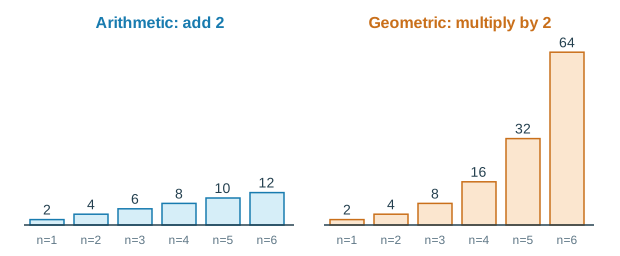
- Arithmetic: nth term a + (n − 1)d. Sum (n ÷ 2)(2a + (n − 1)d).
- Geometric: nth term a × rn − 1. Sum a(rn − 1) ÷ (r − 1), for r not equal to 1.
- Fibonacci: F(n) = F(n − 1) + F(n − 2). The ratio of neighbours tends to φ ≈ 1.618.
Solved examples
Follow each one line by line. The steps stay the same when the numbers change, so cover the steps and try it yourself.
Example 1: Arithmetic sum in a word problem
Question: A hall has 12 seats in the first row and 4 more in each row after it. How many seats are in the first 10 rows?
- Spot the pattern. "4 more in each row" is a fixed difference, and "how many in all" asks for a sum.
- List what you know. a = 12, d = 4, n = 10.
- Write the rule. S = (n ÷ 2)(2a + (n − 1)d).
- Substitute. (10 ÷ 2)(2 × 12 + 9 × 4) = 5 × (24 + 36) = 5 × 60 = 300.
Answer: There are 300 seats.
Example 2: Geometric growth
Question: A pond has 200 fish, and the number triples every 4 years. How many fish are there after 12 years?
- Spot the pattern. "Triples" means multiply by a fixed number, so it is geometric with r = 3.
- Count the periods. 12 ÷ 4 = 3 triplings, not 12.
- Apply the multiplier once per period. 200 × 33 = 200 × 27 = 5400.
Answer: There are 5400 fish.
Example 3: Fibonacci and the golden ratio
Question: F(9) = 34 and F(10) = 55. Find F(12), then find F(12) ÷ F(11) to three decimal places.
- Write the rule. F(n) = F(n − 1) + F(n − 2).
- Build up. F(11) = 55 + 34 = 89. F(12) = 89 + 55 = 144.
- Divide neighbours. 144 ÷ 89 = 1.6179…, which rounds to 1.618.
- Look back. The result is close to φ ≈ 1.618, as neighbours in this sequence should be.
Answer: F(12) = 144, and the ratio is about 1.618.
Doubling every 3 hours for 12 hours is 4 doublings, not 12. Count the periods before you compute.