The Rizal Law and the study of Rizal
Why Republic Act No. 1425 exists: the 1956 Senate debate, the Church opposition, the Laurel compromise, and what the law requires of every school.
What the board asks
Items on the Rizal Law are almost always recall: the number of the act, the date, the authors, the opponents, and what the exemption covers. Know these cold.
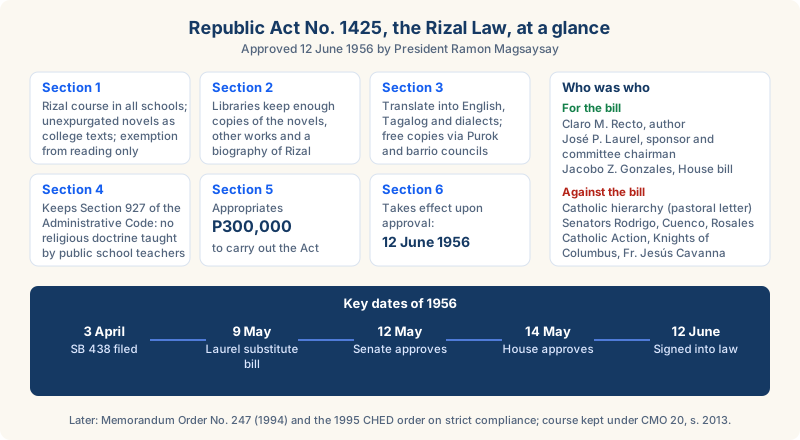
- Law: Republic Act No. 1425, the Rizal Law, approved 12 June 1956 and effective upon approval.
- Bills: Senate Bill No. 438 (filed 3 April 1956) and House Bill No. 5561 (Jacobo Z. Gonzales).
- Author: Claro M. Recto. Sponsor and compromise: José P. Laurel, chairman of the Senate Committee on Education; substitute bill of 9 May 1956.
- Signed by: President Ramon Magsaysay.
- Opposed by: the Catholic hierarchy (pastoral letter), Catholic Action, the Knights of Columbus; in the Senate, Francisco Rodrigo, Mariano Jesús Cuenco and Decoroso Rosales.
- Requires: courses on Rizal in all schools; unexpurgated novels as basic texts at college level; library copies; translations distributed free through Purok organizations and barrio councils.
- Exemption: from reading the novels only, on a sworn written statement of religious belief; never from the course.
- Money: three hundred thousand pesos appropriated by Section 5.
- Later orders: Memorandum Order No. 247 of 1994 (Ramos) and the 1995 CHED order on strict compliance; the course kept as a mandated subject under CHED Memorandum Order No. 20, series of 2013.
Must-know facts
| Item | Fact | Why it is asked |
|---|---|---|
| Number of the law | Republic Act No. 1425 | Direct recall; distractors are nearby numbers. |
| Date approved | 12 June 1956 | Often paired with the president, Magsaysay. |
| Senate bill | No. 438, filed 3 April 1956 | Tested with the House bill, No. 5561. |
| Principal author | Claro M. Recto | Confused with Laurel. |
| Committee chairman / sponsor | José P. Laurel | Wrote the 9 May substitute bill. |
| Senate opponents | Rodrigo, Cuenco, Rosales | Any one may appear as a distractor among supporters. |
| Church response | Pastoral letter of the bishops | Tested as "which group opposed". |
| Texts required at college | Original or unexpurgated editions or English translations | The word "unexpurgated" is a favourite. |
| Exemption | Reading only, sworn written statement, religious belief | Distractor: "exempt from the course". |
| Translations | English, Tagalog and principal dialects; free via Purok organizations and barrio councils | Tests Section 3. |
| Religion clause | Section 4 preserves Section 927 of the Administrative Code | Tests the limit on public school teachers. |
| Appropriation | Three hundred thousand pesos | Numeric recall. |
| 1994 order | Memorandum Order No. 247, President Ramos | Tests implementation history. |
Solved examples
Read each stem for its exact verb, then eliminate.
Example 1: Author or sponsor
Question: Which senator chaired the Committee on Education and sponsored the substitute bill that allowed Republic Act No. 1425 to pass? A. Claro M. Recto B. José P. Laurel C. Francisco Rodrigo D. Mariano Jesús Cuenco
- Read the verb. The stem asks who chaired the committee and sponsored the substitute, not who authored the bill.
- Eliminate the opponents. Rodrigo and Cuenco fought the bill, so C and D are out.
- Separate the two allies. Recto authored Senate Bill No. 438; Laurel chaired the committee and wrote the 9 May compromise.
Answer: B. Laurel sponsored the substitute bill; Recto was the author.
Example 2: The exemption
Question: Under Republic Act No. 1425, a college student who objects on religious grounds may be excused from which of the following? A. Enrolling in the Rizal course B. Reading the unexpurgated novels, upon a sworn written statement C. Taking the final examination of the course D. Attending classes on Rizal's essays
- Recall the proviso. The exemption is "from the reading requirement… but not from taking the course".
- Test each option against it. A and C excuse the course itself; D has nothing to do with the law.
- Check the procedure. Only B mentions the sworn written statement the law demands.
Answer: B. The exemption is narrow: the reading, on a sworn statement.
Example 3: Dates
Question: Arrange in chronological order: I. President Magsaysay signs the Rizal Law. II. Senate Bill No. 438 is filed. III. Laurel presents the substitute bill. IV. The Senate approves the bill. A. II, III, IV, I B. II, IV, III, I C. III, II, IV, I D. II, III, I, IV
- Anchor the ends. A bill must be filed first (II) and signed last (I); that removes C and D.
- Order the middle. The substitute bill (9 May) came before Senate approval (12 May), so III precedes IV.
- Confirm. 3 April, 9 May, 12 May, 12 June.
Answer: A. Filing, substitute, approval, signing.