The Philippines in the nineteenth century
The world Rizal was born into: the opening of the economy, the rise of the ilustrados, Spanish liberalism, the friars, and the Cavite Mutiny and GomBurZa of 1872.
What the board asks
Items on this topic test the background facts that explain Rizal's generation: the opening of trade, the new middle class, the liberal interlude and, above all, the Cavite Mutiny and GomBurZa. Expect dates, names and the two versions of 1872.
- Galleon trade: Manila–Acapulco, ended when the last galleon arrived in 1815.
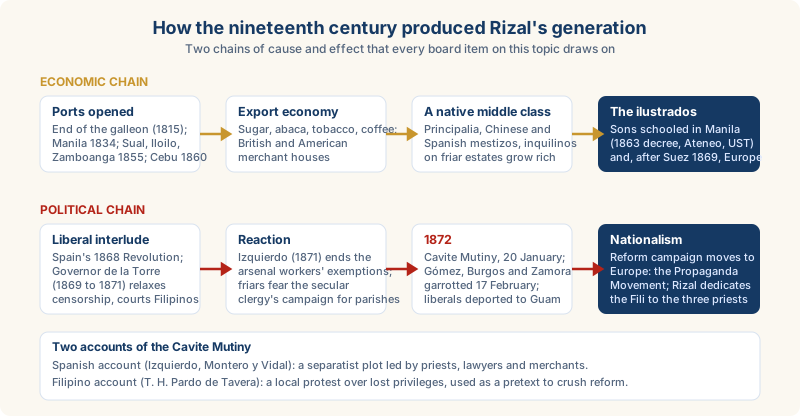
- Ports opened: Manila 1834 (end of the Royal Philippine Company); Sual, Iloilo, Zamboanga 1855; Cebu 1860.
- Export crops: sugar, abaca, coffee, indigo; the tobacco monopoly ran from 1782 to 1882.
- New class: principalia and Chinese mestizos; inquilinos on friar estates; their educated sons were the ilustrados.
- Education: Educational Decree of 1863 (free primary schools, Spanish, a normal school); Jesuits back in 1859; Ateneo Municipal 1865.
- Suez Canal: opened 1869, cutting the voyage to Spain to about a month.
- Liberal interlude: Spain's Glorious Revolution of 1868; Governor-General Carlos María de la Torre, 1869–1871; replaced by Rafael de Izquierdo in 1871.
- Secularization: Fr. Pedro Peláez (died in the earthquake of 1863) and Fr. José Burgos led the Filipino secular priests' claim to the parishes.
- Cavite Mutiny: 20 January 1872, Fort San Felipe, Sergeant La Madrid; about two hundred men.
- GomBurZa: Mariano Gómez (73), José Burgos (35), Jacinto Zamora (37), garrotted at Bagumbayan on 17 February 1872; Archbishop Martínez refused to defrock them.
- Deported to Guam: Joaquín Pardo de Tavera, Antonio Ma. Regidor, José Basa, Máximo Paterno, Fr. Toribio H. del Pilar and others.
Must-know facts
| Item | Fact | Why it is asked |
|---|---|---|
| End of the galleon trade | 1815 | Distractors: 1821 (Mexican independence), 1834. |
| Manila opened to world trade | 1834 | Paired with the end of the Royal Philippine Company. |
| Other ports | Sual, Iloilo, Zamboanga 1855; Cebu 1860 | Tested as "which port was NOT opened in 1855". |
| Tobacco monopoly | 1782–1882 | Century-long dates are easy items. |
| Educational Decree | 1863; free primary schools; normal school | Confused with the Moret decree of 1870 on higher education. |
| Suez Canal | Opened 1869 | Asked as the reason for faster travel and ideas. |
| Liberal governor | Carlos María de la Torre, 1869–1871 | Swapped with Izquierdo. |
| Reactionary governor | Rafael de Izquierdo, 1871; withdrew arsenal workers' exemptions | Cause of the mutiny in the Filipino account. |
| Secularization leaders | Pedro Peláez, then José Burgos | Peláez's 1863 death is a favourite distractor. |
| Cavite Mutiny | 20 January 1872, Fort San Felipe, Sergeant La Madrid | Date and place recall. |
| Execution of GomBurZa | 17 February 1872, Bagumbayan, by garrote | Method and place are tested; also Rizal's wrong date. |
| Ages of the three | Gómez 73, Burgos 35, Zamora 37 | Rizal wrote 85, 30, 35. |
| Spanish account | Izquierdo and Montero y Vidal: a separatist plot | Paired against the Filipino account. |
| Filipino account | T. H. Pardo de Tavera: a local protest used as a pretext | Author's name is the usual item. |
Solved examples
Read for the exact year or the exact author before you choose.
Example 1: Which version
Question: Which writer held that the Cavite Mutiny of 1872 was a local protest of arsenal workers over the loss of their privileges, magnified by the friars and Governor Izquierdo into a separatist plot? A. José Montero y Vidal B. Rafael de Izquierdo C. Trinidad H. Pardo de Tavera D. Carlos María de la Torre
- Sort the names. Montero y Vidal and Izquierdo gave the Spanish account of a planned revolution; that removes A and B.
- Check the remaining two. De la Torre was the liberal governor who had left in 1871 and wrote no account of the mutiny.
- Confirm. Pardo de Tavera, nephew of a deportee, wrote the Filipino account.
Answer: C. Pardo de Tavera's is the Filipino version.
Example 2: Dates
Question: Fathers Gómez, Burgos and Zamora were executed at Bagumbayan on A. 20 January 1872 B. 17 February 1872 C. 28 February 1872 D. 3 June 1863
- Eliminate the other events. 20 January 1872 is the mutiny itself; 3 June 1863 is the earthquake that killed Peláez.
- Spot the trap. 28 February 1872 is the wrong date Rizal gave in the Fili dedication.
- Confirm. The execution took place on 17 February 1872.
Answer: B. 17 February 1872; the Fili dedication's date is an error.
Example 3: Cause and effect
Question: Which development most directly explains why Filipino families like the Mercados of Calamba could afford to send sons to Manila and Europe for schooling in the 1870s and 1880s? A. The galleon trade's profits reaching the provinces B. The opening of Philippine ports to world trade and the growth of export agriculture C. The abolition of the tribute in 1884 D. The Glorious Revolution of 1868 in Spain
- Test A. The galleon trade enriched Manila Spaniards and ended in 1815; it did not create provincial wealth.
- Test C and D. The cédula replaced, not abolished, the tribute, and a Spanish revolution did not raise Calamba incomes.
- Confirm B. Export crops sold through the opened ports made the principalia and mestizo inquilinos prosperous.
Answer: B. The export economy created the wealth that paid for the ilustrados' education.