Patterns, Fibonacci and the golden ratio
Read number patterns, extend sequences, and see the Fibonacci numbers and the golden ratio at work in nature and design.
By the end of this lesson you can:
- identify patterns in nature and describe them with numbers;
- tell arithmetic, geometric and Fibonacci-type sequences apart and find any term;
- find the sum of an arithmetic or a geometric sequence;
- explain the golden ratio and where it really appears;
- describe how mathematics helps us organize, predict and control the world.
Mathematics as the study of patterns
Mathematics looks for regularity: in the spirals of a sunflower, the stripes of a zebra, the growth of a population. Once a pattern is written as a rule, it can be extended and used to predict.
Look closely at almost anything in nature and you will find order. A honeycomb is made of hexagons. A starfish has five arms spaced evenly around its centre. A snowflake has six matching branches. The seeds of a sunflower sit in two families of spirals, one turning clockwise and the other counter-clockwise. None of this is an accident. Each shape is an efficient answer to a problem the plant or animal faces, such as storing honey with the least wax or packing the most seeds into a flower head.
Mathematics gives us a way to describe that order exactly. Instead of saying "the spirals look neat", we can count them, write a rule, and test whether the rule holds in other flowers. That shift from noticing, to describing, to predicting is what this course means by the nature of mathematics.
1. Patterns you can see
Patterns in nature fall into a few families. Knowing their names helps you spot them.
| Pattern | What it looks like | Where you see it |
|---|---|---|
| Symmetry | One part mirrors or repeats another | Butterfly wings, gumamela flowers, starfish |
| Spirals | A curve winding out from a centre | Snail shells, sunflower heads, typhoon clouds |
| Tessellation | Shapes covering a surface with no gaps | Honeycomb, pineapple skin, fish scales |
| Stripes and spots | Repeating marks on a surface | Zebras, tigers, leopards |
| Branching | Each branch splits into smaller copies | Trees, rivers, blood vessels, lightning |
Some patterns are visual, like the stripes of a zebra. Others are patterns in numbers: the count of petals on a flower, the number of rabbits after each month, the money in a bank account after each year. The rest of this lesson works with number patterns, because once a pattern is a list of numbers we can write a rule for it.
2. Sequences
A sequence is an ordered list of numbers called terms. We write the first term as a1, or simply a, the second as a2, and the term in position n as an. The key question for any sequence is how you get from one term to the next.
Arithmetic sequences
In an arithmetic sequence you add the same number each time. That number is the common difference, d. To find d, subtract any term from the one after it.
To reach the nth term you start at a and add d a total of n − 1 times, because the first term needs no additions. That gives the rule:
an = a + (n − 1)d
In 5, 9, 13, …, the difference is 4, so the 20th term is 5 + 19 × 4 = 81.
The difference can be negative. In 50, 47, 44, 41, … the difference is 47 − 50 = −3, so the 10th term is 50 + 9 × (−3) = 50 − 27 = 23. A shrinking arithmetic sequence describes anything that loses the same amount at each step, such as a water tank that drains the same number of litres every hour.
Geometric sequences
In a geometric sequence you multiply by the same number each time. That number is the common ratio, r. To find r, divide any term by the one before it.
Reaching the nth term takes n − 1 multiplications by r, so:
an = a × rn − 1
In 3, 6, 12, …, the ratio is 2, so the 8th term is 3 × 27 = 384.
The ratio can be a fraction. In 64, 32, 16, 8, … each term is half the one before, so r = 1/2. The terms shrink toward zero without ever reaching it. The 7th term is 64 × (1/2)6 = 64 ÷ 64 = 1.
Telling them apart
Given a list of numbers, run these tests in order.
| Test | If it holds | Sample |
|---|---|---|
| Subtract neighbours. Same answer every time? | Arithmetic, with that difference | 107, 112, 117, 122: difference 5 |
| Divide neighbours. Same answer every time? | Geometric, with that ratio | 81, 27, 9, 3: ratio 1/3 |
| Add two neighbours. Do you get the next term? | Fibonacci-type | 10, 15, 25, 40, 65 |
| Do the differences themselves grow steadily? | A second-order pattern | 1, 3, 6, 10, 15: differences 2, 3, 4, 5 |
The last row shows the triangular numbers, the counts of dots that form a triangle. Their differences grow by 1 each time, so the next term is 15 + 6 = 21. The nth triangular number is n(n + 1) ÷ 2.
3. Adding up a sequence
Sometimes we need the total of the terms, not one term. That total is a series, written Sn for the sum of the first n terms.
Arithmetic series
A well-known story says the young Carl Friedrich Gauss added 1 + 2 + 3 + … + 100 in seconds. He paired the first and last terms: 1 + 100 = 101, 2 + 99 = 101, 3 + 98 = 101, and so on. There are 50 such pairs, so the total is 50 × 101 = 5,050.
The same pairing works for any arithmetic sequence. Each pair adds up to the first term plus the last term, and there are n ÷ 2 pairs:
Sn = n(a1 + an) ÷ 2
If you do not know the last term, find it first with a + (n − 1)d. A theatre whose first row has 20 seats and each later row 2 more has 20 + 29 × 2 = 78 seats in row 30, so the 30 rows hold 30 × (20 + 78) ÷ 2 = 1,470 seats.
Geometric series
For a geometric sequence whose ratio r is not 1, the sum of the first n terms is:
Sn = a(rn − 1) ÷ (r − 1)
For 1 + 2 + 4 + … + 512, the first term is 1, the ratio is 2 and there are 10 terms. The sum is 1 × (210 − 1) ÷ (2 − 1) = 1,024 − 1 = 1,023. The sum is one less than the next term, 1,024, and that holds for every doubling series that starts at 1.
Growth by doubling
Doubling grows faster than intuition expects. A culture of 1,000 bacteria that doubles every 20 minutes goes through 6 doublings in 2 hours, so it reaches 1,000 × 26 = 64,000 cells. After a full day it would have doubled 72 times, giving a number 25 digits long. This is why health workers watch infections that double: a small outbreak becomes a large one very quickly.
4. The Fibonacci sequence
Start with 1, 1. Each later term is the sum of the two before it: 1, 1, 2, 3, 5, 8, 13, 21, 34, 55, … Consecutive Fibonacci numbers often appear as the counts of spirals in sunflower heads, pine cones and pineapples.
Leonardo of Pisa, known as Fibonacci, described the sequence in 1202 through a puzzle about rabbits. Start with one young pair. A pair needs a month to mature and then produces a new pair every month. Counting pairs month by month gives 1, 1, 2, 3, 5, 8, …, because this month’s pairs are last month’s pairs plus one newborn pair for every pair that was alive two months ago.
The same numbers show up in plants. Many flowers have 3, 5, 8, 13 or 21 petals: lilies have 3, buttercups have 5 and cosmos often have 8. A sunflower head commonly shows 34 spirals one way and 55 the other. Botanists explain this as efficient packing. Placing each new seed at a fixed turn of about 137.5° from the last fills the head with no wasted space, and that turn produces Fibonacci spiral counts.
Any sequence in which each term is the sum of the two before it is called Fibonacci-type, whatever its first two terms are. 10, 15, 25, 40, 65, … follows the same rule, and so does the Lucas sequence 2, 1, 3, 4, 7, 11, … To continue one, you only ever need its last two terms.
5. The golden ratio
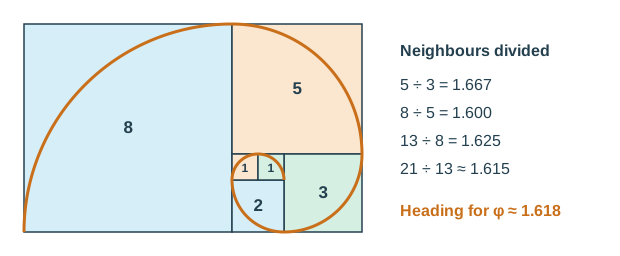
Divide each Fibonacci number by the one before it: 8 ÷ 5 = 1.6, 13 ÷ 8 = 1.625, 21 ÷ 13 ≈ 1.615. These ratios approach φ = (1 + √5) ÷ 2 ≈ 1.618, the golden ratio.
A golden rectangle has sides in that ratio, so one that is 10 cm wide is about 16.18 cm long.
The golden ratio has unusual properties. Its square is one more than itself: φ² ≈ 2.618 = φ + 1. Its reciprocal is one less than itself: 1 ÷ φ ≈ 0.618 = φ − 1. Cutting a square off a golden rectangle leaves a smaller golden rectangle, and repeating the cut forever traces the spiral in the figure above.
Artists and architects have used proportions near φ, and some writers claim it appears in the Parthenon, the Mona Lisa or the human face. Treat these claims with care. Many are measured loosely, and a ratio of 1.5 or 1.7 is often reported as golden. The well-supported examples come from plant growth, where the link with Fibonacci numbers is real.
6. What mathematics is for
Patterns matter because a rule written for them lets us do three things.
- Organize. A rule turns a messy list of observations into one short statement. "Each term is the sum of the two before it" replaces an endless list of numbers.
- Predict. Once the rule is known, we can compute terms nobody has observed yet. Weather forecasts, population projections and tide tables all extend patterns into the future.
- Control. Understanding a pattern lets us change the outcome. Knowing how an infection spreads tells health officials when to vaccinate. Knowing how a loan grows lets a borrower choose a shorter term.
Mathematics is also a human creation. People invented its symbols, definitions and proofs, and they keep extending them. Yet the patterns it describes existed in nature long before anyone wrote them down, which is part of why mathematics explains the world so well.
A warning about short patterns
A few terms never prove a pattern. Mark points on a circle and join every pair of points with a straight line. With 1, 2, 3, 4 and 5 points the circle is cut into 1, 2, 4, 8 and 16 regions, which looks like doubling. With 6 points, however, there are 31 regions, not 32. A rule has to be stated and checked, never guessed from the first few terms.
Solved examples
Follow each one line by line. The steps stay the same when the numbers change, so cover the steps and try it yourself.
Example 1: Arithmetic sequence
Question: What is the 15th term of 4, 10, 16, 22, …?
- Spot the pattern. Subtract neighbours: 10 − 4 = 6, 16 − 10 = 6, 22 − 16 = 6. The difference stays the same, so the sequence is arithmetic.
- List what you know. First term a = 4, difference d = 6, position n = 15.
- Write the rule. nth term = a + (n − 1)d.
- Substitute. 4 + (15 − 1) × 6 = 4 + 14 × 6 = 4 + 84 = 88.
Answer: The 15th term is 88.
Example 2: Geometric sequence
Question: What is the 6th term of 2, 10, 50, 250, …?
- Spot the pattern. Differences are 8, 40 and 200, so it is not arithmetic. Divide neighbours: 10 ÷ 2 = 5, 50 ÷ 10 = 5, 250 ÷ 50 = 5. The ratio stays the same, so the sequence is geometric.
- List what you know. First term a = 2, ratio r = 5, position n = 6.
- Write the rule. nth term = a × rn − 1.
- Substitute. 2 × 55 = 2 × 3125 = 6250.
Answer: The 6th term is 6250.
Example 3: Fibonacci-type sequence
Question: What is the 8th term of 3, 4, 7, 11, 18, …?
- Spot the pattern. Differences are 1, 3, 4 and 7, so it is not arithmetic. Ratios are not equal either, so it is not geometric. Now add neighbours: 3 + 4 = 7, 4 + 7 = 11, 7 + 11 = 18. Each term is the sum of the two before it, so it follows the Fibonacci rule.
- Write the rule. Next term = the two terms before it, added.
- Build up to the term you need. 6th: 11 + 18 = 29. 7th: 18 + 29 = 47. 8th: 29 + 47 = 76.
Answer: The 8th term is 76.
Common mistakes
- Using n instead of n − 1. The first term already sits in position 1, so the 15th term needs only 14 steps. Writing a + nd gives the 16th term instead.
- Dividing in the wrong direction. The ratio is a later term divided by the earlier one. In 81, 27, 9 the ratio is 27 ÷ 81 = 1/3, not 3.
- Calling every growing list geometric. 2, 4, 6, 8 grows by adding 2, so it is arithmetic. Test the list before you choose a rule.
- Raising the wrong number to the power. In a × rn − 1 only r takes the power. 3 × 27 is 3 × 128, not 67.
- Rounding φ too early. Keep 1.618 or more decimals until the last step, or a long calculation drifts.
Where you will meet this
- Savings and loans. Money that earns interest every year grows as a geometric sequence. The lesson on the mathematics of finance builds on this.
- Population and disease. Doubling and halving describe bacteria, the spread of a virus and radioactive decay.
- Seats and stacks. Theatre rows that each gain the same number of seats, or cans stacked in a pyramid, form arithmetic sequences.
- Design. Photographers and designers use grids close to the golden ratio to place the subject of a picture.
Key terms
- Sequence
- An ordered list of numbers called terms.
- Common difference
- The fixed amount added to get each term of an arithmetic sequence.
- Common ratio
- The fixed number each term is multiplied by in a geometric sequence.
- Series
- The sum of the terms of a sequence.
- Fibonacci sequence
- 1, 1, 2, 3, 5, 8, …, where each term is the sum of the two before it.
- Golden ratio
- φ = (1 + √5) ÷ 2 ≈ 1.618, the value that ratios of neighbouring Fibonacci numbers approach.
Summary
- Mathematics describes the regularities found in nature and turns them into rules.
- An arithmetic sequence adds a fixed d, so an = a + (n − 1)d. A geometric sequence multiplies by a fixed r, so an = a × rn − 1.
- The sum of n arithmetic terms is n(a1 + an) ÷ 2. The sum of n geometric terms is a(rn − 1) ÷ (r − 1).
- In a Fibonacci-type sequence each term is the sum of the two before it, and the ratios of neighbours approach φ ≈ 1.618.
- Rules let us organize, predict and control, but a few terms alone never prove a rule.
Write the rule first, then compute. Counting terms one by one is how errors enter long sequences.