Problem solving
Use Pólya’s four steps and common strategies to solve word problems.
By the end of this lesson you can:
- tell inductive from deductive reasoning and use a counterexample;
- apply Pólya’s four steps to an unfamiliar problem;
- choose a strategy: an equation, a table, a pattern, a diagram or working backward;
- solve age, number, coin, digit, ratio, work and motion problems;
- check an answer against the conditions of the problem.
Two kinds of reasoning
Every problem is solved by reasoning, and mathematics uses two kinds.
- Inductive reasoning moves from particular cases to a general guess, called a conjecture. You notice that 1 + 3 = 4, 1 + 3 + 5 = 9 and 1 + 3 + 5 + 7 = 16, and you guess that adding odd numbers always gives a square. Induction is how we discover ideas, but it never proves them.
- Deductive reasoning moves from accepted facts and rules to a conclusion that must follow. "Every even number is divisible by 2; 846 is even; so 846 is divisible by 2." Deduction is how we prove ideas.
One counterexample is enough to show a conjecture is false. Someone guesses "every odd number is prime". The number 9 is odd and equals 3 × 3, so the guess fails. No number of examples can prove a general claim, but a single counterexample can disprove it.
Pólya’s four steps
The mathematician George Pólya described how good problem solvers work in his 1945 book How to Solve It.
- Understand the problem: what is given, and what is asked?
- Devise a plan: draw a diagram, look for a pattern, write an equation, work backward.
- Carry out the plan: do the work and check each step.
- Look back: does the answer fit the conditions?
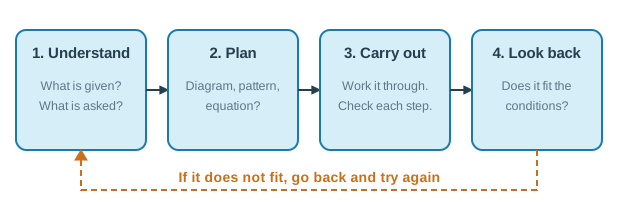
Each step comes with questions to ask yourself.
| Step | Ask yourself |
|---|---|
| Understand | Can I say the problem in my own words? What is unknown? What data and conditions are given? Is anything missing or extra? |
| Plan | Have I seen a similar problem? Can I solve a simpler case first? Which strategy fits? |
| Carry out | Is each step correct? Am I keeping track of units? |
| Look back | Does the answer satisfy every condition? Is it reasonable in size? Could I solve it another way? |
Common strategies include guessing and checking, making a table or list, drawing a diagram, looking for a pattern, solving a simpler problem, writing an equation and working backward. The sections below show the most useful ones.
1. Writing an equation
Ana is 3 times as old as Ben, and their ages add up to 48. Let Ben be x, so x + 3x = 48, x = 12. Ben is 12 and Ana is 36. Look back: 12 + 36 = 48.
Choose the smaller or simpler quantity as x, then write every other quantity in terms of it. The same plan solves many standard problems.
Age problems with time shifts
A father is 30 years older than his son. In 5 years he will be 3 times as old as his son. Let the son be x now, so the father is x + 30. In 5 years they will be x + 5 and x + 35, so x + 35 = 3(x + 5). Then x + 35 = 3x + 15, so 2x = 20 and x = 10. The son is 10 and the father is 40. Look back: in 5 years they are 15 and 45, and 45 = 3 × 15. When a problem mentions "in 5 years" or "4 years ago", add or subtract that time from both people.
Consecutive integers
Consecutive integers differ by 1: x, x + 1, x + 2. Consecutive even integers, and consecutive odd integers, differ by 2: x, x + 2, x + 4. Three consecutive integers add up to 93. Then x + (x + 1) + (x + 2) = 93, so 3x + 3 = 93 and x = 30. The integers are 30, 31 and 32.
Coins and other mixtures
A purse has 30 coins, all ₱5 and ₱1, worth ₱90. Let x be the number of ₱5 coins, so there are 30 − x one-peso coins. Their value gives 5x + (30 − x) = 90, so 4x = 60 and x = 15. There are 15 of each. A quick check without algebra: if all 30 were ₱1 coins they would be worth ₱30. Each ₱5 coin in place of a ₱1 adds ₱4, and the extra ₱60 needs 60 ÷ 4 = 15 such coins.
Digit problems
A two-digit number with tens digit t and ones digit u has the value 10t + u. Reversing it gives 10u + t, and the difference is 9(u − t). So reversing a number always changes it by a multiple of 9. If the digits of a number add up to 9 and reversing them makes the number smaller by 45, then the digits differ by 45 ÷ 9 = 5. Digits adding to 9 and differing by 5 are 7 and 2, and since the number gets smaller, the larger digit comes first: 72. Check: 72 − 27 = 45.
Sharing in a ratio
To divide an amount in a ratio, add the parts, find one part, and multiply. Split ₱4,000 between two people in the ratio 3 : 5. There are 3 + 5 = 8 parts, so one part is ₱500. The shares are 3 × 500 = ₱1,500 and 5 × 500 = ₱2,500, which add up to ₱4,000.
2. Using a table of assumptions
A yard has chickens and goats with 20 heads and 56 legs. If all 20 were chickens there would be 40 legs. The 16 extra legs come in pairs, one pair for each goat, so there are 8 goats.
The idea is to make the simplest assumption, see how far it misses, and correct the miss one unit at a time. A table of guesses shows the same thing.
| Goats | Chickens | Legs |
|---|---|---|
| 0 | 20 | 40 |
| 4 | 16 | 48 |
| 8 | 12 | 56 |
Each goat added in place of a chicken adds 2 legs, which is why the legs rise by 8 for every 4 goats.
3. Looking for a pattern
1 = 1, 1 + 3 = 4, 1 + 3 + 5 = 9. The sum of the first n odd numbers is n², so 1 + 3 + … + 19, which has 10 terms, is 100.
A simpler case often shows the pattern. How many squares of any size are on an 8 by 8 chessboard? Count small boards first. A 1 by 1 board has 1 square. A 2 by 2 board has 4 small squares and 1 large one, 5 in all. A 3 by 3 board has 9 + 4 + 1 = 14. The pattern is a sum of squares, so the chessboard has 64 + 49 + 36 + 25 + 16 + 9 + 4 + 1 = 204 squares.
4. Working backward
When a problem gives the end result and the steps that led to it, undo the steps in reverse order. Each operation is replaced by its opposite.
Lito spent half his money on a book and then ₱35 on lunch. He has ₱65 left. Start from the end: before lunch he had 65 + 35 = ₱100. That was half his money, so at the start he had 100 × 2 = ₱200. Look back: half of 200 is 100, and 100 − 35 = 65.
5. Drawing a diagram
A snail is at the bottom of a well 10 m deep. Each day it climbs 3 m, and each night it slips back 2 m. A quick guess says 10 days, because it gains 1 m a day. A diagram shows otherwise. After 7 days and nights it is 7 m up. On day 8 it climbs 3 m, reaches the top and does not slip back. The answer is 8 days. Looking back at the conditions caught the trap.
6. Work and motion
- A takes 6 hours and B takes 3 hours on one job. Together they do 1/6 + 1/3 = 1/2 of it per hour, so they take 2 hours.
- Distance = rate × time.
In work problems, add rates, never times. A worker who finishes a job in t hours does 1/t of it each hour. The combined rate is the sum of the separate rates, and the time together is 1 divided by that sum.
In motion problems, keep the units the same. A bus at 60 km/h for 2.5 hours covers 60 × 2.5 = 150 km. To reach a town 150 km away in 2 hours instead, it would need 150 ÷ 2 = 75 km/h. Rearrange d = rt to t = d ÷ r or r = d ÷ t as needed.
7. Recreational problems
Puzzles train the same habits. In a 3 by 3 magic square, the numbers 1 to 9 are placed so that every row, column and diagonal has the same sum. The numbers add up to 45 and there are 3 rows, so each row must total 45 ÷ 3 = 15, and the centre must be 5. Reasoning from the conditions, not trial and error, finds the answer quickly.
Solved examples
Follow each one line by line. The steps stay the same when the numbers change, so cover the steps and try it yourself.
Example 1: Writing an equation
Question: A notebook costs ₱15 more than a pen. Together they cost ₱55. How much is the pen?
- Understand. Given: the total and the difference. Asked: the price of the pen.
- Plan. Let the pen cost x, so the notebook costs x + 15. Their sum is 55.
- Carry out. x + x + 15 = 55, so 2x = 40 and x = 20.
- Look back. The notebook costs ₱35, and 20 + 35 = 55.
Answer: The pen costs ₱20.
Example 2: A table of assumptions
Question: A parking lot has cars and motorcycles: 30 vehicles and 96 wheels in all. How many cars are there?
- Understand. Two kinds of vehicle, with two totals.
- Plan. Assume all of one kind, then see how far the total is off.
- Carry out. If all 30 were motorcycles there would be 60 wheels. That is 96 − 60 = 36 too few. Each car adds 2 more wheels, so 36 ÷ 2 = 18 cars.
- Look back. 18 cars have 72 wheels and 12 motorcycles have 24 wheels, and 72 + 24 = 96.
Answer: There are 18 cars.
Example 3: Working together
Question: One pump fills a tank in 4 hours and another in 12 hours. How long do they take together?
- Understand. Times do not add. Rates do.
- Plan. Write each pump’s share of the tank per hour.
- Carry out. 1/4 + 1/12 = 3/12 + 1/12 = 4/12 = 1/3 of the tank per hour, so the whole tank takes 3 hours.
- Look back. The answer is less than the faster pump’s 4 hours, as it should be.
Answer: They take 3 hours.
Common mistakes
- Skipping the first step. Many wrong answers solve a different problem. Underline what is asked before you start.
- Shifting only one age. "In 5 years" adds 5 to everyone in the problem.
- Adding times in work problems. Two people do not take 6 + 3 = 9 hours together. Add their rates.
- Mixing units. A speed in km/h needs a time in hours, so 30 minutes is 0.5 h.
- Stopping before looking back. A count of goats that is negative or a fraction means an error somewhere.
- Trusting a pattern without testing it. Induction suggests; only deduction proves.
Where you will meet this
- Board and licensure exams. Age, number, mixture, work and motion problems are standard items.
- Budgeting. Working backward from what is left tells you what you spent.
- Planning. Combined work rates schedule a crew; distance and speed plan a trip.
- Programming. Breaking a problem into smaller cases is how algorithms are designed.
Key terms
- Inductive reasoning
- Reaching a general conjecture from particular cases.
- Deductive reasoning
- Reaching a conclusion that must follow from accepted facts and rules.
- Counterexample
- One case that shows a general claim is false.
- Conjecture
- A statement believed to be true but not yet proved.
- Working backward
- Undoing the steps of a problem in reverse order, starting from the result.
- Rate of work
- The part of a job done per unit of time, 1/t for a job that takes t hours.
Summary
- Induction finds conjectures; deduction proves them; one counterexample disproves them.
- Pólya’s steps are understand, plan, carry out and look back, repeated as needed.
- Name the unknown, write the other quantities in terms of it, and form an equation.
- Use tables, patterns, simpler cases, diagrams and working backward when an equation is not obvious.
- Add rates in work problems, use d = rt with matching units, and always check the answer against every condition.
The last step is the one most people skip. Put your answer back into the words of the problem.