Mathematical language and symbols
Tell expressions from sentences, translate words into symbols, and read relations and functions.
By the end of this lesson you can:
- describe the characteristics of mathematical language;
- tell an expression from a mathematical sentence and judge a sentence true, false or open;
- read the common symbols, number sets and quantifiers;
- translate English phrases into mathematics and back;
- decide whether a relation is a function, and find its domain, range and inverse.
A language of its own
Mathematical language is precise (it makes fine distinctions), concise (it says things briefly) and powerful (it can express complex ideas simply).
Everyday language is full of double meanings. "I saw the man with the binoculars" could mean you used the binoculars, or that the man was holding them. Mathematics cannot afford that. A bridge engineer, a pharmacist measuring a dose and a bank computing interest all need a statement to mean exactly one thing to every reader.
Compare the sentence "The square of any real number is never negative" with its mathematical form, ∀x ∈ ℝ, x² ≥ 0. The symbols say the same thing in a fraction of the space, and a reader in Manila, Tokyo or Nairobi reads them the same way. That is what concise and precise mean in practice.
Like any language, mathematics has a vocabulary, the symbols and terms, and a grammar, the rules for combining them. This lesson covers both.
1. Expressions and sentences
- An expression names a quantity: 3x + 2. It has no truth value.
- A sentence states a complete thought: 3x + 2 = 11. It can be true or false, or open until x is known.
The comparison with English is direct. An expression works like a noun, and a mathematical sentence works like a sentence.
| English | Mathematics | Sample |
|---|---|---|
| Noun: names a thing | Expression: names a number | "the sum of 8 and a number" is 8 + x |
| Sentence: states a complete thought | Mathematical sentence: uses =, ≠, <, >, ≤ or ≥ | 8 + x = 20 |
A mathematical sentence is true, false or open. 6 + 9 = 15 is true. 7 − 10 = 4 is false. x + 1 = 40 is open: it becomes true only when x is 39, and false for every other number.
2. The vocabulary: symbols and number sets
These symbols appear in every topic of this course.
| Symbol | Read as | Symbol | Read as |
|---|---|---|---|
| =, ≠ | is equal to, is not equal to | ∈, ∉ | is an element of, is not an element of |
| <, > | is less than, is greater than | ⊆ | is a subset of |
| ≤, ≥ | is at most, is at least | ∪, ∩ | union, intersection |
| ∀ | for all, for every | ⇒ | implies |
| ∃ | there exists | ⇔ | if and only if |
The common number sets have their own letters.
- ℕ, the natural numbers: 1, 2, 3, …
- ℤ, the integers: …, −2, −1, 0, 1, 2, …
- ℚ, the rational numbers: any fraction of integers, such as 3/4 or −5.
- ℝ, the real numbers: every point on the number line, including √2 and π.
Quantifiers turn an open sentence into a true or false statement. ∀ means "for all". ∃ means "there exists". "∃x ∈ ℤ, x + 4 = 1" reads "there is an integer x with x + 4 = 1", and it is true because x = −3 works. "∀x ∈ ℕ, x > 1" is false, because x = 1 fails.
3. The grammar: conventions
Mathematics fixes the order in which operations are done, so that every reader gets the same value.
- Work inside grouping symbols first: parentheses, brackets and fraction bars.
- Then evaluate exponents.
- Then multiply and divide, from left to right.
- Then add and subtract, from left to right.
So 3 + 4 × 2 is 3 + 8 = 11, not 14. And 24 ÷ 4 × 2 is 6 × 2 = 12, not 24 ÷ 8 = 3, because division and multiplication go left to right.
Other conventions save writing. 5x means 5 × x. Letters near the end of the alphabet, such as x and y, usually stand for unknowns, and letters near the start, such as a and b, for fixed values.
4. Translating words
- "Five less than twice a number" is 2x − 5. The order flips: the five comes off afterwards.
- "The sum of a number and 7 is 19" is x + 7 = 19.
Key words point to each operation.
| Operation | Key words | Phrase | Translation |
|---|---|---|---|
| + | sum, more than, increased by, added to | ten more than half a number | x ÷ 2 + 10 |
| − | difference, less than, decreased by, subtracted from | a number decreased by 15 | x − 15 |
| × | product, times, twice, of | the product of a number and itself | x × x, or x² |
| ÷ | quotient, divided by, per, ratio | the quotient of a number and 12 | x ÷ 12 |
| = | is, equals, gives, results in | a number tripled is 60 | 3x = 60 |
| ≤, ≥ | at most, at least | a number is at most 30 | x ≤ 30 |
Watch the small words. "Eight less than a number" is x − 8, but "eight less a number" is 8 − x. "The square of the sum of a and b" is (a + b)², while "the sum of the squares of a and b" is a² + b². These give different values: with a = 1 and b = 10, the first is 121 and the second is 101.
5. Relations and functions
A relation is any set of ordered pairs. A function is a relation in which each input has exactly one output, so {(1, 2), (1, 3)} is not a function.
Everyday pairings help. Matching each student to a Learner Reference Number is a function, because each student has exactly one. Matching each mother to her children is only a relation, because a mother can have more than one child. On a graph, a relation is a function when no vertical line crosses it more than once. This is the vertical line test.
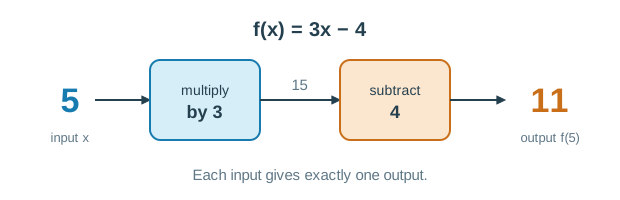
Function notation works by substitution. If f(x) = 3x − 4, then f(5) = 3(5) − 4 = 11.
Substitution works for any input, including negatives. If g(x) = x² + 1, then g(−3) = (−3)² + 1 = 9 + 1 = 10. Put the negative number in parentheses before squaring, or the sign gets lost.
Domain and range
The domain is the set of allowed inputs, and the range is the set of outputs. The function f(x) = 1 ÷ (x − 2) cannot take x = 2, so its domain is all real numbers except 2.
Two rules cause most domain limits: you cannot divide by zero, and you cannot take the square root of a negative number in the real numbers. So √(x − 30) needs x − 30 ≥ 0, giving the domain x ≥ 30.
To find a range, ask which outputs are possible. A square is never negative, so x² can be any number from 0 upward. That makes the range of f(x) = x² the set y ≥ 0, and the range of f(x) = x² − 15 the set y ≥ −15, since every output is 15 less.
Inverse functions
An inverse function, written f−1, undoes f: it takes the output back to the input. To find it, write y = f(x), swap x and y, and solve for y.
For f(x) = 8x + 12, write y = 8x + 12. Swapping gives x = 8y + 12. Subtract 12 and divide by 8: y = (x − 12) ÷ 8. So f−1(x) = (x − 12) ÷ 8. Check it: f(1) = 20, and f−1(20) = 8 ÷ 8 = 1. The inverse reverses the steps in reverse order, the way you take off your shoes before your socks.
Defined operations
Mathematics lets you define a new operation with a rule and a symbol. If a ∆ b = a² − b, then 5 ∆ 3 means 5² − 3 = 25 − 3 = 22. The symbol has no meaning beyond its rule, so always substitute into the rule exactly as written. Order often matters: 3 ∆ 5 = 9 − 5 = 4, which is not the same as 5 ∆ 3.
Solved examples
Follow each one line by line. The steps stay the same when the numbers change, so cover the steps and try it yourself.
Example 1: Translating words into an equation
Question: Three less than four times a number is 17. What is the number?
- Name the unknown. Let the number be x.
- Translate piece by piece. "Four times a number" is 4x. "Three less than" takes 3 off afterwards: 4x − 3. "Is" becomes the equals sign: 4x − 3 = 17.
- Solve. Add 3 to both sides: 4x = 20. Divide by 4: x = 5.
- Check. 4 × 5 − 3 = 17.
Answer: The number is 5.
Example 2: Telling a function from a relation
Question: Which of these is a function: R = {(1, 4), (2, 4), (3, 7)} or S = {(2, 1), (2, 5), (3, 6)}?
- Look only at the inputs, the first number of each pair.
- Check R. The inputs 1, 2 and 3 each appear once. The output 4 repeats, and that is allowed.
- Check S. The input 2 appears twice, with outputs 1 and 5. One input has two outputs.
Answer: R is a function, and S is not.
Example 3: Evaluating a function
Question: If f(x) = 2x² − 3, what is f(4)?
- Replace x with the input. f(4) = 2(4)² − 3.
- Do the power first. 4² = 16.
- Then multiply and subtract. 2 × 16 − 3 = 32 − 3 = 29.
Answer: f(4) = 29.
Common mistakes
- Reading "less than" in order. "Six less than a number" is x − 6, not 6 − x. The quantity after "than" comes first.
- Calling an expression true or false. 4x + 1 has no truth value. Only a sentence with =, < or another relation symbol can be true or false.
- Rejecting repeated outputs. A function may send different inputs to the same output. It fails only when one input has two outputs.
- Losing the sign of a negative input. For g(x) = x² + 1, g(−3) is (−3)² + 1 = 10, not −9 + 1.
- Inverting the steps in the same order. The inverse of "times 8, then plus 12" is "minus 12, then divide by 8", not "divide by 8, then minus 12".
Where you will meet this
- Every other topic. Sets, logic and statistics are all written in this symbol language.
- Spreadsheets and programming. A spreadsheet formula such as =B2*1.12 is an expression, and the order of operations decides its value.
- Rates and fares. A jeepney or taxi fare that depends on distance is a function: each distance gives one fare.
Key terms
- Expression
- A combination of numbers, variables and operations that names a quantity.
- Mathematical sentence
- A statement that relates expressions and can be true, false or open.
- Quantifier
- ∀ (for all) or ∃ (there exists), which says how many values a statement covers.
- Function
- A relation in which each input has exactly one output.
- Domain and range
- The set of allowed inputs, and the set of outputs they produce.
- Inverse function
- The function that sends each output of f back to its input.
Summary
- Mathematical language is precise, concise and powerful.
- An expression names a quantity. A sentence relates quantities and is true, false or open.
- The order of operations and fixed symbols make every statement mean one thing.
- Translate key words carefully, especially "less than" and "subtracted from".
- A function gives each input exactly one output. Its domain avoids division by zero and square roots of negatives, and its inverse undoes it step by step.
"Less than" and "subtracted from" reverse the order you read them in. Write them slowly.