Mathematics of finance
Compute simple and compound interest, annuities and loan payments, and compare ways to save and invest.
By the end of this lesson you can:
- compute simple interest, maturity value, rate and time;
- compute compound amounts for any compounding period, and the effective rate;
- find the present value of a future amount;
- find the future and present value of an annuity;
- compute an amortized loan payment and a credit card balance;
- explain stocks, bonds and dividends, and estimate doubling time.
Why the mathematics of finance matters
Every peso you save, borrow or invest grows or costs money over time. A bank deposit, a motorcycle loan, a credit card, a pension and a share of stock all follow the same few formulas. Knowing them lets you compare offers, avoid expensive debt and plan for goals such as tuition or a house.
The central idea is the time value of money: a peso today is worth more than a peso next year, because today’s peso can earn interest in the meantime. Interest is the price paid for using someone else’s money. The amount borrowed or deposited is the principal, P; the yearly percentage charged is the rate, r; and the length of the loan in years is the time, t.
Interest
Simple interest: I = P × r × t. ₱10,000 at 6% for 3 years earns ₱1,800.
Simple interest is charged on the principal only, so the interest is the same every year. The total paid back at the end is the maturity value, F = P + I = P(1 + rt). In the example, F = 10,000 + 1,800 = ₱11,800.
The same formula can be turned around. ₱20,000 that earns ₱3,000 of simple interest in 2 years has a rate of r = I ÷ (Pt) = 3,000 ÷ 40,000 = 0.075, or 7.5%. To find the time, use t = I ÷ (Pr). If the time is given in months, divide by 12 first: 9 months is 0.75 years.
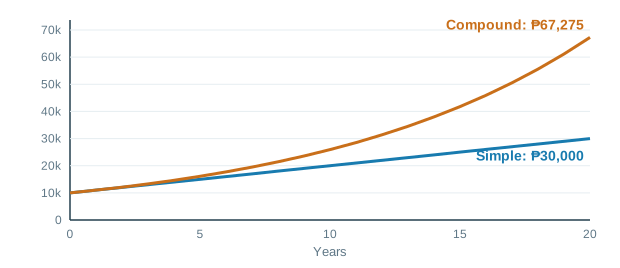
Compound interest: A = P(1 + r/m)mt, where m is the number of periods per year. ₱10,000 at 10% compounded annually for 2 years grows to ₱12,100, because interest also earns interest.
- 8% compounded quarterly is 2% per quarter.
- More frequent compounding gives a larger amount, at the same stated rate.
Two values do most of the work: the rate per period, i = r ÷ m, and the number of periods, n = mt. Then A = P(1 + i)n and the compound interest is A − P.
| Compounded | m | i = r ÷ m (r = 12%) | ₱100,000 after 1 year |
|---|---|---|---|
| Annually | 1 | 12% | ₱112,000.00 |
| Semi-annually | 2 | 6% | ₱112,360.00 |
| Quarterly | 4 | 3% | ₱112,550.88 |
| Monthly | 12 | 1% | ₱112,682.50 |
The monthly account actually earns 12.68% in a year. That true yearly growth is the effective rate, (1 + r/m)m − 1. Comparing effective rates is the fair way to compare offers that compound differently.
1. Present value
Present value asks how much must be put in now: P = A ÷ (1 + r/m)mt.
Present value runs compounding in reverse, which is called discounting. To have ₱200,000 for tuition in 5 years at 6% compounded annually, you need 200,000 ÷ 1.065 ≈ ₱149,451.63 today. The higher the rate or the longer the time, the less you need to deposit now.
2. Annuities
An annuity is a series of equal payments. For payments R at the end of each period, the future value is R × ((1 + i)n − 1) ÷ i. Saving ₱5,000 at the end of each year for 3 years at 10% gives ₱16,550.
Payments made at the end of each period form an ordinary annuity; payments made at the start form an annuity due. Pensions, insurance premiums, rent and monthly savings plans are all annuities.
The present value of an annuity is the single amount today that is worth the whole stream of payments:
PV = R × (1 − (1 + i)−n) ÷ i
A prize that pays ₱25,000 at the end of each year for 5 years, at 6% per year, is worth 25,000 × (1 − 1.06−5) ÷ 0.06 ≈ ₱105,309.09 today. That is less than the ₱125,000 total, because the later payments are discounted more.
3. Loans
An amortized loan is repaid in equal payments: M = P × i ÷ (1 − (1 + i)−n). Early payments are mostly interest, and later ones mostly principal.
The loan formula is the annuity present value solved for the payment, because the bank lends the present value of your future payments. A ₱500,000 car loan at 9% per year, paid monthly for 5 years, has i = 0.09 ÷ 12 = 0.0075 and n = 60. The payment is 500,000 × 0.0075 ÷ (1 − 1.0075−60) ≈ ₱10,379.18 a month. In the first month the interest is 500,000 × 0.0075 = ₱3,750, so only ₱6,629.18 reduces the balance. Over 60 payments the borrower pays about ₱622,751 in all, so the loan costs about ₱122,751 in interest. A table that lists each payment’s interest, principal and remaining balance is an amortization schedule.
Credit cards
Credit cards usually charge interest every month on the unpaid balance, and the interest is added to what you owe. A balance of ₱15,000 at 3% a month, with no payments, grows to 15,000 × 1.036 ≈ ₱17,910.78 in 6 months. A monthly rate of 3% is an effective rate of about 42.6% a year, which is why paying only the minimum is so costly.
4. Stocks and bonds
A stock is part ownership of a company. A bond is a loan to a company or government that pays interest.
- A stockholder may receive a dividend, a share of the profit. The dividend yield is the yearly dividend divided by the share price: a ₱4 dividend on an ₱80 share is a 5% yield. Stock prices rise and fall, so stocks can gain or lose value.
- A bond has a face value repaid at maturity and a coupon rate paid as interest. A ₱100,000 bond at 5% pays ₱5,000 a year until it matures. Government bonds such as Philippine Retail Treasury Bonds are lower in risk and return than most stocks.
- A mutual fund pools many investors’ money into a mix of stocks and bonds managed by professionals.
A quick estimate called the rule of 72 says money doubles in about 72 ÷ (rate in percent) years. At 6% a year, money doubles in about 12 years; at 9%, in about 8.
Solved examples
Follow each one line by line. The steps stay the same when the numbers change, so cover the steps and try it yourself.
Example 1: Simple interest
Question: ₱8,000 is invested at 5% simple interest for 4 years. What is the final amount?
- Spot the type. "Simple" means interest is earned on the principal only, so use I = P × r × t.
- List what you know. P = 8000, r = 0.05, t = 4.
- Substitute. I = 8000 × 0.05 × 4 = ₱1,600.
- Add the principal. 8000 + 1600 = ₱9,600.
Answer: The final amount is ₱9,600.
Example 2: Compound interest
Question: ₱15,000 is invested at 4% compounded quarterly. What is the amount after 1 year?
- Spot the type. "Compounded" means interest earns interest, so use A = P(1 + r/m)mt.
- Find the rate per period. 4% ÷ 4 = 1% = 0.01.
- Find the number of periods. 4 × 1 = 4.
- Substitute. 15000 × 1.014 = 15000 × 1.04060401 ≈ ₱15,609.06.
Answer: The amount is ₱15,609.06.
Example 3: Future value of an annuity
Question: ₱2,000 is deposited at the end of each year for 3 years at 5% compounded annually. What is the future value?
- Spot the type. Equal payments every period make an annuity, so use R × ((1 + i)n − 1) ÷ i.
- List what you know. R = 2000, i = 0.05, n = 3.
- Work out the power. 1.053 = 1.157625.
- Substitute. 2000 × 0.157625 ÷ 0.05 = 2000 × 3.1525 = ₱6,305.
Answer: The future value is ₱6,305.
Common mistakes
- Using the yearly rate per period. At 8% compounded quarterly, use 2% per period and 4 periods per year.
- Leaving the rate as a whole number. 6% is 0.06 in every formula.
- Forgetting to convert months to years. In I = Prt, t is in years, so 6 months is 0.5.
- Confusing interest with the amount. I is what is earned; A or F is principal plus interest.
- Adding up annuity payments. Future and present values include interest, so they are not simply R × n.
- Comparing nominal rates that compound differently. Compare effective rates instead.
Where you will meet this
- Banking. Savings, time deposits and loans all quote rates and compounding periods.
- Consumer credit. Credit cards, salary loans and installment plans use monthly rates.
- Housing and vehicles. Pag-IBIG housing and car loans are amortized.
- Retirement. SSS and GSIS pensions and insurance are annuities; stocks, bonds and funds build long-term savings.
Key terms
- Principal
- The amount borrowed or deposited.
- Simple interest
- Interest computed on the principal only: I = Prt.
- Compound interest
- Interest computed on the principal plus the interest already earned.
- Present value
- The amount today that will grow to a given future amount.
- Annuity
- A series of equal payments made at equal intervals.
- Amortization
- Paying off a loan with equal payments that cover interest and principal.
Summary
- Simple interest: I = Prt and F = P + I.
- Compound amount: A = P(1 + r/m)mt; more frequent compounding gives more, and the effective rate compares offers.
- Present value discounts: P = A ÷ (1 + r/m)mt.
- An annuity’s future value is R × ((1 + i)n − 1) ÷ i and its present value is R × (1 − (1 + i)−n) ÷ i.
- A loan payment is P × i ÷ (1 − (1 + i)−n); early payments are mostly interest.
- Stocks are ownership, bonds are loans, and money doubles in about 72 ÷ rate years.
Before you compute, write the rate per period and the number of periods. Both change with the compounding.