Voting, apportionment and fair division
Compare ways of counting votes, allot seats fairly, and divide goods among people.
By the end of this lesson you can:
- read a preference schedule and tell a majority from a plurality;
- find winners by plurality, Borda count, elimination and pairwise comparison;
- test a method against the fairness criteria;
- apportion seats by Hamilton’s, Jefferson’s, Webster’s and Adams’s methods;
- divide goods fairly by divide and choose, lone divider and sealed bids.
Why voting needs mathematics
Clubs, student councils, juries, companies and nations all make group decisions by voting. When there are only two choices, the choice with more votes wins and there is little to argue about. With three or more choices, the result can depend on the method used to count, and mathematics shows how much it matters.
In a ranked election each voter lists the candidates in order of preference. Ballots that are the same are grouped together in a preference schedule, a table that shows each ranking and how many voters chose it.
Majority and plurality
A majority is more than half of the votes. A plurality is simply the most votes, which may be less than half. Of 1,200 votes, half is 600, so a majority needs at least 601. Of 1,201 votes, half is 600.5, and the next whole number, 601, is again a majority. A candidate can win a plurality without a majority whenever there are three or more candidates.
Voting methods
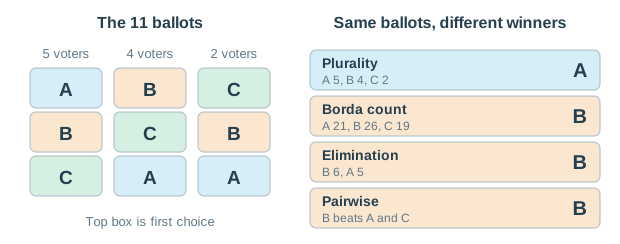
Take 11 voters: 5 rank A > B > C, 4 rank B > C > A, and 2 rank C > B > A.
- Plurality: most first-place votes. A wins with 5.
- Borda count: with 3 candidates, award 3, 2 and 1 points. A has 21, B has 26 and C has 19, so B wins.
- Plurality with elimination: drop the last-place candidate and recount. C goes, so B has 6 and A has 5. B wins.
- Pairwise comparison: compare head-to-head. B beats A 6 to 5, and B beats C 9 to 2. A candidate who beats every other one is a Condorcet winner.
Different methods can choose different winners from the same ballots.
How each method works
- Plurality looks only at first choices. It is simple and is used in Philippine elections: the presidential candidate with the most votes wins, even without a majority, and the 12 senatorial candidates with the most votes win the 12 seats.
- In a Borda count with n candidates, a first place earns n points, a second place n − 1, and so on down to 1 point for last place. Each ballot hands out 1 + 2 + … + n = n(n + 1) ÷ 2 points, which gives a quick check of the total. Borda rewards candidates that many voters rank highly, even if few rank them first.
- Plurality with elimination repeats rounds. If no candidate has a majority, the one with the fewest first places is removed, and those ballots move to their next choice. This is the idea behind instant runoff voting.
- Pairwise comparison runs a separate two-person contest for every pair of candidates. A candidate earns 1 point for each win and ½ for each tie. With n candidates there are n(n − 1) ÷ 2 contests, so 5 candidates need 10.
Fairness criteria
Mathematicians judge methods by whether they always meet some reasonable rules.
- Majority criterion: a candidate with a majority of first-place votes should win. The Borda count can fail it.
- Condorcet criterion: a candidate who beats every other one head-to-head should win. Plurality fails it in the example above, where A wins although B is the Condorcet winner.
- Monotonicity criterion: if a winner gains support and nothing else changes, the winner should still win. Plurality with elimination can fail it.
- Independence of irrelevant alternatives: if a losing candidate drops out, the winner should not change. Plurality, Borda and pairwise comparison can all fail it.
Sometimes there is no Condorcet winner at all. If one third of voters rank A > B > C, one third B > C > A, and one third C > A > B, then A beats B, B beats C, and C beats A. In 1951 Kenneth Arrow proved that no ranked voting method with three or more candidates can satisfy every fairness criterion in every election. This is Arrow’s impossibility theorem: choosing a method means choosing which flaws to accept.
1. Apportionment
The standard divisor is total population ÷ seats, and a state’s standard quota is its population ÷ that divisor.
Hamilton’s method: give each state its quota rounded down, then give leftover seats to the largest decimal parts. For populations 525, 310 and 165 with 10 seats, the divisor is 100 and the quotas are 5.25, 3.10 and 1.65. Rounding down gives 5, 3, 1, and the last seat goes to the 1.65: 5, 3, 2.
Apportionment is the problem of sharing a fixed number of seats, such as seats in a legislature or slots for delegates, in proportion to population. The difficulty is that quotas are rarely whole numbers, and seats cannot be split. The quota rounded down is the lower quota and rounded up is the upper quota.
Divisor methods
The other common methods do not hand out leftover seats. Instead they change the divisor to a modified divisor until the rounded quotas add up to exactly the number of seats. They differ only in how they round.
| Method | How quotas are rounded | 525, 310, 165 with 10 seats |
|---|---|---|
| Jefferson | Always down; the divisor is made smaller | Divisor 85: 6.18, 3.65, 1.94 give 6, 3, 1 |
| Webster | To the nearest whole number | Divisor 100: 5.25, 3.10, 1.65 give 5, 3, 2 |
| Adams | Always up; the divisor is made larger | Divisor 120: 4.38, 2.58, 1.38 give 5, 3, 2 |
Jefferson’s method favours large states, as the 6 seats here show, while Adams’s method favours small ones. Webster’s method sits between them.
Paradoxes
Hamilton’s method always gives each state its lower or upper quota, but it can behave strangely. In the Alabama paradox, adding one seat to the total makes a state lose a seat. In the population paradox, a growing state loses a seat to a state that grew more slowly. In the new-states paradox, adding a state with its fair share of new seats changes the seats of the others. The divisor methods avoid these paradoxes but can sometimes break the quota rule. Balinski and Young proved that no method can avoid every problem at once.
2. Fair division
Divide and choose: one person divides, and the other picks. Each can guarantee a share they consider fair.
A share is fair when its owner believes it is worth at least 1/n of the whole, where n is the number of people. Fair division does not need everyone to value things the same way; each person judges by their own values.
- Lone divider works for three or more people. One person, the divider, cuts the item into n pieces they consider equal. Each of the others, the choosers, says which pieces they find fair. The pieces are then handed out so that each chooser gets a piece they accepted, and the divider takes what is left.
- Sealed bids divide things that cannot be cut, such as a house or a car. Each heir secretly bids what the item is worth to them. The highest bidder gets the item and pays into a fund; the others draw their fair shares from the fund, and any money left over is split equally.
Suppose Ana and Ben inherit a house. Ana bids ₱900,000 and Ben bids ₱750,000. Each fair share is half of their own bid: ₱450,000 for Ana and ₱375,000 for Ben. Ana gets the house, which is worth ₱900,000 to her, so she pays 900,000 − 450,000 = ₱450,000 into the fund. Ben takes his ₱375,000, leaving a surplus of ₱75,000, which is split ₱37,500 each. Ben ends with ₱412,500, and Ana keeps the house after paying ₱412,500. Each of them receives more than they considered fair.
Solved examples
Follow each one line by line. The steps stay the same when the numbers change, so cover the steps and try it yourself.
Example 1: Plurality and elimination
Question: Of 13 voters, 6 rank P > Q > R, 4 rank Q > R > P and 3 rank R > Q > P. Who wins by plurality, and who wins by plurality with elimination?
- Count first places. P has 6, Q has 4, R has 3. P wins by plurality.
- Drop the last candidate. R has the fewest, so R goes.
- Move those ballots to their next choice. R’s 3 voters rank Q next, so Q has 4 + 3 = 7 and P still has 6.
Answer: P wins by plurality, and Q wins with elimination.
Example 2: Borda count
Question: For the same 13 ballots, who wins a Borda count with 3, 2 and 1 points?
- Score P. 6 × 3 + 4 × 1 + 3 × 1 = 25.
- Score Q. 6 × 2 + 4 × 3 + 3 × 2 = 30.
- Score R. 6 × 1 + 4 × 2 + 3 × 3 = 23.
- Check the total. 25 + 30 + 23 = 78, and 13 voters × 6 points = 78.
Answer: Q wins with 30 points.
Example 3: Hamilton’s method
Question: Populations are A 410, B 350 and C 240, with 10 seats. How are the seats allotted?
- Find the standard divisor. 1000 ÷ 10 = 100.
- Find each quota. 4.10, 3.50 and 2.40.
- Round every quota down. 4, 3 and 2 make 9 seats, so 1 seat is left.
- Give it to the largest decimal. 0.50 is the largest, so B gets it.
Answer: A gets 4, B gets 4 and C gets 2.
Common mistakes
- Treating a plurality as a majority. A majority must be more than half of all the votes.
- Giving Borda points backwards. First place earns the most points: n for n candidates.
- Forgetting to move ballots in elimination. The eliminated candidate’s voters go to their next choice.
- Rounding quotas the usual way in Hamilton’s method. Round every quota down first, then hand out the leftover seats.
- Using the standard divisor for Jefferson or Adams. Adjust the divisor until the seats add up.
- Splitting the sealed-bid surplus by bid size. The surplus is shared equally.
Where you will meet this
- Elections. National, school and club elections choose a counting method, often plurality.
- Legislatures. Seats in congresses and councils are apportioned by population.
- Competitions. Rankings for awards and sports polls use Borda-style points.
- Inheritance and business. Estates, partnerships and shared assets are settled by fair-division methods.
Key terms
- Preference schedule
- A table showing each ranking of the candidates and how many voters chose it.
- Majority
- More than half of the votes.
- Condorcet winner
- A candidate who beats every other candidate head-to-head.
- Standard quota
- A state’s population divided by the standard divisor.
- Modified divisor
- A divisor adjusted so that the rounded quotas add up to the number of seats.
- Fair share
- A share worth at least 1/n of the whole to the person who receives it.
Summary
- A majority is more than half; a plurality is the most votes.
- Plurality, Borda count, elimination and pairwise comparison can pick different winners from the same ballots.
- Every method fails some fairness criterion; Arrow’s theorem says this cannot be avoided.
- Hamilton’s method rounds down and hands out leftovers; Jefferson, Webster and Adams adjust the divisor and round down, to the nearest, or up.
- Divide and choose, lone divider and sealed bids give each person a share they consider fair.
Add up all the Borda points as a check. With 11 voters and points 3 + 2 + 1, they must total 66.