Geometry, symmetry and fractals
Recognize symmetry, tessellations and transformations, and follow how fractals grow step by step.
By the end of this lesson you can:
- find the lines of symmetry and the order of rotational symmetry of a figure;
- name the isometries and use them to describe patterns;
- classify rosette, frieze and wallpaper patterns;
- use angle sums to decide which polygons tessellate;
- describe fractals and count the parts of the Sierpinski triangle and the Koch snowflake.
Geometry in design
Geometric shapes are everywhere in art, architecture and nature: the hexagons of a honeycomb, the repeated motifs of a Filipino banig mat or a T’boli t’nalak cloth, the tiles of a church floor, the branching of a fern. This lesson studies the mathematics of those designs: symmetry, transformations, tilings and fractals.
Symmetry
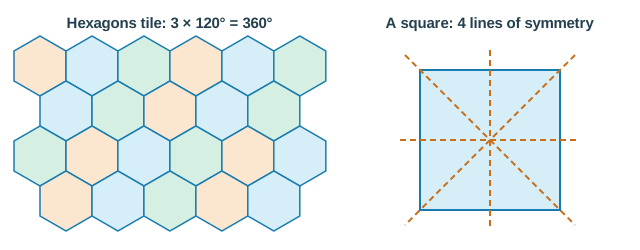
- Line symmetry: one half mirrors the other. A square has 4 lines of symmetry.
- Rotational symmetry: the figure matches itself before a full turn. A regular hexagon has order 6, matching every 60°.
Line symmetry
A line of symmetry, or mirror line, divides a figure into two halves that match when folded. The letter A has one vertical line of symmetry, the letter H has two, and the letter X has two. A rectangle that is not a square has only 2, because its diagonals do not fold it onto itself. A regular polygon with n sides has exactly n lines of symmetry, so a regular pentagon has 5 and a regular octagon has 8. A circle has infinitely many.
Rotational symmetry
The order of rotational symmetry is the number of positions in one full turn in which the figure looks the same. The smallest angle that works is 360° divided by the order. A regular n-gon has order n, matching every 360° ÷ n. An equilateral triangle has order 3, matching every 120°. The letter S has order 2, matching after a half turn. A figure that only matches after a full turn, such as the letter F, has no rotational symmetry; we say its order is 1.
1. Transformations
Reflections, rotations and translations keep size and shape, so they are called isometries. A dilation changes size, so it is not one.
| Transformation | What it does | What stays the same |
|---|---|---|
| Translation | Slides every point the same distance in the same direction | Size, shape and orientation |
| Reflection | Flips the figure over a mirror line | Size and shape; orientation is reversed |
| Rotation | Turns the figure about a fixed point by an angle | Size and shape |
| Glide reflection | A reflection followed by a translation along the mirror line | Size and shape, like footprints in sand |
| Dilation | Enlarges or shrinks from a centre by a scale factor | Shape and angles only; not an isometry |
A dilation with scale factor 3 makes every length 3 times as long and every area 3 × 3 = 9 times as large, while all angles stay the same. Figures with the same shape but different sizes are similar; figures with the same shape and size are congruent.
2. Patterns in design
- Rosette: repeats around a point.
- Frieze: repeats in one direction, like a border.
- Wallpaper: repeats in two directions.
A rosette, such as a flower or the design on a capiz lantern, has only rotations and possibly reflections about its centre. It has no translations. A frieze, such as a border on a barong or a running pattern along a wall, repeats by translation in one direction; mathematicians have shown there are exactly 7 types of frieze pattern. A wallpaper pattern, such as a floor of tiles or a woven mat, repeats by translations in two directions, and there are exactly 17 types.
3. Tessellations
A tessellation covers a plane with no gaps or overlaps. The interior angles at each point must total 360°, so the only regular polygons that tile alone are the triangle (60°), the square (90°) and the hexagon (120°). The regular pentagon, at 108°, cannot.
The interior angles of an n-sided polygon add up to (n − 2) × 180°.
The reason is that any polygon can be cut into n − 2 triangles from one corner, and each triangle has angles adding up to 180°. Dividing by n gives each interior angle of a regular polygon: (n − 2) × 180° ÷ n. A regular octagon has angles of 6 × 180° ÷ 8 = 135°. The exterior angles of any convex polygon, one at each corner, always add up to 360°, so each exterior angle of a regular n-gon is 360° ÷ n.
Why only three regular tilings
For copies of one regular polygon to meet at a point, the interior angle must divide 360° exactly. Three triangles is too few (180°), but 6 × 60° = 360°. Four squares give 4 × 90° = 360°. Three hexagons give 3 × 120° = 360°. Pentagons fail, because 3 × 10⁸° = 324° leaves a gap and 4 × 10⁸° = 432° overlaps. Any polygon with more than 6 sides has angles above 120°, so fewer than 3 would fit, which is impossible.
Semi-regular tilings
Two or more regular polygons can tile together if the angles at each vertex add up to 360°. Triangles and hexagons in the order triangle, hexagon, triangle, hexagon give 60° + 120° + 60° + 120° = 360°; this tiling is named 3.6.3.6. An octagon, an octagon and a square give 135° + 135° + 90° = 360°, the 4.8.8 tiling often seen on bathroom floors. There are exactly 8 such semi-regular tilings.
The Dutch artist M. C. Escher turned tessellations into art, changing the edges of squares and hexagons into interlocking birds, fish and lizards while keeping the angle sums unchanged.
4. Fractals
A fractal is self-similar: a part looks like the whole at a smaller scale.
- Sierpinski triangle: each step turns every triangle into 3 smaller ones: 1, 3, 9, 27, …
- Koch curve: each step multiplies the length by 4/3.
The Sierpinski triangle
Start with a filled triangle. Join the midpoints of its sides and remove the middle triangle, leaving 3 smaller ones. Repeat with each of those. After n steps there are 3n shaded triangles, each with 1/4n of the original area. Each step keeps 3/4 of what was shaded, so after n steps the shaded fraction is (3/4)n and the removed fraction is 1 − (3/4)n. After 3 steps, 27/64 remains shaded and 37/64 has been removed. As the steps continue, the shaded area shrinks toward zero while the number of triangles grows without end.
The Koch snowflake
Start with an equilateral triangle. On the middle third of every side, build a smaller equilateral triangle pointing outward and erase its base. Each side becomes 4 sides, each one third as long. So after n steps the snowflake has 3 × 4n sides, and its perimeter has been multiplied by (4/3)n. After 2 steps it has 3 × 16 = 48 sides. The perimeter grows without limit, yet the snowflake always fits inside a circle drawn around the first triangle, so its area stays finite.
Fractals in nature
Ferns, broccoli, river networks, coastlines, lightning and the branching of our lungs all repeat their shape at smaller scales. Fractal geometry is used to model these forms, to compress images and to design small antennas for mobile phones.
Solved examples
Follow each one line by line. The steps stay the same when the numbers change, so cover the steps and try it yourself.
Example 1: Angles of a regular polygon
Question: What is each interior angle of a regular decagon (10 sides), and can it tile a plane alone?
- Write the rule. The angles add up to (n − 2) × 180°.
- Substitute. (10 − 2) × 180° = 1440°.
- Share equally. 1440° ÷ 10 = 144° each.
- Test the tiling. The angles at a point must total 360°, and 360° ÷ 144° = 2.5, which is not a whole number.
Answer: Each angle is 144°, and it cannot tile a plane alone.
Example 2: Order of rotational symmetry
Question: A figure matches itself after every 72° turn. What is its order of rotational symmetry?
- Write the rule. Order = 360° ÷ the smallest matching turn.
- Substitute. 360° ÷ 72° = 5.
- Check. Five turns of 72° make a full turn, and a regular pentagon behaves this way.
Answer: The order is 5.
Example 3: Length of a Koch curve
Question: A Koch curve starts as a 27 cm segment. How long is it after 2 steps?
- Write one step as a multiplier. Each step multiplies the length by 4/3.
- Step 1. 27 × 4/3 = 36 cm.
- Step 2. 36 × 4/3 = 48 cm.
Answer: The curve is 48 cm long.
Common mistakes
- Counting diagonals as mirror lines on every quadrilateral. A square’s diagonals are lines of symmetry; a non-square rectangle’s are not.
- Confusing the order with the angle. A regular hexagon has order 6 and matches every 60°, not order 60.
- Using n × 180° for the angle sum. The sum is (n − 2) × 180°.
- Calling a dilation an isometry. It changes size, so it is not.
- Multiplying the Koch sides by 3. Each step turns one side into 4, so multiply by 4.
- Subtracting 1/4 each step in the Sierpinski triangle. Each step keeps 3/4 of the shaded area, so multiply by 3/4.
Where you will meet this
- Design and weaving. Banig, t’nalak, inabel and capiz designs use rosette, frieze and wallpaper symmetry.
- Architecture and tiling. Floor and wall tiles must satisfy the 360° rule.
- Nature. Honeycombs, flowers and snowflakes show symmetry and fractal growth.
- Technology. Computer graphics, image compression and antennas use transformations and fractals.
Key terms
- Line of symmetry
- A line that divides a figure into two mirror-image halves.
- Order of rotational symmetry
- The number of positions in one full turn in which a figure looks unchanged.
- Isometry
- A transformation that keeps size and shape: translation, reflection, rotation or glide reflection.
- Tessellation
- A covering of the plane by shapes with no gaps or overlaps.
- Fractal
- A figure in which parts repeat the whole at smaller scales.
- Frieze pattern
- A pattern that repeats by translation in one direction.
Summary
- A regular n-gon has n lines of symmetry and rotational order n, matching every 360° ÷ n.
- Translations, reflections, rotations and glide reflections are isometries; dilations are not.
- Rosettes repeat around a point, friezes in one direction, wallpaper in two.
- Interior angles add up to (n − 2) × 180°; a tiling needs 360° at each vertex, so only the regular triangle, square and hexagon tile alone.
- The Sierpinski triangle has 3n triangles with (3/4)n of the area left; the Koch snowflake has 3 × 4n sides.
Write how one step changes the figure as a multiplier, then apply it once per step.