The Rizal Law and the study of Rizal
Why Republic Act No. 1425 exists: the 1956 Senate debate, the Church opposition, the Laurel compromise, and what the law requires of every school.
Why a law makes you study Rizal
Every Filipino college student takes a course on José Rizal because a statute says so. Republic Act No. 1425, usually called the Rizal Law, was approved on 12 June 1956 after one of the most heated debates the Philippine Senate had seen. It orders all public and private schools, colleges and universities to teach the life, works and writings of Rizal, particularly his two novels, Noli Me Tángere and El Filibusterismo. Understanding why the law was written, who fought over it and what it actually requires is the proper starting point of the course, because the arguments of 1956 are still the arguments about what a national hero is for.
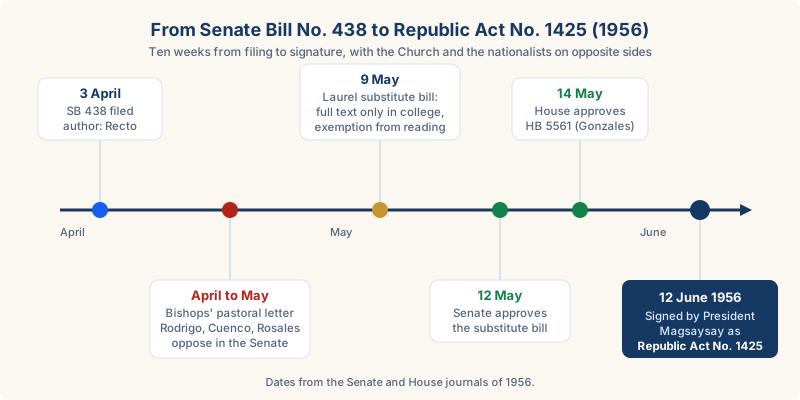
- 3 April 1956 – Senate Bill No. 438 is filed by the Senate Committee on Education, chaired by José P. Laurel; its principal author is Claro M. Recto.
- April–May 1956 – Senate debates; the Catholic hierarchy issues a pastoral letter against the bill.
- 9 May 1956 – Laurel presents a substitute bill that softens the reading requirement.
- 12 May 1956 – the Senate approves the substitute bill; the House approves its counterpart, House Bill No. 5561 by Jacobo Z. Gonzales, on 14 May.
- 12 June 1956 – President Ramon Magsaysay signs the measure into law as Republic Act No. 1425.
1. The Philippines of the 1950s
The Rizal Law was a product of its decade. The Republic was barely ten years old. Manila had been destroyed in 1945, the economy leaned on American aid and trade preferences, American military bases stood on Philippine soil, and the Hukbalahap rebellion had only just been contained. A group of nationalist politicians and intellectuals, with Senator Claro M. Recto as their most eloquent voice, argued that political independence had not brought economic or cultural independence. Recto wanted Filipinos to rediscover the nationalism of the Propaganda Movement and the Revolution, and he saw Rizal, the most widely honoured Filipino, as the natural teacher of that nationalism.
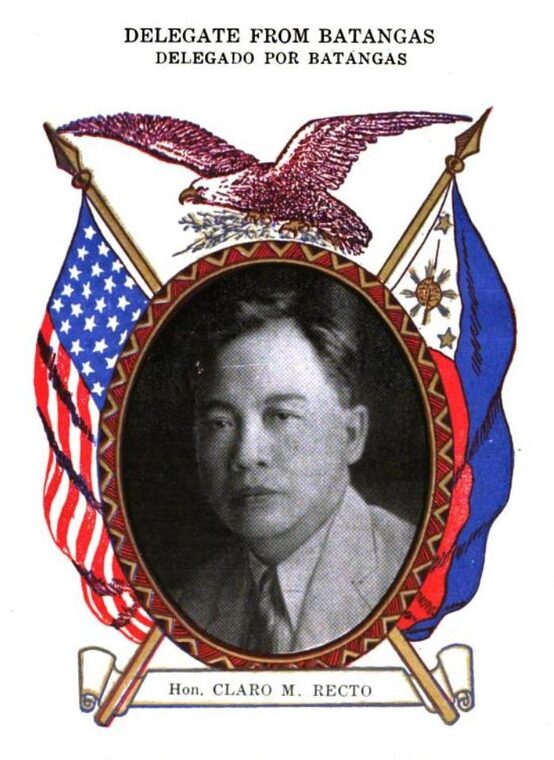
Recto was not a new figure. He had presided over the 1934–1935 Constitutional Convention that drafted the Commonwealth constitution, served in the Senate across several decades, and in the 1950s was the sharpest critic of what he called the colonial mentality of Philippine foreign and economic policy. His ally in the Senate on the Rizal bill was José P. Laurel, the former President of the Japanese-sponsored Second Republic, by then a senator and chairman of the Committee on Education.
2. The original bill and what it asked
Senate Bill No. 438 was filed on 3 April 1956 by the Committee on Education. In its first form it was blunt: it would have made the Noli and the Fili compulsory reading, in their original, unexpurgated texts, in all schools, colleges and universities. The preamble gave the reasons. It declared that there was a need, more than in any other period of the nation's history, for a rededication to the ideals of freedom and nationalism for which the heroes lived and died; that Rizal's life, works and writings, particularly the two novels, were a constant and inspiring source of patriotism; and that the State, which supervises all schools, had the duty to develop moral character, personal discipline, civic conscience and the duties of citizenship in the young.
Recto argued that the novels were not attacks on religion but attacks on the abuses of the friars who had governed the colony, and that a nation that would not let its students read its own hero was a nation afraid of its own history. He described the attempt to keep the books out of the schools as an attempt to erase the hero from the national memory.
3. The opposition
The Catholic Church hierarchy opposed the bill from the start. A pastoral letter, issued in the name of the bishops and read in churches, warned that the novels contained passages offensive to Catholic doctrine and that compelling Catholic students to read them violated freedom of conscience. Catholic lay organizations, among them the Catholic Action of the Philippines and the Knights of Columbus, campaigned against the measure, and some Catholic schools threatened to close rather than comply. The Jesuit Jesús Cavanna argued in print that the novels belonged to the past, described conditions that no longer existed, and would be harmful to young readers who could not place them in context. Radio commentator Jesús Paredes said that Catholics had the right to refuse to read the novels because reading them endangered their faith.
In the Senate the fight was led by Francisco "Soc" Rodrigo, Mariano Jesús Cuenco and Decoroso Rosales. Rodrigo, himself a prominent Catholic layman, said that a reader could admire Rizal the patriot while being troubled by Rizal the critic of the Church, and that he did not want young students to lose their faith over a compulsory book. Cuenco pointed to specific passages of the Noli that he read as denials of Catholic teaching. The debates filled the galleries and the newspapers for weeks. Recto answered that the opposition came not from the people but from the hierarchy, and that the bishops were asking the State to do what Spain had done: decide which books Filipinos might read.
4. The Laurel compromise
The deadlock was broken by José P. Laurel. On 9 May 1956 he presented a substitute bill that kept the course but changed the reading requirement. The compulsory reading of the unexpurgated novels was limited to the collegiate level; in elementary and secondary schools the law required the study of Rizal's life, works and writings generally, so that younger pupils could use edited editions and the other writings. Most importantly, the substitute bill allowed a student to be exempted from the reading requirement on grounds of religious belief, provided the student filed a sworn written statement. The exemption covered only the reading of the novels, not the course itself.
With these changes the Senate approved the bill on 12 May 1956, the House followed with its own version on 14 May, and President Magsaysay signed the law on 12 June. The compromise is why the course you are taking exists at all: it gave each side something it could live with. The nationalists got Rizal into every school; the Church got the exemption and the limit to college for the full text.
5. What the law actually says
The full title of the statute is "An Act to Include in the Curricula of All Public and Private Schools, Colleges and Universities Courses on the Life, Works and Writings of José Rizal, Particularly His Novels Noli Me Tángere and El Filibusterismo, Authorizing the Printing and Distribution Thereof, and for Other Purposes." It has six sections.
| Section | What it provides |
|---|---|
| Section 1 | Courses on the life, works and writings of Rizal, especially the two novels, are included in the curricula of all schools, colleges and universities, public or private. In the collegiate courses the original or unexpurgated editions, or their English translations, must be used as basic texts. The Board of National Education issues the rules, including rules for the exemption of students from the reading requirement for reasons of religious belief stated in a sworn written statement; no exemption applies to the course as a whole. |
| Section 2 | All schools, colleges and universities must keep in their libraries an adequate number of copies of the original and unexpurgated editions of the novels, together with Rizal's other works and biography. The Board of National Education sets the minimum number of copies. |
| Section 3 | The Board of National Education causes the translation of the novels and other writings of Rizal into English, Tagalog and the principal Philippine dialects, prints them in cheap popular editions, and distributes them free through the Purok organizations and barrio councils. |
| Section 4 | Nothing in the Act amends or repeals Section 927 of the Administrative Code, which prohibits public school teachers from discussing religious doctrines and from attempting to influence pupils for or against any church. |
| Section 5 | Appropriates three hundred thousand pesos to carry out the Act. |
| Section 6 | The Act takes effect upon its approval. |
6. How the law has been carried out
The Board of National Education issued the implementing rules in August 1956. In the decades that followed the course was often reduced to a biography unit, and the free barrio editions never reached the scale Section 3 imagined. In 1994 President Fidel V. Ramos issued Memorandum Order No. 247 directing the Department of Education, Culture and Sports and the Commission on Higher Education to fully implement Republic Act No. 1425, and the Commission on Higher Education followed in 1995 with a memorandum order requiring strict compliance in all higher education institutions. When the general education curriculum was redesigned for the K to 12 system through CHED Memorandum Order No. 20, series of 2013, the Rizal course was retained as a three-unit subject mandated by law, separate from the new core general education courses. The present course, usually titled "The Life and Works of Rizal", is the direct descendant of Section 1.
7. Why the debate still matters
The 1956 quarrel was about three questions that the rest of this course keeps returning to. First, is Rizal mainly a patriot or mainly a critic of the Church, and can the two be separated? Second, who owns the hero: the State that builds the monuments, the Church that baptised and buried him, or the readers who meet him in the novels? Third, what is the purpose of studying a hero at all? The law answers the last question in its preamble: to form citizens with moral character, personal discipline and civic conscience. Whether a compulsory course can do that is a question you are entitled to test against your own experience of this semester.
Key terms
| Term | Meaning |
|---|---|
| Republic Act No. 1425 | The Rizal Law, approved 12 June 1956, requiring courses on the life, works and writings of Rizal in all schools. |
| Senate Bill No. 438 | The original Rizal bill filed on 3 April 1956 by the Senate Committee on Education; authored by Claro M. Recto. |
| House Bill No. 5561 | The House counterpart of the Rizal bill, authored by Representative Jacobo Z. Gonzales. |
| Unexpurgated edition | A complete text with nothing cut out; the law requires it at college level. |
| Substitute bill | Laurel's revised version of 9 May 1956 that limited full-text reading to college and added the religious exemption. |
| Religious exemption | Release from the reading requirement only, granted on a sworn written statement of religious belief. |
| Pastoral letter | A letter from the bishops read in churches; in 1956 it opposed the bill. |
| Board of National Education | The body charged by the law with issuing rules, setting library minimums and translating the novels. |
| Section 927, Administrative Code | The rule forbidding public school teachers to discuss religious doctrine, expressly preserved by Section 4. |
| Memorandum Order No. 247 (1994) | President Ramos's order directing full implementation of the Rizal Law. |
Guided readings
The law and the speeches around it are short and worth reading in the original. Work through these three passages with the steps given.
Reading 1: The preamble of Republic Act No. 1425
Source: The three "whereas" clauses that open the Rizal Law, 1956.
Whereas, today, more than any other period of our history, there is a need for a re-dedication to the ideals of freedom and nationalism for which our heroes lived and died; whereas, it is meet that in honoring them, particularly the national hero and patriot, Jose Rizal, we remember with special fondness and devotion their lives and works that have shaped the national character…
- Underline the words that describe the purpose of the law: rededication, freedom, nationalism, national character.
- Notice what is absent: the preamble never mentions the Church, the friars or religion. The law frames itself as a civic measure.
- Ask what "more than any other period" refers to. Recall the 1950s context: a young republic dependent on a former coloniser.
- Compare the purpose stated here with the purpose of your own course syllabus.
Takeaway: The law justifies the study of Rizal as the formation of citizens, which is why the course is compulsory and not elective.
Reading 2: The exemption clause in Section 1
Source: The proviso added by the Laurel substitute bill, Republic Act No. 1425, Section 1.
The Board of National Education shall promulgate rules and regulations… including those for the exemption of students from the reading requirement for reasons of religious belief stated in a sworn written statement, but not from taking the course…
- Separate the two things a student might be excused from: reading the novels, and taking the course. Only the first can be waived.
- Note the procedure: a sworn written statement, not a verbal objection.
- Explain why this clause satisfied the Church without defeating Recto's aim.
Takeaway: The exemption is narrow and formal, which is how the compromise kept both the course and freedom of conscience.
Reading 3: Recto's defence of the bill
Source: Senator Claro M. Recto's speeches in the Senate debates of April and May 1956, as summarised in the newspapers of the time (close paraphrase).
In substance Recto argued that the novels attacked the abuses of a friar-ruled government and not the Catholic faith; that Rizal wrote for his countrymen, who therefore had the right to read him; and that those who would remove his books from the schools would in time remove the hero himself from the nation's memory.
- Identify the distinction Recto relies on: the Church as institution of power in the 1880s versus the Catholic faith.
- Find the same distinction later in the course, in the Noli itself, where the good priest Padre Fernández is set against Padre Dámaso and Padre Salví.
- Decide whether the opponents answered this distinction or simply denied it.
Takeaway: The nationalist case for the law rested on reading the novels as social criticism, and that reading is the one this course will test.