La Liga Filipina and the Dapitan exile
The return of 1892, the founding and aims of La Liga Filipina, the arrest and deportation, and four years of teaching, healing, building and science in Dapitan.
From propagandist to exile
In 1892 Rizal did what his friends in Europe and his family at home had begged him not to do: he went back to the Philippines. Within eleven days of landing he had founded a civic association, La Liga Filipina, been arrested, and been ordered into exile. The four years that followed in Dapitan, on the northern coast of Mindanao, were the most productive and peaceful of his adult life.
- December 1891 – June 1892 – eye practice in Hong Kong; plan for a Filipino colony in British North Borneo.
- 26 June 1892 – lands in Manila with his sister Lucía; received by Governor-General Eulogio Despujol.
- 3 July 1892 – La Liga Filipina founded at Doroteo Ongjunco's house in Tondo.
- 6–7 July 1892 – arrested and held in Fort Santiago; deportation decree dated 7 July. The Katipunan is founded the same night.
- 17 July 1892 – arrives in Dapitan, where he stays until 31 July 1896.
- September 1892 – a shared lottery ticket wins second prize; he buys land at Talisay.
- February 1895 – Josephine Bracken arrives with George Taufer.
- June 1896 – Pío Valenzuela brings the Katipunan's request for support; Rizal refuses.
- 31 July 1896 – sails on the España, bound for Cuba as a volunteer military doctor.
1. The decision to go home
After El Filibusterismo appeared in Ghent in September 1891, Rizal left Europe for good and settled in Hong Kong, where his parents, Paciano and several sisters, driven from Calamba by the hacienda case, joined him.
His first plan was to move the dispossessed Calamba tenants to a settlement in British North Borneo, where in March 1892 the company at Sandakan offered land on favourable terms. Despujol refused permission, calling it unpatriotic to export Filipino labour while Philippine land lay idle. Rizal then resolved to return himself. Before leaving Hong Kong he wrote two sealed letters, to be opened only after his death, one to his family and one to the Filipino people, saying he was going home freely and knowing the risk, because a man must be ready to die for his convictions.
2. Manila, June 1892, and the founding of La Liga Filipina
Rizal and his widowed sister Lucía landed from the Don Juan on 26 June 1892. Despujol received him that evening and, over several interviews, pardoned his father and lifted his sisters' banishment.
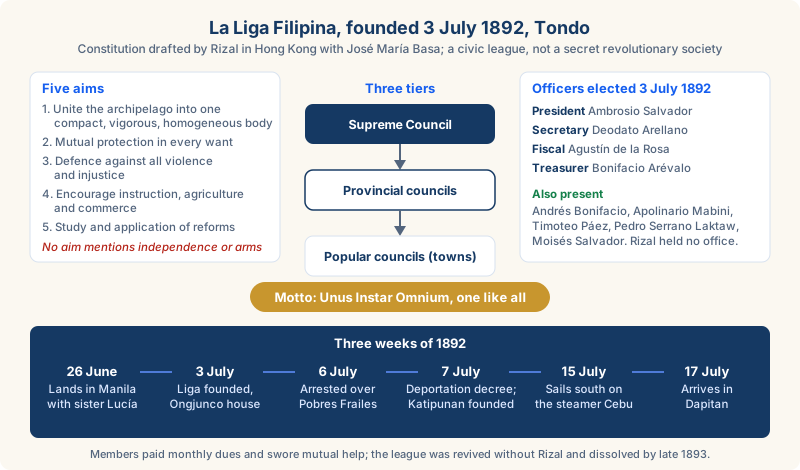
On the night of 3 July 1892, at Doroteo Ongjunco's house on Ilaya Street, Tondo, he presented the constitution of La Liga Filipina, drafted in Hong Kong with José María Basa, the exile of 1872. The Liga was a civic league, neither secret nor revolutionary. Its five aims were: to unite the whole archipelago into one compact, vigorous and homogeneous body; mutual protection in every want and necessity; defence against all violence and injustice; encouragement of instruction, agriculture and commerce; and the study and application of reforms. Its motto was Unus Instar Omnium, "one like all". It had three tiers: a Supreme Council, provincial councils, and popular councils in the towns.
The officers elected were Ambrosio Salvador, president; Deodato Arellano, secretary; Agustín de la Rosa, fiscal; and Bonifacio Arévalo, treasurer. Among those present were Andrés Bonifacio, a warehouse clerk, Apolinario Mabini, Timoteo Páez, Pedro Serrano Laktaw and Moisés Salvador. Rizal held no office.
3. Arrest, deportation and the birth of the Katipunan
On 6 July 1892 at Malacañang, Despujol confronted Rizal with leaflets titled Pobres Frailes ("Poor Friars"), a satire on the wealth of the religious orders, which customs officers claimed to have found in Lucía's luggage. Rizal denied all knowledge of them; historians generally treat them as planted or at least as a pretext. He was taken to Fort Santiago. The deportation decree, dated 7 July 1892 and published in the Gaceta de Manila, charged him with bringing in anti-friar leaflets, with dedicating El Filibusterismo to the priests executed in 1872, and with writings against religion and the integrity of Spain. On 15 July he sailed on the steamer Cebu, which reached Dapitan on 17 July.
On the same night of 7 July, in a house on Azcarraga Street, Andrés Bonifacio, Deodato Arellano, Teodoro Plata, Ladislao Diwa, Valentín Díaz and José Dizon founded the Katipunan. The Liga was revived without Rizal under Domingo Franco but split: the wealthier members, the Cuerpo de Compromisarios, wanted to keep funding La Solidaridad, while the Katipunan faction wanted separation by force. By late 1893 the Liga had dissolved.
4. Dapitan: the commandant, the Jesuit and the lottery
Dapitan was a quiet town under a politico-military commandant, Captain Ricardo Carnicero. The Jesuits offered Rizal lodging on conditions set by their superior, Father Pablo Pastells: a public retraction of his religious errors, a general confession, and conduct befitting a Spanish subject and a man of religion. Rizal refused and lived in the commandant's house. Carnicero became a friend; Rizal wrote the sonnet A Don Ricardo Carnicero for his birthday, and the two, with a Spaniard named Francisco Equilior, shared a Manila lottery ticket. On 21 September 1892 ticket 9736 won second prize, twenty thousand pesos. Rizal's share was 6,200 pesos; he sent part to his father, part to Basa, and bought land across the bay at Talisay with the rest.
From September 1892 to April 1893 Rizal and Pastells exchanged four long letters each on religion. Pastells argued from authority and revelation; Rizal answered that he believed in God, known through the order of nature and through reason and conscience, that he could not accept dogma imposed by fear. Neither convinced the other. Catholic writers read the letters as proof that Rizal remained a believer open to return, which makes the later retraction plausible; secular historians read them as a settled rationalism that makes it unlikely.
5. The Talisay estate: teacher, engineer, doctor
At Talisay Rizal built the square house where he lived (the Casa Cuadrada), the round house for his pupils (the Casa Redonda), an octagonal clinic hut. He planted coconuts, cacao, coffee, sugar cane and fruit trees. He opened a free school for sixteen to twenty boys and taught reading, writing, Spanish and English, arithmetic, geometry, geography and nature study, with farming, carpentry, swimming and gymnastics. The pupils paid by working the farm, and he wrote them a school song, the Himno a Talisay, which the prosecutor at his trial would cite as subversive.
Dapitan drank from muddy wells. With Father Francisco de Paula Sánchez, his old Ateneo teacher who visited in 1893, Rizal designed a gravity water system that carried spring water through clay and bamboo pipes to a fountain in the town, finished in 1895 with local labour and almost no money. An American engineer, H. F. Cameron, later called it remarkable for a man with no engineering training, few tools and no budget. Rizal also drained marshes against malaria, lit the streets with coconut-oil lamps, and with Sánchez built a large relief map of Mindanao in the plaza, which still exists.
As a doctor he treated the townspeople free and charged the wealthy who came from Manila and abroad. His mother and sister Trinidad joined him in August 1893, and he operated on his mother's cataract. Among his foreign patients was George Taufer, a blind American resident of Hong Kong, who arrived in February 1895 with his adopted daughter, Josephine Bracken.
6. Scientist, artist and poet in exile
Rizal collected shells, insects, reptiles and plants for the Dresden museum of his friend Adolf Bernhard Meyer, who sent books and instruments in return. Three species were named for him: a flying lizard, Draco rizali; a beetle, Apogonia rizali; and a frog, Rhacophorus rizali.
He also sculpted. When a crocodile killed his dog he carved The Mother's Revenge, a mother dog attacking the crocodile that took her pup, often read as an allegory of the motherland. He made a bust of Father José Guerrico and a figure called Oyang Dapitana. His poems include Mi Retiro ("My Retreat"), written in 1895 at his mother's request, and the Himno a Talisay. The Canto del Viajero is placed by some in Dapitan and by others in 1896; its date is not settled.
7. Josephine Bracken
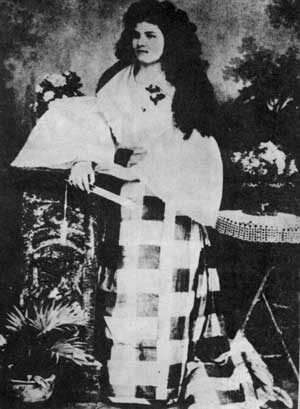
Josephine Bracken was born in Hong Kong in 1876 to an Irish soldier and raised by George Taufer after her mother died. Rizal could do little for Taufer's eyes, but he and Josephine fell in love within weeks. Rizal asked the parish priest, Father Antonio Obach, to marry them; Obach needed the Bishop of Cebu's permission, which was made to depend on Rizal retracting his religious writings. He refused. Josephine left briefly with Taufer, then returned, and from mid-1895 the two lived at Talisay as husband and wife. In 1896 she gave birth prematurely to a son who lived only hours; Rizal named him Francisco after his father and buried him on the estate. In his last poem he called her "dulce extranjera", sweet stranger.
8. Valenzuela's visit and the road to Cuba
By 1896 the Katipunan was preparing to rise. In June its Supreme Council sent Dr Pío Valenzuela to Dapitan to inform Rizal and seek his support. He arrived on 21 June aboard the Venus with a blind man, Raymundo Mata, as a pretext for consulting the eye doctor. What Rizal said is disputed. Questioned by the Spanish after the Revolution broke out, Valenzuela said Rizal had opposed the uprising absolutely. In his memoirs years later he said Rizal had not opposed revolution in principle but insisted the people were unprepared, that a rising without arms and money would be a massacre, that the wealthy and educated should first be won over, and that a trained commander, Antonio Luna, should be secured. Both accounts agree that Rizal refused to endorse an immediate rising; the prosecution still used the visit as proof that he led the movement.
Rizal had already sought a way out of Dapitan that did not involve rebellion. Yellow fever was killing Spanish troops in Cuba, where another colonial revolution had begun, and on 17 December 1895 he wrote to Governor-General Ramón Blanco offering to serve there as a volunteer army doctor. Blanco's acceptance, dated 1 July 1896, reached Dapitan on 30 July. On 31 July 1896 Rizal sailed on the España with Josephine, his sister Narcisa, a nephew and three pupils. He had spent four years and two weeks in Dapitan.
Key terms
| Term | Meaning |
|---|---|
| La Liga Filipina | Civic league Rizal founded on 3 July 1892 in Tondo for unity, mutual protection, education, commerce and reform. |
| Unus Instar Omnium | "One like all", the motto of the Liga. |
| Supreme, provincial and popular councils | The three tiers of the Liga, national body down to the towns. |
| Pobres Frailes | Anti-friar leaflets allegedly found in Lucía Rizal's luggage, the pretext for the arrest of 6 July 1892. |
| Decree of 7 July 1892 | Despujol's order deporting Rizal to Mindanao, published in the Gaceta de Manila. |
| Katipunan | Secret revolutionary society founded by Bonifacio and five others on 7 July 1892. |
| Cuerpo de Compromisarios | Faction of the revived Liga that preferred to keep funding the reform campaign in Spain. |
| Talisay | Land across the bay from Dapitan bought with the lottery share; home, farm, school and clinic. |
| Casa Cuadrada and Casa Redonda | The square house where Rizal lived and the round house for his pupils. |
| Draco rizali | Flying lizard named after Rizal; also Apogonia rizali (beetle) and Rhacophorus rizali (frog). |
| Mi Retiro | Rizal's 1895 poem on his Dapitan life, written for his mother. |
| Valenzuela mission | Pío Valenzuela's June 1896 visit seeking Rizal's endorsement of the uprising, which he refused. |
Guided readings
Reading 1: The aims of La Liga Filipina
Source: Opening article of the constitution of La Liga Filipina, presented in Tondo on 3 July 1892 (translated).
The aims of this association are: to unite the whole archipelago into one compact, vigorous and homogeneous body; mutual protection in every want and necessity; defence against all violence and injustice; encouragement of instruction, agriculture and commerce; and the study and application of reforms.
- Sort the five aims: one political (unity), two protective, two developmental. None mentions independence or arms.
- Ask why the authorities still treated the Liga as dangerous; consider "unite" in a colony governed by keeping provinces apart.
- Compare these aims with the Katipunan's goal of separation, and note which men attended both foundings.
Takeaway: The Liga was national self-organisation within the law, and the colonial state could not tolerate even that.
Reading 2: Rizal to Father Pastells on belief
Source: Rizal's letters to Father Pablo Pastells, Dapitan, 1892–1893 (close paraphrase of the main argument).
Rizal told Pastells that he had not lost his belief in God; that he read the Creator in the order and beauty of nature; that reason and conscience were the lights God had given man and he could not put them out at another's command; and that a faith accepted only out of fear of punishment was submission, not faith.
- List the sources of religious knowledge Rizal accepts: nature, reason, conscience. Note the one he rejects: authority enforced by fear.
- Identify what Pastells wanted, a public retraction, and why this letter made it impossible in 1892.
- Keep the passage for the retraction debate in the final topic.
Takeaway: In Dapitan Rizal called himself a believer in God who rejected imposed dogma, a position both sides of the retraction debate claim.
Reading 3: Mi Retiro
Source: Opening of Rizal's poem Mi Retiro (My Retreat), Dapitan, 1895, in a plain prose rendering.
Beside a spacious beach of fine and delicate sand, at the foot of a mountain greener than a leaf, I planted my humble hut beneath a pleasant orchard, seeking in the still forest repose for my weary mind and silence for my sorrow.
- Place the hut: the beach is Talisay, the mountain the hills where the spring for the water system rose.
- Notice the mood: rest, not rebellion, in the very years the Katipunan used his name.
- Ask whether the poem is resignation or contentment.
Takeaway: Dapitan gave Rizal a settled, useful life; the poem explains why he could call his exile a retreat rather than a prison.