Arrest, trial and martyrdom, 1896
From the voyage to Cuba to Bagumbayan: the arrest, Fort Santiago, the charges and the court martial, the Manifesto, Mi último adiós, and 30 December 1896.
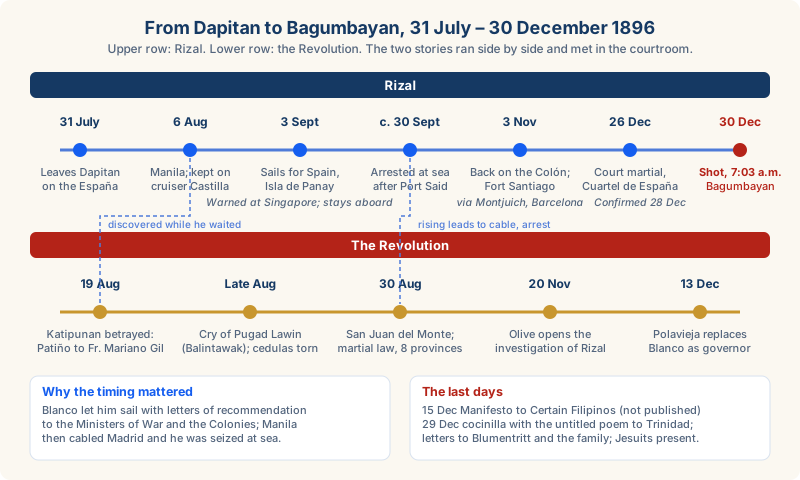
Five months from Dapitan to Bagumbayan
Rizal left Dapitan on 31 July 1896 a free man with a government commission in his pocket. Five months later he was dead on the Luneta. In between, the Katipunan was discovered, the Revolution began, and a colonial government that had accepted him as a volunteer doctor decided that the exile who had refused to join the uprising was its "living soul".
- 6 August 1896 – reaches Manila on the España; the Cuba mail boat has gone, so he is kept aboard the cruiser Castilla in Manila Bay.
- 19 August – the Katipunan is betrayed to Father Mariano Gil in Tondo.
- Late August – the Cry of Pugad Lawin; on 30 August martial law is declared in eight provinces.
- 3 September – sails for Spain on the Isla de Panay with Blanco's letters of recommendation.
- About 30 September – arrested aboard after Port Said, by cable from Manila.
- Early October – Barcelona; held at Montjuich; put aboard the Colón for Manila on 6 October.
- 3 November – Fort Santiago. 20 November – preliminary investigation by Colonel Francisco Olive begins.
- 13 December – Polavieja replaces Blanco. 15 December – Rizal's Manifesto to Certain Filipinos.
- 26 December – court martial at the Cuartel de España. 28 December – Polavieja confirms the death sentence.
- 30 December 1896, 7:03 a.m. – shot at Bagumbayan.
1. Manila Bay and the discovery of the Katipunan
The España reached Manila on 6 August 1896. The monthly mail steamer for Spain had left the day before, so Governor-General Ramón Blanco kept Rizal, as a courtesy and a precaution, aboard the cruiser Castilla anchored off Cavite. He waited nearly a month.
While he waited the secret was lost. On 19 August Teodoro Patiño, a Katipunan member working at the Diario de Manila printing press, told his sister, who told the nuns, who sent him to Father Mariano Gil, the Augustinian parish priest of Tondo. Gil went to the police; the press was searched, and arrests began that night. Bonifacio gathered the members outside the city and, in the last week of August at Pugad Lawin or Balintawak (the place and the exact day are still argued), they tore up their cedulas and resolved to fight. On 30 August the Katipuneros attacked the powder magazine at San Juan del Monte and were beaten off; that evening Blanco placed Manila and seven neighbouring provinces, Cavite, Laguna, Batangas, Bulacan, Pampanga, Tarlac and Nueva Ecija, under martial law. Hundreds of suspects were jailed, among them several Liga men of 1892.
2. The voyage, the warnings and the arrest at sea
Blanco let Rizal go. On 3 September he sailed on the Isla de Panay carrying two letters from the governor, to the Minister of War and the Minister of the Colonies, stating that Rizal had behaved well in Dapitan and was in no way connected with the uprising. At Singapore, Filipino friends urged him to leave the ship and stay in British territory, as Pedro Roxas, a fellow passenger, did. Rizal refused; he had Blanco's safe conduct and his word, and he would not act like a guilty man.
The decision was fatal. While he was at sea Manila cabled Madrid, and after the ship passed Port Said the captain was ordered to confine him to his cabin as a prisoner. On reaching Barcelona at the start of October he was lodged in the fortress of Montjuich. The Captain-General of Catalonia was Eulogio Despujol, who had deported him in 1892; he had Rizal put aboard the transport Colón, sailing on 6 October with troops bound for the Philippine war. The Colón reached Manila on 3 November, and Rizal was taken to Fort Santiago.
3. Investigation and charges
On 20 November Colonel Francisco Olive opened the preliminary investigation. For five days Rizal was questioned; he was not allowed counsel or to confront those whose statements were read against him. The case was then passed to a judge advocate, Captain Rafael Domínguez, and the case went to a court martial. The charges were founding illegal associations and inciting rebellion, with the prosecution's claim that Rizal was the "principal organizer and the living soul of the Filipino insurrection".
The evidence was of three kinds. First, his writings: the novels, the annotations to Morga, poems including the Himno a Talisay, and his letters to the propagandists in Europe. Second, the Liga of 1892, treated as the parent of the Katipunan. Third, testimony: statements by arrested Katipuneros, several of them obtained under torture, that Rizal was the society's honorary president, that his portrait hung in its meeting places and that his name was its password, together with Pío Valenzuela's account of the Dapitan visit. None of the witnesses claimed that Rizal had ordered or planned the uprising; the prosecution's argument was that he had created the ideas and the organisation from which it grew.
4. The defender and the court
Under military law Rizal could choose a defender only from a list of Spanish army officers. He picked Lieutenant Luis Taviel de Andrade, the brother of José Taviel de Andrade, the officer who had been his bodyguard and friend during the Calamba visit of 1887. Taviel de Andrade took the task seriously and argued that the court was trying ideas, not acts.
The court martial met on 26 December 1896 in the hall of the Cuartel de España in Intramuros. Seven officers sat on it, presided over by Lieutenant Colonel José Togores Arjona. Lieutenant Enrique de Alcocer prosecuted and asked for death; Captain Domínguez acted as judge advocate. Rizal, his elbows bound, listened and then read a statement he had prepared in his cell, the Additions to my defence. Its twelve points included: that he had advised Valenzuela against the uprising; that he had had no correspondence with the Katipunan since 1892; that he could have escaped at Singapore and did not; that if he had led the rising he would not have been in Dapitan or on his way to Cuba; that the Liga was a civic society that died within months; that he had lived an exemplary life in exile; and that his writings called for reform, not war. The court deliberated briefly and found him guilty. Polavieja, who had replaced Blanco as governor-general on 13 December, confirmed the sentence on 28 December and ordered the execution for the morning of the 30th.
5. The last days
Rizal spent 29 December writing and receiving visitors. His mother came, and his sisters, in turn; his brother Paciano was in the field with the revolutionaries and could not. To his sister Trinidad, who spoke English, he handed an alcohol cooking stove, a cocinilla, saying softly in English that there was something inside. Hidden in it was a folded sheet with an untitled poem of fourteen five-line stanzas. The family later gave it the title by which it is known, Mi Último Adiós; it was printed in Hong Kong in 1897, and Andrés Bonifacio made the first Tagalog translation, Pahimakas.
He wrote to Ferdinand Blumentritt, his "dear brother", that he would be shot at seven the next morning and was innocent of rebellion. He wrote to his family asking them to forgive those who had wronged him and to bury him in the ground with a stone and a cross, his name, the dates of his birth and death, and nothing more. Jesuit priests from the Ateneo, among them Fathers Vicente Balaguer, José Vilaclara and Estanislao March, visited through the day and night; according to Balaguer, Rizal signed a retraction of his religious writings late that night and married Josephine Bracken canonically shortly before dawn. Both claims are disputed, and the next topic examines the document and the arguments.
6. Bagumbayan, 30 December 1896
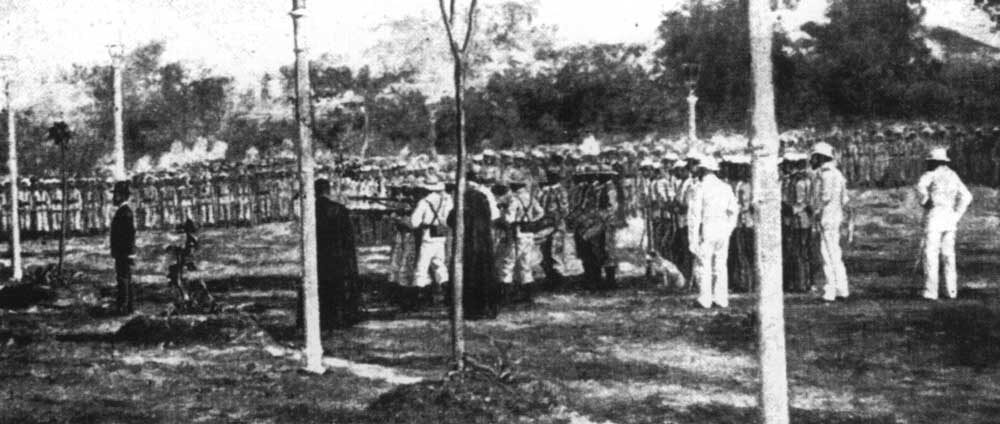
At half past six the procession left Fort Santiago: Rizal in black with his arms tied behind him, Taviel de Andrade at his side, Fathers March and Vilaclara, and a column of soldiers. They walked to the field of Bagumbayan, now Rizal Park, where a square of troops and a large crowd waited. A Spanish military doctor, Felipe Ruiz Castillo, asked to take his pulse and found it normal. Rizal asked to face the firing squad and was refused; a traitor was shot in the back. He asked that his head be spared, and that was granted.
The firing squad was Filipino, soldiers of the regular colonial army, with a line of Spanish troops behind them to fire on them if they wavered. At 7:03 a.m. the volley was fired. Rizal twisted as he fell so that he came to rest on his back, facing the sky. Witnesses reported his last words as Consummatum est, "it is finished", the words of Christ on the cross.
The body was not given to the family. It was buried secretly in the Paco cemetery, without a coffin, in unconsecrated ground. Narcisa Rizal searched the cemeteries that day, saw guards at Paco and freshly turned earth, and persuaded the keeper to let her mark the place with a small plaque bearing the initials in reverse, R.P.J. In August 1898, after the Americans took Manila, the family exhumed the remains; and on 30 December 1912 they were carried in procession to the base of the Rizal Monument on the Luneta, where they lie today.
7. Reading Mi Último Adiós
The poem is a farewell in fourteen stanzas. The first stanza salutes the beloved country, "pearl of the Orient seas", and offers a life that the poet would give even if it were brighter and fresher. Stanzas two to four place his death beside the deaths of those who fight and those who are tortured and executed, and say he dies without regret if his blood helps to colour the dawn of freedom. The middle stanzas imagine his grave: a flower growing over it, the moon, the dawn, the wind and a bird singing peace. He asks the country to pray for all who have died, suffered or been betrayed, and for itself. The closing stanzas take leave of parents, brothers and sisters, childhood friends, the "sweet stranger" who was his friend and joy, and everything he loved, and end with the line that he goes where there are no slaves, hangmen or oppressors, where faith does not kill, and where God alone reigns. In 1902 Representative Henry A. Cooper read the poem to the United States House of Representatives in the debate on the Philippine Bill, arguing that a people who could produce such a man deserved self-government.
Key terms
| Term | Meaning |
|---|---|
| Castilla | The Spanish cruiser in Manila Bay where Rizal was kept from 6 August to 2 September 1896 while awaiting the boat to Spain. |
| Teodoro Patiño | The Katipunan member whose confession to Father Mariano Gil on 19 August 1896 exposed the society. |
| Cry of Pugad Lawin | The tearing of cedulas and resolve to fight in late August 1896; the place and date are debated. |
| Isla de Panay | The steamer on which Rizal sailed for Spain on 3 September 1896 and aboard which he was arrested after Port Said. |
| Francisco Olive | The colonel who conducted the preliminary investigation from 20 November 1896. |
| Luis Taviel de Andrade | The Spanish lieutenant Rizal chose as defender, brother of his 1887 bodyguard. |
| José Togores Arjona | Lieutenant colonel who presided over the court martial of 26 December 1896. |
| Enrique de Alcocer | The prosecuting attorney who demanded the death penalty. |
| Camilo de Polavieja | Governor-general from 13 December 1896 who confirmed the death sentence on 28 December. |
| Manifesto to Certain Filipinos | Rizal's statement of 15 December 1896 condemning the uprising, which the judge advocate refused to publish. |
| Cocinilla | The alcohol stove in which Rizal hid his last poem and handed to his sister Trinidad. |
| Mi Último Adiós | The title later given to the untitled fourteen-stanza farewell poem; Bonifacio's Tagalog version is Pahimakas. |
| Bagumbayan | The field outside Intramuros, now Rizal Park, where Rizal was shot at 7:03 a.m. on 30 December 1896. |
| R.P.J. | Rizal's initials reversed, the marker Narcisa placed on the unmarked grave at Paco. |
Guided readings
Reading 1: The first stanza of Mi Último Adiós
Source: Rizal's farewell poem, in Charles Derbyshire's English translation of 1911, which is in the public domain.
Farewell, dear Fatherland, clime of the sun caress'd,
Pearl of the Orient seas, our Eden lost!
Gladly now I go to give thee this faded life's best,
And were it brighter, fresher, or more blest,
Still would I give it thee, nor count the cost.
- Identify the addressee: not God, not family, but the country, which the whole poem treats as a person.
- Note the two images for the Philippines, "pearl of the Orient seas" and "Eden lost", and what each claims.
- Weigh "faded life" against "gladly": the poet calls his own life spent and still offers it without regret.
Takeaway: The opening sets the poem's argument, that a life freely given for the country is a gift, not a loss.
Reading 2: The last letter to Blumentritt
Source: Rizal to Ferdinand Blumentritt, Fort Santiago, 29 December 1896 (translated).
My dear brother: when you receive this letter I shall be dead. Tomorrow at seven I shall be shot; but I am innocent of the crime of rebellion. I am going to die with a tranquil conscience.
- Note the tone: no appeal, no complaint, a plain statement of fact to his closest friend.
- Read "innocent of the crime of rebellion" against the charges: he denies the act, not his ideas.
- Connect "tranquil conscience" with the doctor's finding of a normal pulse the next morning.
Takeaway: To the end Rizal insisted on the distinction the court refused to make, between advocating reform and leading a revolt.
Reading 3: The Manifesto to Certain Filipinos
Source: Rizal's manifesto of 15 December 1896, written in Fort Santiago at the suggestion of his defender; plain translation of its central passage.
I have given proofs that I desire liberties for our country as much as anyone, and I still desire them. But I set as a condition the education of the people, so that they might have a character of their own and make themselves worthy of those liberties. I condemn this absurd and savage uprising, which dishonours us Filipinos.
- Separate the two claims: he wants liberty; he condemns this rising. Ask which the Spanish authorities heard.
- Find the condition, education first, and compare it with Father Florentino's speech in El Filibusterismo.
- Explain why the judge advocate thought the document would help the rebels rather than hurt them.
Takeaway: The Manifesto condemns the method and timing of the Revolution, not its goal, which is why it saved neither Rizal nor the Revolution from the other.