Noli Me Tángere
Rizal's first novel: how it was written and printed in Berlin in 1887, its plot and characters, what they stand for, and why Spain and the friars condemned it.
A novel that touched the wound
Noli Me Tángere turned a medical student into the most dangerous Filipino in the eyes of the friars, and it is why Republic Act 1425 orders schools to teach the unexpurgated novels: they, not the essays or poems, carried Rizal's diagnosis of colonial society to ordinary readers.
- 2 January 1884 – at the Paterno house in Madrid, Rizal proposes a novel written jointly by the Filipinos; the plan dies and he writes alone.
- 1884–1887 – written in Madrid, Paris and Berlin; the manuscript is dated 21 February 1887.
- 21 March 1887 – 2,000 copies come off the press of the Berliner Buchdruckerei-Actiengesellschaft, paid for with 300 pesos lent by Máximo Viola.
- August 1887 – Rizal comes home; Governor-General Terrero assigns Lieutenant José Taviel de Andrade as his bodyguard.
- December 1887 – the Permanent Commission of Censorship, in a report by Fr. Salvador Font, recommends a ban.
1. How the novel came to be written
The Noli began as a group project that never happened. On 2 January 1884, at the Paterno house in Madrid, a gathering that included the Paterno brothers, Graciano López Jaena, Eduardo de Lete, Julio Llorente and Valentín Ventura agreed to Rizal's proposal to write a novel about the Philippines together. The others preferred to write about women and love affairs, so Rizal wrote the whole book himself. He named Harriet Beecher Stowe's Uncle Tom's Cabin as his model: a story that exposes an evil so vividly that readers can no longer pretend not to see it.
He wrote the first half in Madrid in 1884 and 1885, continued in Paris while studying under the eye doctor Louis de Wecker, and finished in Berlin in the winter of 1886–1887.
2. Printing in Berlin: Viola and the 2,000 copies
Máximo Viola, a fellow medical graduate from Bulacan, reached Berlin in December 1886 with money for a European tour and found Rizal ill and nearly destitute. He insisted on lending the cost of printing. Rizal chose the cheapest printer, the Berliner Buchdruckerei-Actiengesellschaft, which printed 2,000 copies for 300 pesos. To cut the bill he dropped a whole chapter, Elías y Salomé, which was published only long after his death. The book came off the press in March 1887; 21 March is the date usually given. Viola is the saviour of the Noli; Valentín Ventura is the saviour of the Fili. Do not swap them.
The book has sixty-three chapters and an epilogue.
3. The title and the dedication
The title is Latin for touch me not, the words of the risen Christ to Mary Magdalene in John 20:17. Rizal chose them because the novel describes a cancer so painful that no one dares touch it. In a March 1887 letter to the painter Félix Resurrección Hidalgo he attributed the phrase to the Gospel of Luke, a slip examiners enjoy; the correct citation is John.
The dedication, headed To my Fatherland and dated Europe 1886, compares the Philippines to a patient with a social cancer. Like the ancients who laid their sick on the temple steps so that every passer-by could suggest a cure, Rizal will lift the veil that hides the evil and sacrifice everything, even his self-love, to the truth. Social cancer became the title of Charles Derbyshire's 1912 English translation, used in Philippine schools for decades.
4. The story, in order
Plot items test sequence. The town is San Diego, a lakeside town modelled on Calamba; the lake is Laguna de Bay.
The return. The novel opens at a dinner given by Capitán Tiago at his house on Anloague Street, Binondo, for Juan Crisóstomo Ibarra, son of the wealthy Don Rafael, back after seven years in Europe. Padre Dámaso, Franciscan and former curate of San Diego, insults him. Ibarra then learns from Lieutenant Guevara of the Guardia Civil how his father died: Don Rafael struck a Spanish tax collector who was beating a boy, the man fell and died, and Don Rafael was jailed while his enemies added charges of heresy and subversion. He died in prison. Dámaso had the body dug up to be moved to the Chinese cemetery, and the gravedigger threw it into the lake.
María Clara and the school. Ibarra visits his betrothed María Clara, daughter of Capitán Tiago, then decides to honour his father's wish by building a school in San Diego, consulting the old scholar Pilosopo Tasio. On a fishing excursion the boatman Elías kills a crocodile with Ibarra's help.
Sisa and her sons. Beside the main plot runs the story of Sisa, whose sons Basilio and Crispín serve as sacristans. The sacristan mayor accuses Crispín of stealing two gold coins; Basilio escapes, hears a shot and a scream, and Crispín is never seen again. Sisa is arrested, released, and loses her mind.
The cornerstone and the dinner. At the fiesta the derrick over the school's cornerstone is rigged to fall on Ibarra; Elías, who warned him, stands at the winch, and the hired killer is crushed instead. At dinner Dámaso insults Don Rafael's memory and Ibarra pins him to the table with a knife, stopped only by María Clara. Ibarra is excommunicated; the Captain-General has it lifted, but María Clara falls ill and Dámaso arranges her engagement to Alfonso Linares, a Spaniard brought over by Doña Victorina.
The sham uprising. Lucas, brother of the dead killer, recruits men to attack the barracks in Ibarra's name. Padre Salví, the new curate, who covets María Clara, exposes the plot at the last moment and is hailed as saviour. Ibarra is arrested; a letter of his, taken from María Clara, is the evidence. She gave it up in exchange for letters proving that her real father is Dámaso, to protect the name of her dead mother, Pía Alba.
The escape and the forest. Elías frees Ibarra and they flee by boat on Christmas Eve. Chased by a Guardia Civil launch, Elías dives in to draw the fire while Ibarra hides. Wounded, Elías reaches the Ibarra forest, where Basilio has just found Sisa dead. He tells the boy to burn the bodies and dig up the treasure, and dies as dawn breaks, asking those who will see the dawn not to forget those who fell in the night.
The convent and the epilogue. Told that Ibarra is dead, María Clara refuses Linares and threatens to throw herself from the azotea unless she may enter the convent of Santa Clara; Dámaso gives in. The epilogue reports Dámaso found dead in a distant province, Capitán Tiago lost to opium, and Salví chaplain of Santa Clara, where on a stormy night guards see a young nun weeping on the roof.
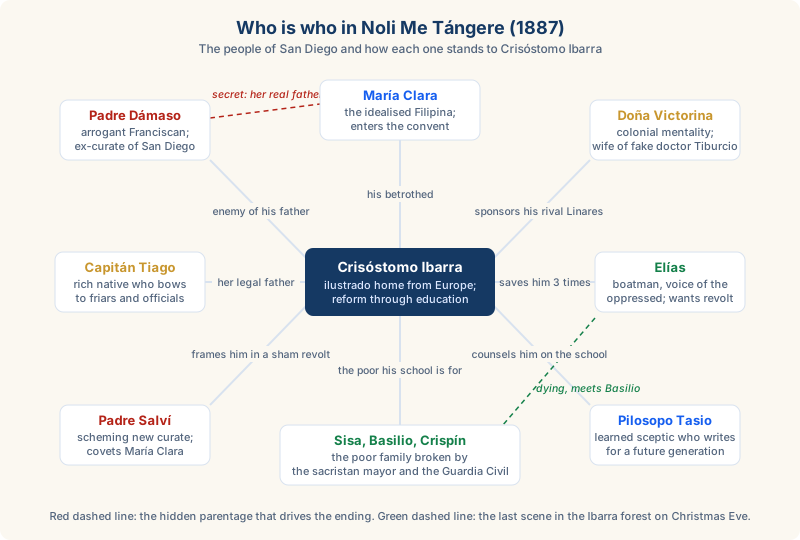
5. The people of San Diego
Character items ask who did something or what a character represents. Learn both.
| Character | Who they are | What they stand for |
|---|---|---|
| Juan Crisóstomo Ibarra | Ilustrado back from Europe; wants a school | The educated Filipino who trusts reform from above; often read as Rizal |
| Elías | Boatman and fugitive whose family was ruined by Ibarra's great-grandfather | The suffering masses; the voice that says reform is not enough |
| María Clara | Daughter of Capitán Tiago by law, of Dámaso by blood | The idealised Filipina, linked to Leonor Rivera; some read her as a critique of convent-bred passivity |
| Padre Dámaso | Franciscan, former curate of San Diego | Friar arrogance and power over native families |
| Padre Salví | Franciscan, new curate; stages the uprising | Friar hypocrisy and cunning |
| Capitán Tiago | Rich native landowner | The wealthy Filipino who buys safety by pleasing friars and officials |
| Doña Victorina and Don Tiburcio | Filipina who apes the Spaniard; her lame husband who poses as a doctor | Colonial mentality and quackery |
| The alférez and Doña Consolación | Guardia Civil commander and his cruel wife who denies knowing Tagalog | Military abuse; colonial self-hatred |
| Sisa, Basilio, Crispín | A mother and her sacristan sons | The poor crushed between Church and Guardia Civil; Sisa as the motherland |
| Pilosopo Tasio | Old scholar who writes for a future generation | The enlightened mind no one heeds; linked to Paciano Rizal |
Tradition names models for others: Doña Victorina on a Manila woman known for her airs, Basilio and Crispín on two sacristan brothers from Hagonoy, Sisa's arrest on the humiliation of Rizal's own mother. Padre Fernández, the friar who argues fairly with a student, belongs to the Fili, not the Noli.
6. Elías and Ibarra: reform or revolution
The intellectual heart of the book is two conversations, one in a boat on the lake and one after the arrest. Elías asks Ibarra to demand radical change: curb the Guardia Civil, reform the friars, give the people justice. Ibarra answers that reforms must come from above to be valid and that the people are not ready for freedom. Elías replies that in three centuries little has come from above, and that a people kept in ignorance cannot be blamed for not being ready. After prison Ibarra embraces the name of filibuster his enemies gave him; Elías warns against a revolt of hatred.
7. Themes and symbols
The social cancer is the governing image: abuses in Church, state and society that feed on each other. The lake swallows Don Rafael's body and, supposedly, Ibarra; the forest hides the treasure and receives Elías and Sisa; Christmas Eve frames an ending that promises a dawn not yet come; the school is Ibarra's whole programme; the convent buries María Clara alive. Themes the board names: friar domination of town and family, the Guardia Civil as terror, colonial mentality in Doña Victorina and Doña Consolación, abuse of the confessional, denial of education, and the corruption of the native elite in Capitán Tiago.
8. Reception: the storm the book raised
Governor-General Emilio Terrero asked the Dominican faculty of the University of Santo Tomás for an opinion; it condemned the book as heretical, impious and scandalous in religion and subversive in politics. The Permanent Commission of Censorship, in a report by the Augustinian Fr. Salvador Font, recommended that its importation, reproduction and circulation be absolutely forbidden. When Rizal arrived in August 1887, Terrero summoned him to Malacañang, asked for a copy and assigned Lieutenant José Taviel de Andrade as his bodyguard. Taviel became a friend; his brother Luis would defend Rizal at his trial nine years later.
The pamphlet war lasted years. The Augustinian Fr. José Rodríguez published Caiingat Cayo (Beware), calling the reading of the Noli a mortal sin; Marcelo H. del Pilar answered with the parody Caiigat Cayo (Be as slippery as an eel). Vicente Barrantes attacked the novel in a Madrid journal in 1890 and Rizal replied in La Solidaridad. The Filipino priest Fr. Vicente García and Rizal's Ateneo teacher, the Jesuit Fr. Francisco de Paula Sánchez, defended it.
Key terms
| Term | Meaning |
|---|---|
| Noli me tángere | Latin, touch me not; words of the risen Christ to Mary Magdalene, John 20:17 |
| Social cancer | The dedication's image for colonial society; title of Derbyshire's 1912 translation |
| Berliner Buchdruckerei-Actiengesellschaft | Berlin printer of the 2,000 copies for 300 pesos |
| Saviour of the Noli | Máximo Viola, who lent the printing money |
| Elías y Salomé | Chapter cut to save printing cost, published after Rizal's death |
| Permanent Commission of Censorship | Body whose report by Fr. Salvador Font recommended the ban |
| Caiingat Cayo | Fr. José Rodríguez's pamphlet against the novel; parodied by del Pilar's Caiigat Cayo |
| Filibustero | Colonial label for a subversive; Ibarra embraces it after his arrest |
Guided readings
Three passages carry most of the quotation items set on this novel.
Reading 1: The dedication
Source: José Rizal, Noli Me Tángere (1887), dedication To my Fatherland, in Charles Derbyshire's translation The Social Cancer (1912), public domain.
Recorded in the history of human sufferings is a cancer of so malignant a character that the least touch irritates it and awakens in it the sharpest pains. ... I will do with thee what the ancients did with their sick, exposing them on the steps of the temple so that every one ... might offer them a remedy.
- What is the cancer, and why does the least touch cause pain? Connect this to the title.
- What does the image of the sick on the temple steps say about the purpose of the novel?
- Why is the dedication dated Europe 1886 when the book was printed in 1887?
Takeaway: The dedication states the method of the whole book: expose the disease so that it can be treated.
Reading 2: Elías and Ibarra on the lake
Source: Noli Me Tángere, chapter 49, The Voice of the Hunted, close paraphrase of Derbyshire's translation; the dialogue is too long to quote in full.
Elías asks Ibarra to plead for radical reforms: restraint of the Guardia Civil, respect for the dignity of the people, and a clergy that serves rather than rules. Ibarra answers that the people are like children who would misuse freedom and that reforms must come from above. Elías replies that three centuries have passed and nothing has come from above.
- List the reforms Elías asks for. Which did the Propaganda Movement later demand in print?
- What assumption about the people does Ibarra make, and how does Elías answer it?
- How does Ibarra's position change after his arrest and escape?
Takeaway: The novel stages the reform-or-revolution argument that runs through Rizal's career. Know the two positions, who holds each, and that Ibarra moves toward Elías by the end.
Reading 3: The death of Elías
Source: Noli Me Tángere, chapter 63, Christmas Eve, Derbyshire's translation (1912), public domain.
I die without seeing the dawn brighten over my native land! You, who have it to see, welcome it – and forget not those who have fallen during the night!
- Who is Elías speaking to, and where are they?
- What is the dawn, and why is it placed on Christmas Eve?
- Why do examiners sometimes wrongly attribute these words to Ibarra or to Rizal himself?
Takeaway: The most quoted line of the novel belongs to Elías, is spoken to Basilio in the Ibarra forest on Christmas Eve, and asks the coming generation to remember those who suffered before freedom came.