Rizal as national hero: debates and legacy
How Rizal became the national hero, the retraction controversy, Rizal versus Bonifacio, the 'American-sponsored hero' thesis, and his place in Filipino life today.
A hero made, or a hero chosen?
Within two years of the execution Filipinos were marking 30 December as a day of mourning, and within twenty a bronze Rizal stood on the Luneta where he fell. Yet three questions keep returning: did the Americans pick him as a safe hero, should Bonifacio stand in his place, and did he retract on his last night? This topic traces the commemoration, lays each dispute out as a debate, and closes with his political thought.
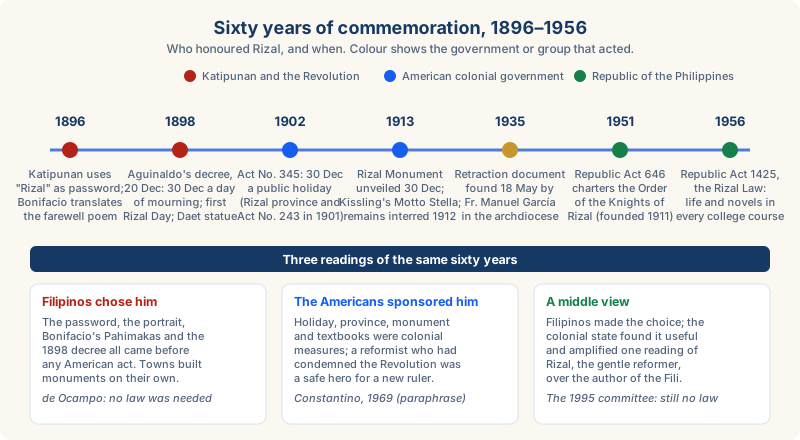
- 20 December 1898 – Aguinaldo's decree makes 30 December a national day of mourning; first Rizal Day ten days later.
- 11 June 1901 – Rizal province created. 28 September 1901 – Act No. 243 authorises a monument on the Luneta.
- 1 February 1902 – Act No. 345 of the Philippine Commission makes 30 December a public holiday.
- 30 December 1913 – Rizal Monument unveiled.
- 18 May 1935 – the retraction document is found in the Manila archdiocesan archives.
- 14 June 1951 – Republic Act 646 charters the Order of the Knights of Rizal.
- 12 June 1956 – Republic Act 1425, the Rizal Law (Topic 1).
- 30 December 1969 – Renato Constantino's Rizal Day lecture, Veneration without Understanding.
1. From mourning to monument
The first acts of commemoration were Filipino. The Katipunan used Rizal's name as a password and hung his portrait in its halls while he lived. Bonifacio translated the farewell poem into Tagalog. On 20 December 1898, in Malolos, President Emilio Aguinaldo decreed that 30 December would be a national day of mourning for Rizal and the other victims of Spanish rule. The first Rizal Day followed on 30 December 1898, and in Daet, Camarines Norte, townspeople finished a stone monument that same month, the earliest anywhere.
The American government then built on what it found. In June 1901 the Philippine Commission created a province named Rizal out of the old Manila and Morong districts. In September 1901 Act No. 243 authorised a monument on the Luneta by public subscription, and in February 1902 Act No. 345 made 30 December a public holiday. The design competition of 1905 to 1907 was won by the Italian sculptor Carlos Nicoli, but the contract went to the second-placed entry, Motto Stella ("guiding star") by the Swiss sculptor Richard Kissling. Rizal's remains were placed in its base on 30 December 1912 and the monument was unveiled on 30 December 1913. His face went onto stamps from 1906 and later onto coins and banknotes, his name onto streets, schools and the park that replaced Bagumbayan.
2. Who made Rizal the national hero?
No law has ever proclaimed Rizal, or anyone, the national hero of the Philippines. The historian Esteban de Ocampo made this point in the 1960s: Rizal's standing rests on commemoration and public regard, not on a statute. A National Heroes Committee drew up criteria in 1995 (one who defines a nation's freedom, shapes its future, and is judged by later generations) and recommended Rizal first among nine names, but its report was never acted on.
The sharper question is whether the Americans chose him. Renato Constantino made the argument in its best-known form in his Rizal Day lecture of 1969. In paraphrase: the American authorities, needing a hero who would not inspire resistance, encouraged the cult of a reformist who had condemned the Revolution and wanted education before liberty, rather than of Bonifacio or Aguinaldo who had fought; the Taft Commission's holidays, monument and school textbooks did the rest; and Filipinos have since venerated Rizal without understanding the limits of his politics. A widely repeated story adds that the commissioners weighed Aguinaldo, Bonifacio, Mabini, del Pilar and Burgos before settling on Rizal, though its documentary basis is thin.
- For the thesis. The holidays, the province, Act No. 243 and the school curriculum were American measures; Rizal had opposed the Revolution and was no threat to the new rulers; a reformist hero suited a colonial government preaching tutelage.
- Against it. The Katipunan used his name as a password and his portrait as an icon before 1896; Bonifacio translated his poem; Aguinaldo's republic made 30 December a day of mourning in 1898, two years before Taft; towns built monuments on their own; the Americans ratified an existing choice rather than making one.
- A middle view. Filipinos chose Rizal; the colonial state found the choice convenient and amplified a particular reading of him, the gentle reformer, over the author of the Fili.
3. Rizal and Bonifacio
Set beside each other, the two men stand for two answers to the same question. Rizal was a Europe-educated ilustrado who wrote in Spanish and asked for reform; when the Revolution came he refused it as premature. Bonifacio was a self-taught warehouse clerk from Tondo who wrote in Tagalog, founded the Katipunan on the night Rizal's deportation was announced, and led the people to arms. Bonifacio Day, 30 November, has been a holiday since 1921, and there have been recurring proposals to name him the national hero, or the first among several.
Those who prefer Bonifacio argue that a nation born of revolution should honour the man who began it, and that Rizal's choice flatters the educated class. Those who keep Rizal reply that his writings created the nation Bonifacio fought for, that the Katipunan itself honoured him, and that a hero who died for ideas without taking up arms is a rare and useful model. Many historians now read the two as stages of one movement: the Propaganda created the idea, the Katipunan acted on it, and Bonifacio read both novels.
4. The retraction controversy
On the morning of 30 December 1896 the Diario de Manila printed a statement said to have been signed by Rizal in his cell the night before. In translation it reads: "I declare myself a Catholic, and in this religion in which I was born and educated I wish to live and die. I retract with all my heart whatever in my words, writings, publications and conduct has been contrary to my character as a son of the Catholic Church." It goes on to abominate Masonry and authorises the archbishop to publish it. It is dated 29 December 1896 and signed by Rizal and two witnesses, Juan del Fresno, chief of the picket, and Eloy Moure, adjutant of the plaza.
The fullest account is that of Father Vicente Balaguer, a Jesuit who said he argued with Rizal through 29 December, that Rizal rejected the archbishop's long formula, accepted a shorter one by Father Pío Pi, wrote and signed it before midnight, confessed, received communion, and married Josephine Bracken canonically before he was led out. The original was not seen again for nearly forty years. On 18 May 1935 Father Manuel García, a Vincentian, found it in the archdiocesan archives of Manila, and it has been the centre of the argument ever since.
- Against. The texts printed in 1896 and 1897 differ from the 1935 document in wording; the family asked to see the original and were refused; no record of the marriage exists in any parish register, and Josephine later called herself his widow without one; the farewell poem, written the same night, contains no hint of recantation; Balaguer's account is uncorroborated in its details and he alone describes the marriage; Ricardo Pascual's study of the handwriting in 1950 concluded that the document was forged, and Rafael Palma had already argued in his biography that the retraction was out of character.
- For. Several Jesuits who were in Fort Santiago left testimony that agreed on the main point; the two witnesses were real officers of the garrison; other handwriting experts have judged the 1935 document genuine; the Diario de Manila printed the text within hours; Rizal's friends in Manila did not publicly deny it at the time; and a man facing death might make his peace with the Church of his childhood without abandoning his politics.
- Why it matters, and why it may not. Claro M. Recto, the author of the Rizal Law, held that a retraction, genuine or not, would change nothing in Rizal's place in the nation, because the nation honours his life and writings, not his final religious state. For the Church, a genuine retraction reconciles a Catholic son; for anticlerical readers, a forged one proves the friars capable of the deception the novels described.
5. Legacies
Rizal's memory has been kept in many ways. The Order of the Knights of Rizal, begun in 1911 as a civic group, was chartered by Republic Act 646 in 1951 and now has chapters abroad. Among rural folk the memory took religious form: Rizalista movements such as the Iglesia Watawat ng Lahi, and groups on Mount Banahaw, honour him as a saint, a prophet or the "Tagalog Christ" who will return. Film has retold him repeatedly, from Gerardo de León's Noli Me Tangere (1961) and El Filibusterismo (1962), to Marilou Díaz-Abaya's José Rizal (1998) with Cesar Montano for the centennial, to Mike de Leon's Bayaning Third World (2000), about two filmmakers who cannot resolve the retraction. The Rizal Law of 1956 (Topic 1) put his life and novels in every college course.
The places are kept too. Rizal Park in Manila holds the monument and the site of the execution; Fort Santiago has a shrine in the cell where he spent his last days; the reconstructed family house in Calamba, rebuilt in 1950 by the architect Juan Nakpil, is a national shrine; Dapitan preserves the Talisay estate. Abroad there are markers in Heidelberg and Wilhelmsfeld, where he finished the Noli, a monument in Madrid, and others from Hong Kong to Chicago, often raised by Filipino communities.
6. His political thought, and what he might say now
Four ideas run through Rizal's work. First, nationalism: the people of the islands are one nation with a history older than Spain, as his Morga argued. Second, education: liberty is useless, even dangerous, to a people not taught to think, which is why he asked for schools before arms and called the rising of 1896 premature. Third, the dignity of the individual: his novels are a catalogue of humiliations, and his remedy is self-respect, honest work and courage, Elías and Father Florentino rather than Simoun. Fourth, non-violence as a question of timing, not of principle: in the Fili and in the Manifesto he rejected a revolt that would fail and dishonour the cause, not revolt as such.
What would he say today? The question is a reflective exercise, and good answers return to his texts. He would ask whether the schools teach people to think or merely to pass. He would ask whether the ruling class he mocked in Capitan Tiago and Doña Victorina has merely changed its language. He would recognise the overseas Filipino, since he was one. And he would probably be impatient with the veneration itself: the monuments, the holidays, the stamps, which he asked his family not to arrange, and which Constantino rightly said can substitute for understanding.
Key terms
| Term | Meaning |
|---|---|
| Decree of 20 December 1898 | Aguinaldo's order making 30 December a national day of mourning; first Rizal Day 1898. |
| Act No. 345 (1902) | Philippine Commission act making 30 December a public holiday. |
| Act No. 243 (1901) | Authorised the Rizal Monument on the Luneta by public subscription. |
| Motto Stella | Richard Kissling's design, built although Carlos Nicoli won the competition; unveiled 30 December 1913. |
| Veneration without Understanding | Renato Constantino's 1969 Rizal Day lecture arguing Rizal was an American-sponsored hero. |
| Esteban de Ocampo | Historian who stressed that no law proclaimed Rizal national hero; Filipinos did. |
| National Heroes Committee | Body whose 1995 criteria and list of nine heroes were never enacted. |
| Retraction | Statement dated 29 December 1896 retracting whatever in Rizal's words and writings was contrary to the Catholic Church. |
| Juan del Fresno, Eloy Moure | The two officers who signed the retraction as witnesses. |
| Fr. Vicente Balaguer | Jesuit whose account describes the retraction and the marriage to Josephine. |
| Fr. Manuel García | Vincentian who found the retraction document on 18 May 1935. |
| Ricardo Pascual | Scholar whose 1950 study judged the document a forgery. |
| Knights of Rizal | Civic order of 1911, chartered by Republic Act 646 in 1951. |
| Rizalistas | Religious movements, such as the Iglesia Watawat ng Lahi, that venerate Rizal as a saint or messiah. |
Guided readings
Reading 1: The retraction document
Source: The statement dated 29 December 1896 and found in 1935, in plain translation; the text is in the public domain.
I declare myself a Catholic, and in this religion in which I was born and educated I wish to live and die. I retract with all my heart whatever in my words, writings, publications and conduct has been contrary to my character as a son of the Catholic Church.
- Note what is retracted: not named books, but "whatever" was contrary to the Church. Ask whether that covers the political content of the novels.
- Compare the tone with the farewell poem written the same night.
- List what would settle the question (a marriage record, a second original, agreed handwriting analysis) and note that none exists.
Takeaway: The text is short and general; the controversy is about its authenticity and meaning, not its words.
Reading 2: Constantino's thesis (paraphrase)
Source: Renato Constantino, Veneration without Understanding, Rizal Day lecture, 30 December 1969. The lecture is under copyright, so what follows is a paraphrase, not a quotation.
Paraphrase: Rizal is unusual among national heroes in that he opposed the revolution that made the nation; his elevation was encouraged by the American government because a reformist who wanted education before freedom was safer than Bonifacio; and Filipinos honour him with monuments while ignoring both the limits of his politics and the radical reading of his novels.
- Separate the three claims and test each against Section 2: which are matters of fact, which of interpretation?
- Set the 1898 decree and the Katipunan password against the claim that the Americans made the choice.
- Ask whether the title describes a problem with Rizal or with his admirers.
Takeaway: Constantino's lecture is the strongest statement of the American-sponsored-hero thesis; the counter-evidence is the Filipino commemoration that preceded the Americans.
Reading 3: Aguinaldo's decree of 20 December 1898
Source: Decree of the President of the Revolutionary Government, Malolos, 20 December 1898, in plain translation.
Article 1. The thirtieth of December is declared a national day of mourning in memory of Doctor José Rizal and the other victims of Spanish domination. On that day all offices shall be closed and the national flag flown at half-mast from the morning on all buildings.
- Note the date: this is a Filipino government, before the American holiday of 1902.
- Note who is mourned: Rizal by name, and the other victims collectively.
- Use it as evidence in the debate of Section 2.
Takeaway: The first official Rizal Day was decreed by the Revolutionary Government, not by the colonial one.