The Philippines in the nineteenth century
The world Rizal was born into: the opening of the economy, the rise of the ilustrados, Spanish liberalism, the friars, and the Cavite Mutiny and GomBurZa of 1872.
The century that made Rizal possible
José Rizal was born in 1861 into a colony changing faster than at any time since the conquest. For two and a half centuries the Philippines had been a closed possession whose only regular link to the world was the Manila galleon. In Rizal's lifetime Manila became a world port, prosperous native and mestizo families sent their sons to school, the Suez Canal put Europe a month away, and Spain lurched between revolution and reaction. These changes produced the ilustrados, and they produced the crisis of 1872 that Rizal said made him a nationalist.
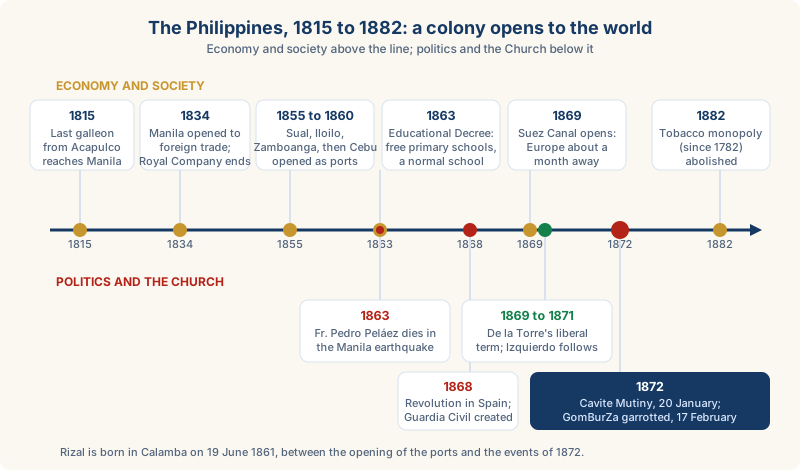
- 1815 – the last galleon reaches Manila.
- 1834 – Manila opened to foreign trade; Sual, Iloilo and Zamboanga follow in 1855, Cebu in 1860.
- 1863 – Educational Decree; Fr. Pedro Peláez dies in the earthquake of 3 June.
- 1868 – the Glorious Revolution deposes Isabel II; the Guardia Civil is organized.
- 1869 – the Suez Canal opens; de la Torre arrives as governor-general.
- 1871 – Izquierdo replaces de la Torre.
- 20 January 1872 – the Cavite Mutiny; 17 February 1872 – Gómez, Burgos and Zamora executed at Bagumbayan.
- 1882 – the tobacco monopoly (since 1782) abolished.
1. From the galleon to the world market
From 1565 to 1815 the colony lived on the Manila–Acapulco galleon: Chinese silks crossed the Pacific and came back as Mexican silver. The trade enriched a small circle of Spaniards in Manila and did almost nothing for the provinces. When the Mexican war of independence cut the route, the last galleon reached Manila in 1815, and Spain had to find a new way to make the colony pay.
The answer was agriculture for export. The Royal Philippine Company, chartered in 1785, was dissolved in 1834, and in the same year Manila was formally opened to foreign merchants. British and American trading houses advanced money to planters and bought their crops. Sual, Iloilo and Zamboanga were opened as ports in 1855 and Cebu in 1860. Sugar from Negros and Pampanga, abaca from Bicol, coffee from Batangas and indigo from the Ilocos moved out through them; the tobacco monopoly, run by the state since 1782, forced the Cagayan Valley to grow tobacco until it was abolished in 1882. The Banco Español-Filipino opened in 1851. By the 1870s the Philippines was an export economy, and Rizal's Calamba, a sugar town on a Dominican estate, was part of it.
2. A new middle class
The export economy created wealth outside the Spanish circle. The principalia, the native town elite of gobernadorcillos and cabezas de barangay, leased land, lent money and built stone houses. The Chinese mestizos, descendants of Chinese traders and native women, moved into landholding and the crop trade in Pampanga, Bulacan, Laguna and Iloilo. Rizal's own family, inquilinos who leased and sublet land on the Dominican hacienda of Calamba, belonged to this rising class.
Wealth bought education. The Educational Decree of 20 December 1863 ordered every town to keep a free primary school for boys and another for girls, made Spanish the medium of instruction and created a normal school under the Jesuits, who had returned in 1859. The Jesuits' Escuela Municipal became the Ateneo Municipal in 1865, and the Dominicans' University of Santo Tomás, founded in 1611, drew students from the provinces. The sons of this class who passed through these schools and went on to Spain were the ilustrados, the "enlightened ones": they spoke Spanish, read European books, and resented an order that treated them as indios.
3. The colonial order
Society was ranked by birth: the peninsulares, Spaniards born in Spain, held the high offices; the insulares or creoles, Spaniards born in the islands, felt passed over; then came the Spanish and Chinese mestizos, the indios, the Christian native majority, and the Chinese. Filipinos paid the tributo, a head tax, until it was replaced in 1884 by the cédula personal, a certificate every adult had to carry. Men owed the polo y servicios, forced labour on public works, forty days a year until 1884 and fifteen after it. The Guardia Civil, created in 1868 to police the provinces, became a byword for abuse; a lieutenant of that force would strike Rizal himself in 1878.
Government ran from the governor-general through the alcaldes mayores to the gobernadorcillo of each town, but the most powerful man in most towns was the friar parish priest. The Augustinians, Franciscans, Dominicans and Recollects held most parishes, and the priest was by law inspector of the schools, member of the boards that supervised elections and taxes, and censor of morals. The orders also owned the great haciendas around Manila and Laguna, including Calamba. Critics called this frailocracia, rule by friars; Marcelo H. del Pilar used the word as the title of a pamphlet in 1888, and the Noli is a portrait of it.
4. Spain's instability and the liberal interlude
Spain swung between liberal constitutions and conservative restorations, and every swing reached Manila. In September 1868 the Glorious Revolution drove Queen Isabel II from the throne and installed a liberal government that proclaimed freedom of the press, religion and association. In June 1869 it sent General Carlos María de la Torre to govern the Philippines. De la Torre walked the streets of Manila in civilian clothes, dismissed the palace's halberdier guard, invited Filipinos and mestizos to receptions, relaxed censorship and pardoned the Cavite bandit leader Casimiro Camerino. Filipino liberals, among them Fr. José Burgos and the lawyers Joaquín Pardo de Tavera and Antonio María Regidor, serenaded him and spoke openly of reforms, including the seat in the Spanish Cortes the colony had held under the constitutions of 1812 and 1820 and lost in 1837.
The interlude lasted less than two years. In April 1871 Madrid replaced de la Torre with General Rafael de Izquierdo, a hard conservative remembered for saying he would govern with a crucifix in one hand and a sword in the other. Izquierdo restored censorship, cancelled a planned school of arts and trades and, decisively, withdrew the exemption of the Cavite arsenal workers and native soldiers from tribute and forced labour.
5. The secularization controversy
Under Church law parishes belong to the secular clergy, priests under a bishop, while the religious orders, the regulars, are meant for missions. In the Philippines the regulars had kept the parishes for three centuries on the ground that there were too few trained native priests. By the nineteenth century the issue was racial, because the secular clergy was largely Filipino and the regulars almost wholly Spanish. The seculars asked for the parishes the law promised them; the friars answered that the natives were unfit.
When the Jesuits were given the Mindanao missions in 1861, the Recollects they displaced were compensated with parishes in Cavite and Manila taken from Filipino seculars. Fr. Pedro Peláez, the leading canonist of the Manila Cathedral chapter, argued the seculars' case until he was killed in the earthquake of 3 June 1863, when the cathedral collapsed. His pupil Fr. José Burgos, a doctor of theology from Santo Tomás, took up the cause and is credited with a manifesto of 1864 defending the Filipino clergy. Burgos, Gómez and Zamora were the visible leaders of the campaign when Izquierdo arrived.
6. The Cavite Mutiny of 1872
On the night of 20 January 1872 about two hundred soldiers and arsenal workers at Fort San Felipe in Cavite, led by Sergeant Fernando La Madrid, rose, killed their officers and seized the fort. They are said to have mistaken fireworks from a fiesta in Sampaloc, Manila, for the signal of a general uprising that never came. Troops under General Felipe Ginovés retook the fort by 22 January and La Madrid was killed. The government treated the mutiny as proof of a conspiracy against Spanish rule and arrested the leading Filipino priests, lawyers and businessmen of Manila.
- The Spanish account. Izquierdo's reports to Madrid, and the historian José Montero y Vidal in the 1890s, described a planned revolution to separate the Philippines from Spain, with the native clergy, lawyers and merchants as its brains, the mutineers as its tools, and Burgos as the intended head of a new government.
- The Filipino account. Trinidad H. Pardo de Tavera, whose uncle Joaquín was among the deportees, wrote that the rising was a local protest by men who had just lost their exemption from tribute and forced labour, and that the friars and Izquierdo magnified it into a revolution in order to destroy the secularization movement and the liberal circle of the de la Torre years. Edmond Plauchut told a similar story in 1877.
- Where historians stand. No evidence of a plot was ever published; the trials were secret and the chief witness, Francisco Zaldúa, testified for a pardon he never received. Whether anyone had hoped to turn the mutiny into something larger remains open.
7. GomBurZa and the aftermath
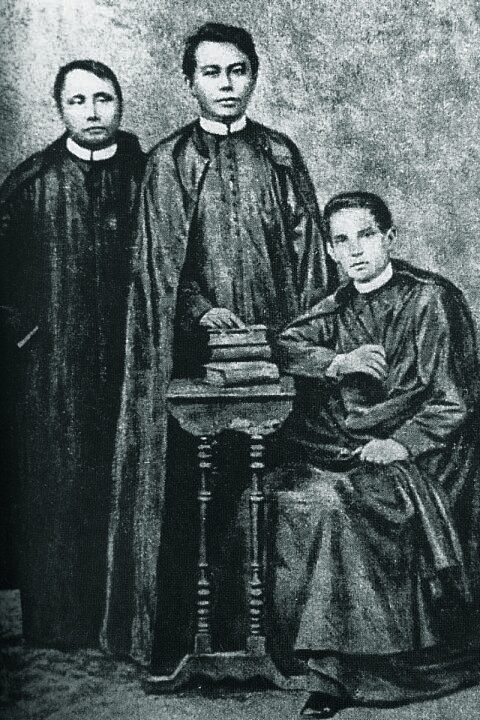
A court-martial condemned to death three secular priests: Mariano Gómez, seventy-three, parish priest of Bacoor, Cavite; José Burgos, thirty-five, of the Manila Cathedral; and Jacinto Zamora, thirty-seven, of Marikina, who by one account was arrested because a note inviting him to a card game with "powder and bullets", meaning money and chips, was read as a call to arms. Zaldúa was executed with them. Archbishop Gregorio Melitón Martínez refused to strip the three of their priesthood and ordered the bells of Manila's churches tolled. On the morning of 17 February 1872 the four were garrotted before a huge crowd at Bagumbayan, where Rizal would be shot twenty-four years later. Gómez was calm, Zamora dazed, and Burgos protested his innocence to the end.
Others were deported to Guam, among them the lawyers Joaquín Pardo de Tavera and Antonio María Regidor, the merchants José Basa and Máximo Paterno, and the priests Pedro Dandan, Agustín Mendoza, Mariano Sevilla and Toribio H. del Pilar, elder brother of Marcelo H. del Pilar. Several later escaped to Hong Kong, where Basa became a link between the exiles and the reformers in Europe. The educated class concluded that reform inside the colony was impossible while the friars ruled and that the fight had to be carried to Spain; that is why the Propaganda Movement worked from Barcelona and Madrid, and why 1872 is called the birth of Filipino nationalism.
The events touched Rizal's family directly. His brother Paciano had lived in Burgos's house as his student and friend. After the executions Paciano left his studies, and when José entered the Ateneo in June 1872 the family enrolled him under the second surname Rizal rather than Mercado, so that the Jesuits would not connect him with the brother who had been close to Burgos.
Key terms
| Term | Meaning |
|---|---|
| Galleon trade | Manila–Acapulco trade in Chinese goods for Mexican silver, 1565–1815. |
| Principalia | The native town elite of gobernadorcillos and cabezas de barangay. |
| Inquilino | A tenant who leased hacienda land and often sublet it; the Mercados in Calamba. |
| Ilustrado | An educated, propertied Filipino of the late nineteenth century. |
| Peninsular / insular | A Spaniard born in Spain / one born in the Philippines (creole). |
| Tributo and cédula | The head tax, replaced in 1884 by the cédula personal. |
| Polo y servicios | Forced labour, forty days a year until 1884, then fifteen. |
| Frailocracia | "Rule by friars"; title of a del Pilar pamphlet of 1888. |
| Secular / regular clergy | Priests under a bishop, largely Filipino / members of orders, almost all Spanish. |
| Secularization | The campaign of Peláez and Burgos to give parishes to Filipino seculars. |
| Cavite Mutiny | Rising at Fort San Felipe, 20 January 1872. |
| GomBurZa | Gómez, Burgos and Zamora, garrotted at Bagumbayan, 17 February 1872. |
Guided readings
Three short texts carry the meaning of 1872.
Reading 1: Rizal's letter to Mariano Ponce, 1889
Source: Letter from Rizal in Paris to Mariano Ponce in Barcelona, 18 April 1889, written when Ponce asked for material on the three priests.
Without 1872 there would not be now either a Plaridel, or Jaena, or Sanciangco, nor would there exist brave and generous Filipino colonies in Europe; without 1872 Rizal would be a Jesuit now and, instead of writing Noli me tángere, would have written the opposite.
- Identify the names: Plaridel is Marcelo H. del Pilar, Jaena is Graciano López Jaena, Sanciangco is Gregorio Sancianco, author of El Progreso de Filipinas (1881).
- Note the claim: the executions, not the schools, turned the ilustrados into nationalists.
- Weigh "would be a Jesuit now": Rizal was eleven in 1872 and a new Ateneo pupil.
- Ask how far one event can explain a movement, and what from this lesson Rizal leaves out.
Takeaway: Rizal himself dated the birth of his generation's nationalism to the executions of 1872.
Reading 2: The dedication of El Filibusterismo, 1891
Source: The dedication page of El Filibusterismo, Ghent, 1891, in the English of Charles Derbyshire's 1912 translation.
To the memory of the priests, Don Mariano Gómez (85 years old), Don José Burgos (30 years old), and Don Jacinto Zamora (35 years old). Executed in Bagumbayan Field on the 28th of February, 1872.
- Check the facts: the ages were 73, 35 and 37, and the date was 17 February. Rizal, writing in Europe without records, got them wrong, and items sometimes test the correct figures.
- Read on: Rizal says the Church, by refusing to unfrock them, cast doubt on the crime imputed to them, and that the government, by surrounding the trial in mystery, suggests a mistake was made.
- Notice the move: the archbishop's refusal and the secrecy of the trial become evidence of innocence.
Takeaway: The dedication makes the three priests the martyrs of the nation and announces that the second novel is about the consequences of their deaths.
Reading 3: Pardo de Tavera's account of the mutiny
Source: Trinidad H. Pardo de Tavera's account of the Cavite Mutiny, printed in English in the Blair and Robertson collection (close paraphrase).
In substance: the arsenal men rose because Izquierdo had taken away their exemption from tribute and forced labour; the friars, alarmed by the liberal ideas of the de la Torre years and by the seculars' demand for parishes, persuaded the government to treat a local riot as a separatist revolution; and the executions and deportations removed exactly the men who led the campaign for reform.
- Note the author's position: his uncle Joaquín was deported to Guam, so he writes as a partisan as much as a witness.
- Compare the motives he gives the friars with the motives Izquierdo gave the mutineers.
- Ask what evidence would settle the question, and notice that the trial records were never published.
Takeaway: The Filipino account reads 1872 as a pretext, and the absence of a public trial record is its strongest point.