Higher education and life abroad, 1882–1887
The secret departure of 1882, medicine and letters in Madrid, the Brindis of 1884, Paris and Germany, Blumentritt, and the printing of the Noli.
The first journey to Europe
On 3 May 1882 a twenty-year-old medical student slipped out of Manila on a passport in another man's name. Five years later he came home with two licentiates, an eye specialist trained in Paris and Heidelberg, a member of Berlin's learned societies, and the author of a novel the friars would call subversive. This topic covers that first European stay, 1882 to 1887; the novel itself is Topic 7 and the second stay (1888–1892) is Topic 5.
- 3 May 1882 – sails from Manila on the Salvadora; reaches Barcelona 16 June.
- 20 August 1882 – El Amor Patrio appears in Diariong Tagalog under the pen-name Laong Laan.
- November 1882 – enrols at the Universidad Central de Madrid.
- 21 June 1884 – Licentiate in Medicine; 25 June 1884 – the Brindis for Luna and Hidalgo.
- 19 June 1885 – Licentiate in Philosophy and Letters, sobresaliente.
- February 1886 – Heidelberg; 31 July 1886 – first letter to Blumentritt.
- 21 March 1887 – Noli me tángere comes off the press in Berlin.
- 5 August 1887 – back in Manila; Calamba on 8 August.
1. Leaving in secret
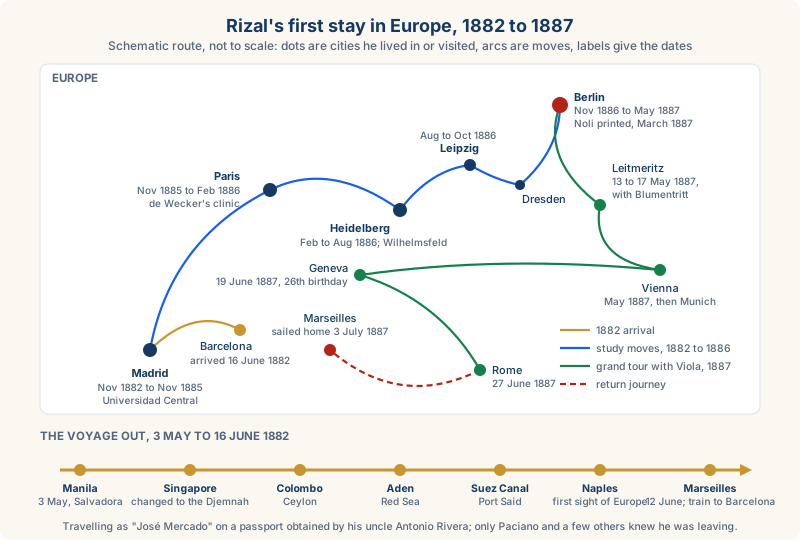
The decision to finish medicine in Spain was Paciano's as much as José's. The elder brother raised the money, promised a monthly allowance of thirty-five pesos, and kept the plan from their parents, who would have refused out of fear for his safety after the sabre incident and his mother's arrest; only Paciano, his sisters Saturnina, Narcisa and Lucía, uncle Antonio Rivera and a few friends knew. Rivera obtained a passport in the name José Mercado, and Saturnina gave him a diamond ring to pawn in need. Paciano's letters add a wider purpose: to observe Europe and prepare to work for the country. Rizal left Leonor Rivera without a farewell.
He sailed on 3 May 1882 on the Spanish steamer Salvadora, the only Filipino among sixteen passengers, and at Singapore transferred on 11 May to the French mail steamer Djemnah. The route lay through Colombo, Aden, the Suez Canal and Naples to Marseilles, reached on 12 June, then by train to Barcelona, where he arrived on 16 June 1882. His diary measures everything against home: Singapore's clean streets, the French passengers' manners, Naples as his first glimpse of Europe.
2. Barcelona and the first article
Barcelona did not impress him at first, but he soon joined the circle of Filipino students who met at the Plaza de Cataluña, among them old Ateneo classmates. There he wrote his first article for publication, El Amor Patrio (Love of Country), which Basilio Teodoro Moran printed in Manila in the bilingual Diariong Tagalog on 20 August 1882 under the pen-name Laong Laan, with a Tagalog version by Marcelo H. del Pilar. The essay argues that love of the fatherland is the purest of loves and a debt each generation must repay. Letters from home in the same weeks told of a cholera epidemic in Manila and of Leonor Rivera's grief at his disappearance.
3. Madrid, 1882–1885: two degrees
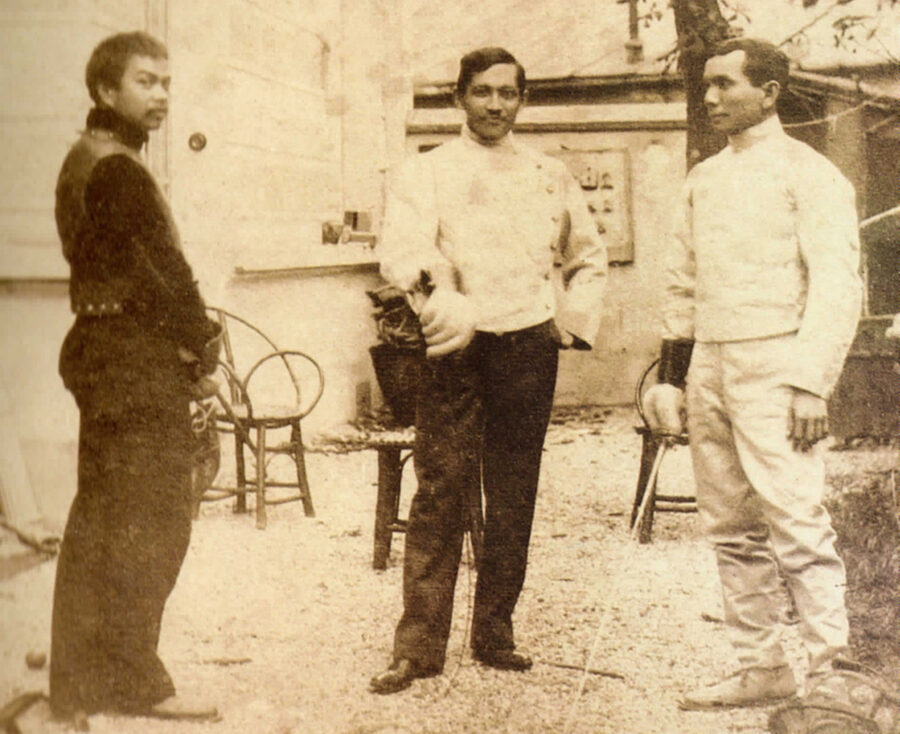
In November 1882 he moved to Madrid and enrolled at the Universidad Central in two faculties at once, Medicine and Philosophy and Letters. He also took painting at the Academia de San Fernando, lessons in French, German and English, and fencing and shooting at the hall of Sanz y Carbonell. He lived frugally in boarding houses on an allowance that often arrived late, and skipped meals to buy books, among them Eugène Sue's The Wandering Jew; his one extravagance was the state lottery.
He completed the Licentiate in Medicine on 21 June 1884 and, on 19 June 1885, his twenty-fourth birthday, the Licentiate in Philosophy and Letters with sobresaliente. He attended the doctoral courses in medicine but never submitted a thesis, so he held no doctorate; the title Doctor was later given him only by courtesy. He joined the Círculo Hispano-Filipino of Juan Atayde, for whose paper he wrote Me Piden Versos (1882), and in 1883 entered Masonry in the Acacia Lodge, later moving to Solidaridad Lodge under the name Dimasalang; he saw the lodges as a counterweight to friar power. He also fell briefly for Consuelo Ortiga y Pérez, daughter of the former Manila mayor Pablo Ortiga y Rey, whose home was the Filipino colony's salon; the poem A la Señorita C.O. y P. (1883) is hers. He withdrew because he was pledged to Leonor Rivera and his friend Eduardo de Lete loved her too.
4. The Brindis, 25 June 1884
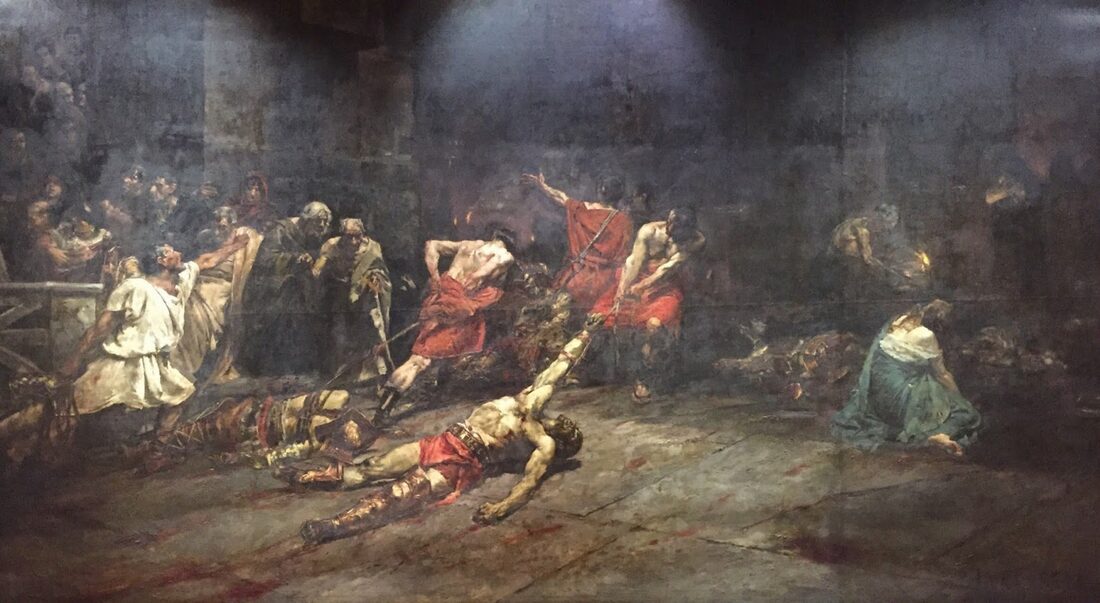
At the National Exposition of Fine Arts in Madrid in 1884, Juan Luna's Spoliarium won a first-class gold medal and Félix Resurrección Hidalgo's Las Vírgenes Cristianas Expuestas al Populacho (Christian Virgins Exposed to the Populace) a silver. The Filipino colony gave a banquet at the Restaurante Inglés on 25 June, and Rizal, four days after his medical licentiate, gave the toast, the Brindis. He hailed the painters as proof that genius has no country; read the Spoliarium as an image of humanity oppressed and reason struggling for light; and declared Spain and the Philippines two peoples joined by history who should share one law. Madrid liberals applauded; Manila's friars read it as sedition, and Teodora wrote begging him not to meddle in things that would bring him grief. Biographers mark the Brindis as the start of Rizal's public political life.
5. Paris, November 1885 – February 1886
Having chosen ophthalmology so that he could treat his mother's eyes, Rizal went to Paris in November 1885 to assist for four months at the clinic of Louis de Wecker, the leading eye surgeon of the day. He spent his free hours in Juan Luna's studio, posing as the Bornean chief Sikatuna in El Pacto de Sangre (The Blood Compact) and as an Egyptian priest in La Muerte de Cleopatra. He frequented the home of the Pardo de Tavera family, whose daughter Paz married Luna in 1886, met Valentín Ventura, who would later pay for the Fili, and continued the Noli; Paris proved too expensive to stay long.
6. Heidelberg and Wilhelmsfeld, 1886
On 3 February 1886 he reached Heidelberg, chosen for its university and eye clinic, and worked under Dr. Otto Becker while attending the lectures of the philosopher Kuno Fischer. On 22 April 1886, moved by the spring flowers on the banks of the Neckar, he wrote A las Flores de Heidelberg, asking the flowers to carry his greeting home. For the summer he moved to the nearby village of Wilhelmsfeld as the guest of the Protestant pastor Karl Ullmer and his family, where he finished the last chapters of the Noli; the Ullmers' kindness left a lasting mark on his view of religion. From Heidelberg on 31 July 1886 he wrote his first letter to Ferdinand Blumentritt, the Austrian schoolmaster of Leitmeritz who had published on the Philippines, sending him a Spanish–Tagalog arithmetic book by Rufino Baltazar Hernández; Blumentritt replied with two books of his own, and the most important friendship of Rizal's life began.
7. Leipzig, Dresden and Berlin, 1886–1887
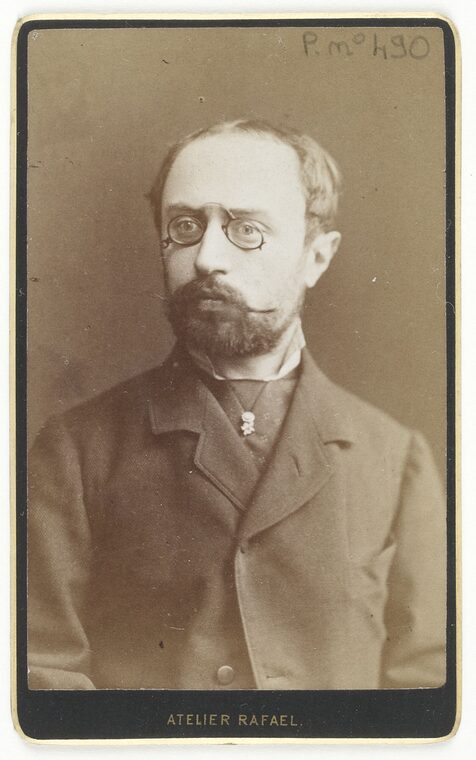
In August 1886 he moved to cheaper Leipzig, heard the geographer Friedrich Ratzel, befriended Dr. Hans Meyer, and to practise German translated Schiller's Wilhelm Tell into Tagalog for Paciano and some of Andersen's tales for his nephews and nieces. In Dresden in October he met Dr. Adolf B. Meyer of the ethnographic museum, and on 1 November 1886 he reached Berlin.
Berlin gave him the company of scholars: the pathologist Rudolf Virchow, the ethnologist Fedor Jagor, whose travel book on the Philippines he had read as a boy, and the eye doctor Karl Ernst Schweigger, in whose clinic he worked. He was admitted to the Berlin Anthropological, Ethnological and Geographical Societies, and in April 1887 read to the Ethnological Society a paper in German, Tagalische Verskunst, on Tagalog metrical art. He was once questioned by the police as a suspected French spy for sketching in the streets. The winter of 1886–1887 was his poorest: Paciano's money stopped, he pawned Saturnina's ring, ate one meal a day and feared tuberculosis. Then in December Maximo Viola, a wealthy medical graduate from Bulacan, arrived and lent him 300 pesos to print the finished Noli. Two thousand copies came off the press of the Berliner Buchdruckerei-Actiengesellschaft on 21 March 1887, and Rizal gave the first copy, the galley proofs and the pen to Viola. The novel itself is Topic 7.
8. The grand tour with Viola, May–June 1887
With the novel printed, Rizal and Viola set out on 11 May 1887 on a tour of central Europe. They saw Potsdam and Dresden, then on 13 May reached Leitmeritz in Bohemia, where Blumentritt, who knew Rizal only from a sketch, met them at the station. They stayed at the Hotel Krebs until 17 May, dined with the Blumentritt family, and Rizal addressed the local tourist club in German. From Leitmeritz they went to Prague and Vienna, down the Danube to Linz, then Salzburg, Munich, Nuremberg, Ulm, Stuttgart, Schaffhausen, Basel, Bern and Lausanne to Geneva, where Rizal spent his twenty-sixth birthday on 19 June 1887. On 23 June the friends parted, Viola for Barcelona and Rizal for Italy: Turin, Milan, Venice, Florence and Rome, reached on 27 June. He took ship at Marseilles on 3 July 1887 on the Djemnah, the steamer that had carried him out, and by way of Saigon reached Manila on 5 August; three days later he was in Calamba.
- Louis de Wecker – Paris eye surgeon under whom Rizal trained, 1885–1886.
- Karl Ullmer – Protestant pastor of Wilhelmsfeld who hosted Rizal in the summer of 1886.
- Ferdinand Blumentritt – Austrian schoolmaster and Philippine scholar; first letter 31 July 1886, first meeting 13 May 1887.
- Maximo Viola – Bulacan physician whose loan printed the Noli and companion of the 1887 tour.
Key terms
| Term | Meaning |
|---|---|
| Laong Laan | Pen-name (ever prepared) under which El Amor Patrio appeared in 1882. |
| Licentiate (licenciado) | Spanish first university degree; Rizal held two, Medicine 1884 and Philosophy and Letters 1885. |
| Brindis | Toast; Rizal's speech of 25 June 1884 honouring Luna and Hidalgo. |
| Dimasalang | Rizal's Masonic name, from the Solidaridad Lodge in Madrid. |
| Spoliarium | Luna's gold-medal canvas of 1884, read by Rizal as an image of oppressed humanity. |
| Tagalische Verskunst | Rizal's German paper on Tagalog versification, read in Berlin in April 1887. |
| Berliner Buchdruckerei-Actiengesellschaft | The Berlin press that printed 2,000 copies of the Noli in March 1887. |
Guided readings
Three primary texts from the period, each the source of recurring board items.
Reading 1: El Amor Patrio
Source: José Rizal, El Amor Patrio, Diariong Tagalog, Manila, 20 August 1882, signed Laong Laan; our translation of the opening.
Of all loves, that of country is the greatest, the most heroic and the most disinterested. Whatever our condition, we love her as a child loves its mother in hunger and in poverty.
- Note the date and place: written in Barcelona two months after arrival, printed in Manila for Filipino readers.
- Mark the comparison of the patria to a mother; it returns in the farewell poem of 1896.
Takeaway: The first published article already contains the moral centre of Rizal's writing: love of country as a duty owed, not a sentiment enjoyed.
Reading 2: The Brindis
Source: José Rizal, toast at the banquet for Luna and Hidalgo, Restaurante Inglés, Madrid, 25 June 1884; our translation.
Genius is like light and air, the patrimony of all, cosmopolitan as space, as life, as God. Luna and Hidalgo are glories of Spain as of the Philippines.
- Underline the claim of equality: Filipino genius is not inferior, and Spain shares in it.
- Note the politics: Rizal asks for assimilation – one law for both peoples – not separation.
- Ask why Manila's friars reacted so strongly to a speech that praised Spain.
Takeaway: The Brindis is the manifesto of the assimilationist Rizal of 1884, and the moment his name became politically dangerous at home.
Reading 3: First letter to Blumentritt
Source: José Rizal to Ferdinand Blumentritt, Heidelberg, 31 July 1886, written in German; our translation.
Esteemed Sir: having heard that you are studying our language, I take the liberty of sending you a small book, an arithmetic in Spanish and Tagalog, which may be of some use to you.
- Note the tone: a student writing to a stranger, in the stranger's language, with a gift.
- Identify the book: Rufino Baltazar Hernández's Aritmética (1868), bilingual in Spanish and Tagalog.
- Follow what it started: more than 200 letters over ten years, and the meeting at Leitmeritz in May 1887.
Takeaway: The greatest friendship of Rizal's life began with a schoolbook and a courteous letter, and gave him an advocate in European scholarship for the rest of his career.