The essays: Indolence, A Hundred Years Hence and the letter to the women of Malolos
Rizal's political essays in La Solidaridad on indolence and the future of the Philippines, and his 1889 letter on the education and dignity of Filipino women.
Rizal the essayist
Rizal's novels made him famous, but his political thought is clearest in his essays. Between 1882 and 1890 he wrote for the Filipino press a series of articles that diagnosed the condition of the Philippines, forecast its future and told Filipinos, and Filipino women in particular, what they must do. Three works carry the weight of a college course: Sobre la indolencia de los filipinos (On the Indolence of the Filipinos), which answers the oldest Spanish slander against the native; Filipinas dentro de cien años (The Philippines a Century Hence), which predicts separation from Spain and names the power that might come next; and the letter to the young women of Malolos, which sets out his view of education, religion and women. Around them stand El Amor Patrio, the first thing he published abroad, and a handful of polemics in La Solidaridad.
- 20 August 1882 – El Amor Patrio appears in Diariong Tagalog, Manila.
- 12 December 1888 – twenty young women of Malolos petition Governor-General Weyler for a night school in Spanish.
- 22 February 1889 – Rizal dates his Tagalog letter to the women of Malolos, in London.
- 31 May and 31 July 1889 – La Verdad para Todos and Una Profanación in La Solidaridad.
- 30 September 1889 – 1 February 1890 – Filipinas dentro de cien años, in four parts.
- 15 July – 15 September 1890 – Sobre la indolencia de los filipinos, in five parts.
1. The first essay: El Amor Patrio, 1882
Rizal wrote El Amor Patrio (Love of Country) in Barcelona within weeks of arriving in Spain, at the age of twenty-one, and sent it to Manila, where Diariong Tagalog printed it on 20 August 1882 under the pen name Laong Laan, in Spanish and in a Tagalog translation by Marcelo H. del Pilar. It is a young man's prose poem rather than an argument: love of country is the purest of feelings, felt most sharply by the exile, and it asks for sacrifice without reward. Its importance is in what it foreshadows: the patria of the essay is already the Philippines, not Spain.
2. Polemics in La Solidaridad, 1889–1890
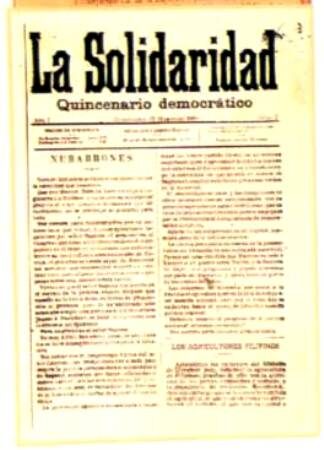
Rizal's shorter pieces in the paper answered particular attacks. La Verdad para Todos (The Truth for All, 31 May 1889) replied to Spanish writers who called Filipinos ignorant and immoral by turning the charge on the men who had governed them for three centuries. Una Profanación (A Profanation, 31 July 1889) denounced the friars of Calamba, who had refused Christian burial to Rizal's brother-in-law Mariano Herbosa, dead of cholera, because he was Rizal's relative. Filipinas en el Congreso (31 March 1890) argued for the restoration of Philippine seats in the Cortes, lost in 1837. Ingratitudes (15 January 1890) replied to Governor-General Weyler's rebuke of the Calamba tenants. These pieces trained the method of the two great essays: take the Spanish accusation seriously, test it against history, and trace its cause to colonial rule.
3. Filipinas dentro de cien años, 1889–1890
The four parts of Filipinas dentro de cien años appeared on 30 September, 31 October and 15 December 1889 and 1 February 1890. The essay is a reading of the past used to forecast the future.
The past. Rizal describes three stages in the history of the Filipino under Spain. First the people were dazzled by the newcomers and their religion; then they were crushed and degraded, losing their old writing, songs, laws and memories, their population reduced by wars, expeditions and forced labour, until they lost confidence in their past, faith in their present and hope in their future. Third, having touched bottom, they began to awaken: contact with the world, the opening of the ports, the education of a middle class and the example of 1872 had produced a generation that read, compared and asked questions.
The present choice. Spain cannot stop the awakening, because ideas cannot be killed by deportation or execution; 1872 had made the three priests martyrs. Nor can Spain hold the islands for ever by force, since no distant domination of one people over another of different race and customs has lasted. Spain has two paths: grant the reforms the propagandists asked for, representation in the Cortes, a free press, secularisation and equal rights, and keep the Philippines as a loyal province; or refuse, and face a revolution that would end in independence. Rizal said plainly that he preferred the first, but that the choice was Spain's.
The future. If the Philippines became independent, would another power take it? Rizal reviewed the candidates. England had enough colonies and would not risk a war for more; Germany preferred to trade; France was occupied in Indochina; Holland, China and Japan had their own reasons to stay out. The one power he thought might one day look to the islands was the United States, the great American republic whose interests lay in the Pacific. The forecast, made eight years before Admiral Dewey entered Manila Bay, is the most quoted passage of the essay.
4. Sobre la indolencia de los filipinos, 1890
Spanish writers had explained every failure of the colony by the laziness of the native. Rizal answered them in five instalments, from 15 July to 15 September 1890, in an essay that owed a debt to Gregorio Sancianco's El Progreso de Filipinas (1881) and to his own notes on Morga. He did not deny that indolence existed; he denied that it was a cause. It was an effect, he said, a chronic disease but not a hereditary one, and he set out to trace its origins.
Climate. A hot climate does require more rest than a cold one; a European who works in the tropics at the pace of his own country falls ill. Some reduction of effort is reasonable and is not a vice. But climate alone cannot explain the change from the industrious people Morga, Pigafetta and Chirino described, who mined gold, wove, built ships and traded with half of Asia, to the discouraged peasant of the nineteenth century. Something had happened in between, and that something was colonial rule.
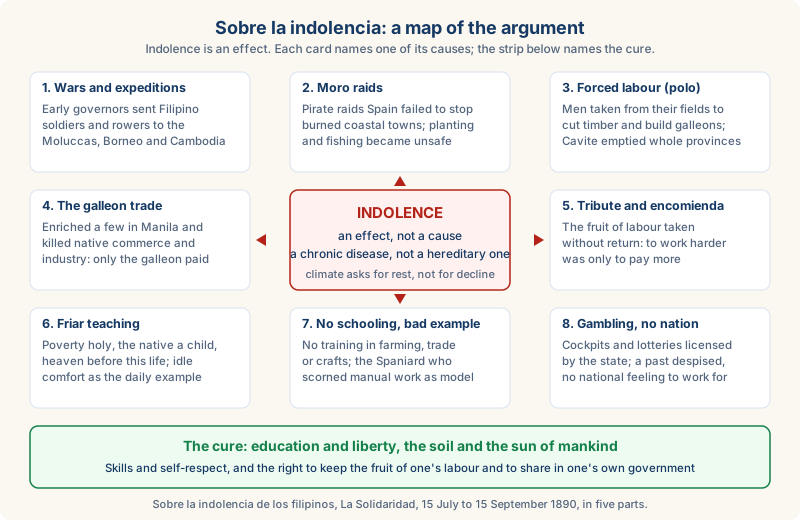
The causes. Rizal listed them in order. The wars and expeditions of the early governors to the Moluccas, Borneo, Cambodia and elsewhere consumed Filipino soldiers, rowers and provisions. The raids of the Moro pirates, which Spain failed to stop, destroyed coastal towns and made planting and fishing unsafe. Forced labour, the polo, took men from their fields to cut timber and build galleons, and the shipyards of Cavite depopulated whole provinces. The galleon trade with Acapulco enriched a few Spaniards and Chinese and killed native commerce and industry, because nothing was worth making when the only business was the galleon. The encomienda and the tribute took the fruit of labour without return, so that to work harder was only to pay more. The friars taught that poverty was holy, that the native was an inferior child, and that the heaven to come mattered more than this life, while their own example of comfortable idleness taught the opposite of industry. The government gave no education in agriculture, trade or crafts, and the Spaniard who despised manual work was the model held up to the Filipino. Gambling, cockfights, lotteries and fiestas were encouraged by the authorities themselves. Enterprise met red tape, insecurity of property and the discouragement of any Filipino who rose. Above all, the people had been taught to despise their own past and lacked the national sentiment that makes men work for something larger than themselves.
The cure. If indolence was an effect of oppression, discouragement and bad teaching, the remedy was not sermons but education and liberty: education that gave the Filipino skills and self-respect, and liberty that let him keep the fruit of his labour and take part in his own government. Without these two, which Rizal called the soil and the sun of mankind, no reform could bear fruit.
5. The letter to the young women of Malolos, 1889
The occasion. On 12 December 1888 twenty young women of Malolos, Bulacan, from the town's leading families and led by Alberta Uitangcoy, presented a petition to Governor-General Valeriano Weyler asking permission to open a night school where they could learn Spanish, with Teodoro Sandiko as teacher. The parish priest, Fr. Felipe García, opposed it, and the petition was at first refused. The women persisted, and the school was eventually allowed, by day and under a woman teacher, Guadalupe Reyes. Because women had asked for education in defiance of the friar, del Pilar wrote to Rizal in London asking him to send them a word of encouragement. Rizal replied in Tagalog, in a letter dated 22 February 1889, Sa mga Kababayang Dalaga sa Malolos.
The argument. The letter has seven main points. First, Filipino women had been taught blind obedience, and the friars had used it; a priest's word is not God's, and not all who wear the habit are holy. Second, God gave every person reason and a will to tell right from wrong, and to surrender that judgment to another is to insult the Giver; religion should be a matter of reason and conscience, not of fear, candles and rosaries bought for money. Third, the first duty of a mother is to raise her children in love of country, honour and truth, to teach them to prefer death to dishonour, like the Spartan mother who told her son to come back with his shield or on it. Fourth, a wife is the companion of her husband, not his slave, and should share his cares and strengthen his courage. Fifth, young women should choose a husband for his character and his love of country, not for his wealth or his position. Sixth, ignorance is servitude, because a person who does not think is led by others; the tyranny of some is possible only through the cowardice of others. Seventh, the women of Malolos had shown that Filipino women could think and act, and their example should spread.
Why it matters. The letter is the fullest statement of Rizal's views on women, religion and education. It rejects not religion but the friar's monopoly of it, and it makes the home the first school of the nation.
Key terms
| Term | Meaning |
|---|---|
| El Amor Patrio | Love of Country; Rizal's first essay abroad, Diariong Tagalog, 20 August 1882, as Laong Laan. |
| Filipinas dentro de cien años | The Philippines a Century Hence; four parts, La Solidaridad, 30 September 1889 to 1 February 1890. |
| Sobre la indolencia de los filipinos | On the Indolence of the Filipinos; five parts, La Solidaridad, 15 July to 15 September 1890. |
| Indolence as effect | Rizal's thesis that laziness was produced by colonial rule, not by race or climate. |
| Polo | Forced labour, which took men from their fields to the shipyards and public works. |
| Galleon trade | The Manila–Acapulco trade that enriched a few and killed native industry and commerce. |
| Encomienda | A grant of the tribute of a district to a Spaniard; a source of abuse. |
| Education and liberty | Rizal's cure for indolence; "the soil and the sun of mankind". |
| Dazzled, crushed, awakened | The three stages of the Filipino under Spain in Filipinas dentro de cien años. |
| Malolos letter | Sa mga Kababayang Dalaga sa Malolos, in Tagalog, London, 22 February 1889. |
| Women of Malolos | Twenty young women who petitioned Weyler on 12 December 1888 for a night school in Spanish. |
| Spartan mother | Rizal's model of the mother who sends her son to duty: return with your shield or on it. |
Guided readings
Reading 1: The cure for indolence
Source: José Rizal, Sobre la indolencia de los filipinos, Part 5, La Solidaridad, 15 September 1890; our plain translation.
Without education and liberty, which are the soil and the sun of mankind, no reform is possible, no measure can give the result desired. A people that is kept ignorant and in chains cannot be asked to work with the energy of a free and instructed people.
- Identify the two conditions Rizal names and the metaphor he gives them: soil and sun.
- Trace each back to the causes in section 4: which causes does education answer, and which does liberty answer?
- Explain why this conclusion made the essay a political programme and not only a defence of the Filipino character.
Takeaway: The essay ends where the Propaganda Movement began: reform meant schools and rights, not sermons on hard work.
Reading 2: The American forecast
Source: José Rizal, Filipinas dentro de cien años, Part 4, La Solidaridad, 1 February 1890; our plain translation.
Perhaps the great American republic, whose interests lie in the Pacific and which has no share in the plunder of Africa, may one day think of possessions overseas. It is not impossible, for the example is contagious, and greed and ambition are among the vices of the strong.
- Note the hedging words: perhaps, may, not impossible. Rizal is weighing possibilities, not prophesying.
- Compare this with his reasons for ruling out England, Germany, France, Holland, China and Japan.
- Consider what happened in 1898 and decide whether the passage shows foresight, luck, or good reading of the newspapers of 1889.
Takeaway: Rizal's forecast rested on an analysis of each power's interests, which is why it is still read.
Reading 3: Reason and obedience
Source: José Rizal, letter to the young women of Malolos, London, 22 February 1889; our plain translation from the Tagalog.
God gave each of us reason and a will of our own, so that we might tell the just from the unjust; all were born without chains, free, and no one has the right to subject the mind and the will of another. Why should we surrender to another the gift that God gave us?
- Identify the two gifts named and the conclusion Rizal draws from them.
- Connect the passage to the occasion: women who had been told by their parish priest not to learn Spanish.
- Decide whether the passage attacks religion or the misuse of religious authority, and quote the lesson's evidence.
Takeaway: The Malolos letter grounds education and freedom of conscience in the same gift of reason, for women as for men.