Family, childhood and early schooling
The Mercado–Alonso family of Calamba, Rizal's eleven siblings, his first teachers, Biñan, the Ateneo and the University of Santo Tomás, and his first poems.
A family of Calamba
José Rizal was the seventh child of a prosperous, educated tenant family in a Laguna town owned by the Dominican order. His languages, his confidence before Spaniards, his sense of grievance and his devotion to his mother were all formed in Calamba and in the schools of Biñan and Manila before he turned twenty-one. This topic runs from his birth in 1861 to May 1882, when he sailed for Spain without telling his parents. Board items here are heavily factual: dates, relatives, teachers, student poems and degrees. Read also for the two shocks of 1871 and 1872 that gave the schoolboy a cause.
- 19 June 1861 – born in Calamba, Laguna; baptised 22 June by Fr. Rufino Collantes, godfather Fr. Pedro Casañas.
- June 1870 – December 1871 – school in Biñan under Maestro Justiniano Aquino Cruz.
- 1871 – his mother Teodora is arrested and jailed at Santa Cruz for about two and a half years.
- 17 February 1872 – GomBurZa executed; Paciano, a housemate of Fr. Burgos, leaves Manila.
- June 1872 – 23 March 1877 – Ateneo Municipal; Bachiller en Artes, sobresaliente.
- 1877–1882 – Santo Tomás: Philosophy and Letters, then Medicine; surveyor's title 25 November 1881.
- 3 May 1882 – sails for Spain after his fourth year of medicine.
1. Birth and name
Rizal was born on Wednesday, 19 June 1861, in Calamba, after a difficult delivery. Three days later the parish priest, Fr. Rufino Collantes, baptised him José Protasio, with Fr. Pedro Casañas as godfather: José for St. Joseph, Protasio for the saint of the day. The family had been Mercados for four generations. In 1849 Governor-General Narciso Clavería ordered Filipino families to take fixed surnames from an official catalogue, and the Mercados added Rizal, from the Spanish ricial, a field green with young growth. In daily life they went on using Mercado, and Paciano never dropped it; José used Rizal from 1872, for a reason given in section 7. His full name was José Protasio Rizal Mercado y Alonso Realonda.
2. The father's line
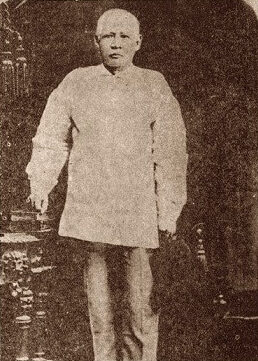
The paternal ancestor was Domingo Lamco, a Chinese merchant from Changchow in Fujian who reached Manila about 1690, was baptised, married Inés de la Rosa, a Chinese mestiza of the Parián, and in 1731 adopted the surname Mercado, meaning market. His son Francisco Mercado married Cirila Bernacha and settled in Biñan; their son Juan Mercado married Cirila Alejandro and served as gobernadorcillo of Biñan. Juan's youngest son, Francisco Mercado Rizal, was born in Biñan on 11 May 1818, studied at the Colegio de San José in Manila, and moved to Calamba, where he leased land from the Dominican hacienda and prospered in sugar, rice and indigo. A quiet, hard-working, well-read man whom his son called a model of fathers, he died in Manila on 5 January 1898.
3. The mother's line
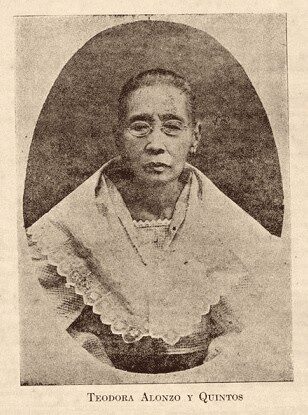
Teodora Alonso Realonda was born in Manila on 8 November 1826 and died on 16 August 1911, outliving her son by fifteen years. Her line was mixed in the way of the principalía: Eugenio Ursua, of Japanese descent, married a Filipina named Benigna; their daughter Regina married Manuel de Quintos, a lawyer from Pangasinan; their daughter Brígida de Quintos married Lorenzo Alberto Alonso of Biñan, a wealthy landowner, and Teodora was their daughter. Educated at the Colegio de Santa Rosa, she read widely, kept the accounts and ran the store, and was her son's first teacher. The parents married on 28 June 1848 and settled in Calamba.
4. The eleven children
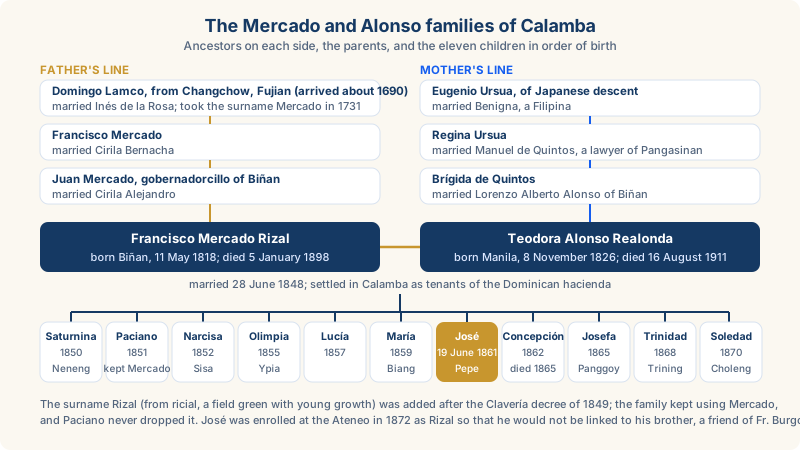
The couple had eleven children, two sons and nine daughters, and the order is a favourite board item. Saturnina (Neneng, 1850) married Manuel Hidalgo. Paciano (1851), the only other son, was José's protector and financier and later a general of the Revolution. Then came Narcisa (Sisa, 1852), Olimpia (Ypia, 1855), Lucía (1857) and María (Biang, 1859). José (Pepe, 1861) was seventh. Concepción (Concha, 1862) died at three in 1865 – the first time, Rizal wrote, that he wept from grief. Josefa (Panggoy, 1865) later joined the Katipunan; Trinidad (Trining, 1868) received his last poem in 1896; Soledad (Choleng, 1870) was the youngest.
5. Calamba: home and first lessons
The family lived in one of the first stone houses in Calamba, on Laguna de Bay below Mount Makiling. The town's lands belonged to the Dominican hacienda, and families like the Mercados were inquilinos, tenants who paid rent and sub-let to smaller farmers – an arrangement that broke down in the 1880s (Topic 8). His mother taught him his letters at three. The family's tutors were Maestro Celestino, Maestro Lucas Padua, and old Leon Monroy, who taught Spanish and the rudiments of Latin and died a few months after taking the post. At five the boy was sketching and modelling clay figures; at eight, by family account, he wrote a short Tagalog comedy that a gobernadorcillo of Paete bought for two pesos.
6. Biñan, 1870–1871
In June 1870, aged nine, Rizal was sent to Biñan to study under Maestro Justiniano Aquino Cruz, a thin, long-necked disciplinarian and a good teacher of Latin and Spanish. Paciano brought him over, and he boarded with an aunt. His memoir records a fight on the first day with the teacher's son Pedro, which he won; an arm-wrestling bout with Andrés Salandanan, which he lost; frequent whippings; and painting lessons from old Juancho, the maestro's father-in-law, taken with his classmate José Guevara. Within months he was ahead of the school in Latin and Spanish. He went home for Christmas 1871 and did not return; his parents had decided on Manila.
7. Two shocks: 1871 and 1872
In 1871 Teodora was arrested. Her brother José Alberto, back from Europe, found that his wife had abandoned their children; when he proposed a separation, the wife, egged on by a Guardia Civil officer, accused him and Teodora of trying to poison her. The alcalde mayor of Laguna, who bore the Mercados a grudge, had Teodora made to walk the fifty kilometres to the provincial jail at Santa Cruz, where a lawyer tricked her into a confession. She was held about two and a half years before the Royal Audiencia freed her. Rizal later said the injustice taught him what Spanish rule could do to an innocent family.
The second shock was the execution of Fathers Gómez, Burgos and Zamora on 17 February 1872, after the Cavite Mutiny of 20 January. Paciano, a student at the Colegio de San José, had lived in Fr. Burgos's house and worked in the secularization campaign. He came home, gave up his studies, and resolved that his brother should have the education he had lost. Because Mercado was now known in Manila as the name of a Burgos follower, José was enrolled at the Ateneo as José Rizal. He later wrote that without 1872 there would have been no Noli and no Fili, and dedicated the second novel to the three priests.
8. The Ateneo Municipal, 1872–1877
In June 1872, aged eleven, Rizal passed the entrance examination at the Colegio de San Juan de Letrán, but his father chose the Jesuit Ateneo Municipal in Intramuros. The rector, Fr. Magín Ferrando, at first refused him as a late and sickly applicant; Manuel Xerez Burgos, a nephew of the executed priest, interceded. His first teacher was Fr. José Bech, thin, bent and eccentric. The Jesuit system divided each class into two rival empires, the Roman for boarders and the Carthaginian for day pupils, with ranks – emperor, tribune, decurion, centurion, standard-bearer – won in daily contests; the newcomer started at the bottom of the Carthaginians and within a month was emperor. He became secretary of the Marian Congregation and carved in batikuling wood an image of the Virgin and a Sacred Heart that the fathers kept.
His favourite teacher was Fr. Francisco de Paula Sánchez, who nurtured his verse and became a lifelong friend. The student poems are board material: Mi Primera Inspiración (1874, to his mother, authorship questioned); El Embarque (1875, on Magellan's fleet); Un Recuerdo a Mi Pueblo (1876, on Calamba); Alianza Íntima entre la Religión y la Buena Educación and Por la Educación Recibe Lustre la Patria (both 1876); and in his last year El Heroísmo de Colón. On 23 March 1877 he received the Bachiller en Artes with the highest mark, sobresaliente.
9. Santo Tomás, 1877–1882
Teodora did not want him to study further; the memoir records her fear that if he came to know more, the Spaniards would cut off his head. Francisco and Paciano overruled her, and in 1877 Rizal entered the Dominican University of Santo Tomás for Philosophy and Letters. In 1878 he switched to medicine, on the advice of the Ateneo rector Fr. Pablo Ramón and because his mother's eyesight was failing. He was unhappy there: the Dominican professors were, in his account, hostile to Filipinos and the teaching old-fashioned, scenes he later put into the Fili's physics class; he heard himself called chongo, monkey, and his grades fell to a mixture of excellent, good and fair. In the summer of 1878, walking in Calamba at dusk, he failed to see and salute a Guardia Civil lieutenant, who slashed his back with a sabre; his complaint to Governor-General Primo de Rivera went unanswered.
These were also his first years of public recognition. In 1879 the Liceo Artístico-Literario de Manila held a poetry contest, and the eighteen-year-old won first prize with A la Juventud Filipina, which called the Filipino youth the fair hope of the fatherland; the prize was a silver pen shaped like a feather, and he was the first native Filipino so honoured. In 1880 the Liceo held a contest in honour of Cervantes, open to all, and his allegory El Consejo de los Dioses, in which the gods judge Homer, Virgil and Cervantes equal, won the gold ring engraved with Cervantes's bust. On 8 December 1880 the Ateneo staged his zarzuela Junto al Pásig. By 1882 he had finished the fourth year of medicine and, with Paciano, decided to complete the degree in Spain.
10. First loves
Three names belong here. Segunda Katigbak of Lipa, met in 1877 and already engaged to Manuel Luz. Leonor Valenzuela, Orang, a neighbour in Intramuros, to whom he wrote in invisible ink. And Leonor Rivera, his cousin, met about 1879 at the Casa Tomasina boarding house of her father, his uncle Antonio Rivera; he called her Taimis, and she was his sweetheart for eleven years and the model for María Clara (Topic 5).
Key terms
| Term | Meaning |
|---|---|
| Clavería decree (1849) | Order that Filipino families adopt fixed surnames; origin of the name Rizal. |
| Inquilino | Tenant who leased hacienda land and often sub-let it; the Mercados' status. |
| Roman and Carthaginian empires | Rival class teams in the Jesuit system; ranks from emperor down. |
| Bachiller en Artes | Secondary degree Rizal received on 23 March 1877, sobresaliente. |
| Perito agrimensor | Surveyor's title; passed 1878, issued 25 November 1881. |
| Liceo Artístico-Literario | Manila society whose contests Rizal won in 1879 and 1880. |
| Sa Aking mga Kabata | Tagalog poem attributed to the eight-year-old Rizal; authorship disputed. |
Guided readings
Three short primary texts: two of Rizal's own, and the disputed poem read as a document rather than as settled fact.
Reading 1: The moth and the lamp
Source: José Rizal, Memorias de un estudiante de Manila, written 1878–1881 under the name P. Jacinto; our translation.
The little moth no longer held my attention; I was watching the real one, which fluttered about the flame and finally fell into the oil, its wings scorched. My mother did not know what I was thinking. I did not fear the flame; I envied the moth its death in the light.
- Note the two moths: the fable's, carrying the mother's moral, and the real one, carrying the son's.
- The memoir was written at seventeen to twenty; ask what an adult reads back into the scene.
- Connect it to the farewell poem of 1896, where dying for the country is again light.
Takeaway: The anecdote matters less as biography than as the earliest statement of a theme – sacrifice for an ideal – that Rizal made the key to his own life.
Reading 2: A la Juventud Filipina
Source: José Rizal, prize poem at the Liceo Artístico-Literario de Manila, 1879; first stanza, our translation.
Lift your smooth brow, Philippine youth, on this day! Shine forth in splendour, your rich gallantry, fair hope of my fatherland!
- Underline fair hope of my fatherland (bella esperanza de la patria mía); the board quotes it constantly.
- Later stanzas praise Spain as the mother who gives the arts: the patria is the Philippines within Spain.
- Note the audience: a Spanish-run society, and the first native Filipino to win its prize.
Takeaway: This is the reformist Rizal of 1879, proud of the Filipino youth and loyal to Spain; his separatism, such as it was, came much later.
Reading 3: Sa Aking mga Kabata
Source: Tagalog poem attributed to Rizal, first printed by Hermenegildo Cruz in Kun Sino ang Kumathâ ng Florante (Manila, 1906); first stanza.
Kapagka ang baya'y sadyáng umiibig sa kanyáng salitáng kaloob ng langit, sanlang kalayaan nasa ring masapit, katulad ng ibong nasa himpapawid.
- Find kalayaan: in 1886 Rizal told Paciano he had only recently learned the word.
- Look at the spelling: k and w, not the c and u of pre-1880s Tagalog.
- Trace the transmission – Cruz, 1906, from Beato Francisco, from Raselis – with no manuscript at any link.
Takeaway: The message about loving one's language is genuinely Rizalian; the authorship is not established, and a good answer says both.