El Filibusterismo
The second novel printed in Ghent in 1891: Simoun's plot, the students, Cabesang Tales, Padre Florentino's answer, and how the Fili differs from the Noli.
The darker sequel
El Filibusterismo is the book Rizal wrote after four years of watching what happened to the people who had read the Noli: his family evicted from the Calamba hacienda, his brother-in-law deported, and the reforms the Propaganda Movement asked for in Madrid going nowhere. The sequel is shorter, angrier and far more political. Its hero is no longer an idealist who wants to build a school but a disguised conspirator who wants to blow up the colonial elite.
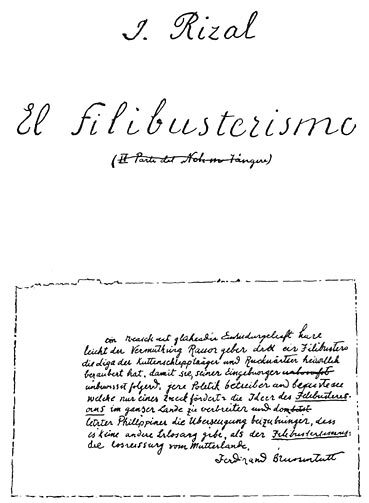
- October 1887 – Rizal begins the sequel in Calamba, soon after returning from Europe.
- 1888–1890 – he continues it in London, Paris and Madrid while annotating Morga and writing for La Solidaridad.
- 29 March 1891 – after revising in Brussels, he finishes the manuscript in Biarritz, France.
- August 1891 – printing at F. Meyer-Van Loo in Ghent, Belgium, stops for lack of money; Valentín Ventura pays for it to resume.
- 18 September 1891 – the book comes off the press.
1. Four years, five cities
Rizal began the sequel in Calamba in October 1887, wrote in London in 1888, in Paris in 1889, in Madrid in 1890, and in Brussels in early 1891, where he cut the manuscript heavily. The last pages were written in Biarritz, on the French Basque coast; the manuscript is dated 29 March 1891.
He chose Ghent because printing was cheap there, and paid the printer F. Meyer-Van Loo in instalments. In August 1891 the money ran out and the press stopped. Valentín Ventura in Paris, a wealthy Pampangueño, sent the balance. For this he is the saviour of the Fili, as Viola is the saviour of the Noli. Rizal gave him the original manuscript in thanks; the Philippine government bought it from Ventura's heirs in 1925. The cuts left 38 chapters against the 63 of the Noli. The book came off the press on 18 September 1891. Rizal left for Hong Kong a month later, quitting Europe for good.
2. Dedication, title and epigraph
The Fili is dedicated to the three secular priests executed at Bagumbayan in 1872, Fathers Mariano Gómez, José Burgos and Jacinto Zamora, known together as GomBurZa. The Church, he says, by refusing to degrade them cast doubt on their guilt, and the government hid the trial in mystery. He wants their memory to be a weapon against those who abuse the Philippines in the name of religion and Spain. The dedication contains two mistakes examiners love. Rizal gives the priests' ages as 85, 30 and 35; they were about 73, 35 and 37. He dates the execution 28 February 1872; it took place on 17 February 1872. Rizal later wrote that without 1872 he would have become a Jesuit.
A filibustero was, in colonial usage, a subversive, a person suspected of wanting separation from Spain. By putting it on his cover Rizal claimed it, as Ibarra does at the end of the Noli. The title-page epigraph, attributed to Blumentritt, says the friars and reactionaries act as if a filibustero had bewitched them, since their policy only convinces every Filipino that there is no salvation except separation from Spain.
3. The story, in order
The novel is set thirteen years after the Noli, mostly in Manila and along the lake, with the climax at a wedding in Binondo and the ending on a Pacific shore. Learn the beats in order.
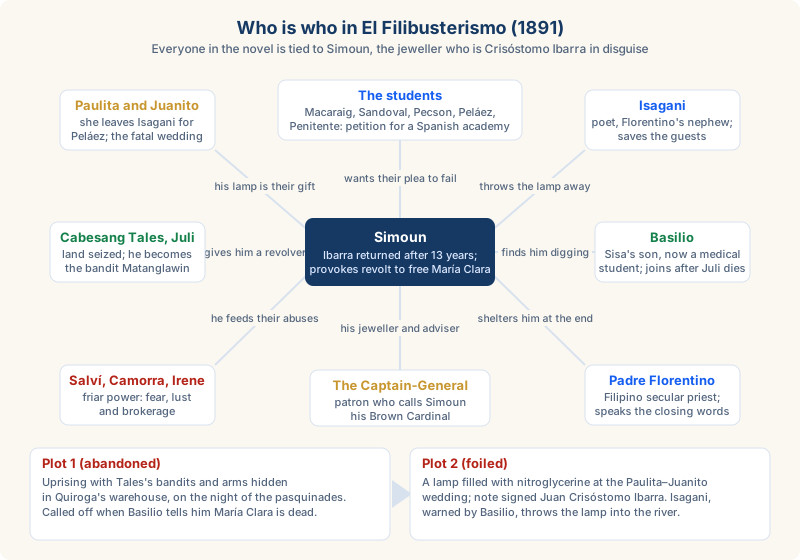
The steamer Tabo (chapter 1). The book opens on the Tabo, a slow steamer going up the Pasig toward Laguna de Bay, its decks a colony in miniature: Spaniards, friars and officials above, natives below. Aboard, with Doña Victorina, the journalist Ben-Zayb, Don Custodio and the friars, is the jeweller Simoun, dark-skinned, in blue-tinted spectacles, confidant of the Captain-General. Simoun is Crisóstomo Ibarra, who survived the lake, grew rich abroad, and has returned to provoke a revolt that will ruin the system and free María Clara from the convent.
Cabesang Tales. Tales cleared land in the hills near Tiani with his father Tandang Selo. The friars claimed it and raised the rent each year; he went to court and lost everything to lawyers' fees. His son Tano is conscripted; his daughter Juli goes into service to pay his ransom after bandits seize him. When the land is given to another tenant, Tales takes Simoun's revolver, kills the tenant, the tenant's wife and the friar-administrator, and becomes the bandit chief Matanglawin.
Simoun and Basilio in the forest. On Christmas Eve Basilio visits the graves of Sisa and Elías in the old Ibarra forest and finds Simoun digging up Ibarra's treasure. Simoun, recognised, tries to recruit him, arguing that Filipinos should keep their own language rather than beg Spain for Spanish, since a people that keeps its language keeps its freedom. Basilio refuses; he wants only to finish medicine and marry Juli.
The students and the Spanish academy. Macaraig, Isagani and their fellow students petition for an academy to teach Spanish, which the friars refuse to teach at the University. Simoun secretly wants the petition to fail so that the students will turn to revolt. Don Custodio approves the academy but places it under Dominican control. They hold a bitter mock celebration at the Pansitería Macanista de Buen Gusto; next morning seditious posters, pasquinades, appear on the University doors and the students are arrested, Basilio among them.
Juli's death and the sphinx. The rich students are soon freed; Basilio, with no influential family, stays in prison, and Capitán Tiago dies without providing for him. Juli goes to Padre Camorra for help; he tries to force himself on her and she throws herself from a window of the convent and dies. Meanwhile at the Quiapo fair the talking sphinx Imuthis, shown by the American Mr. Leeds and staged by Simoun, tells of a priest who falsely accused a young man and desired his betrothed; Padre Salví faints.
The first plot. Simoun has armed Tales's bandits and hidden rifles with the Chinese merchant Quiroga. The rising is set for the night of the pasquinades, but that night Basilio brings word that María Clara died in the convent of Santa Clara that afternoon. Simoun collapses and cancels the revolt meant to free her.
The second plot and the lamp. Freed after months, Basilio, embittered by Juli's death, joins Simoun. The target is the wedding feast of Paulita Gómez, Doña Victorina's niece, who has left Isagani for the richer Juanito Peláez, held at Capitán Tiago's old house. Simoun's gift is a magnificent lamp whose reservoir holds nitroglycerine; when the dimming wick is turned up it will kill the Captain-General, the friars and the whole elite while his men attack outside. He leaves a note reading Mene Thecel Phares, signed Juan Crisóstomo Ibarra. Basilio, outside, warns Isagani to flee; Isagani instead rushes in, seizes the lamp and throws it into the Pasig. The note exposes the plot and Simoun, recognised as Ibarra, flees.
The shore and the sea. Wounded, Simoun reaches the house of Padre Florentino, a Filipino secular priest and Isagani's uncle, on a cliff above the Pacific. With the Guardia Civil coming, he takes poison and, dying, confesses his life. Florentino tells him God did not will his plans because the end was not sought by just means: freedom must be deserved, the glory of saving a country is not for the man who helped ruin it, and hatred breeds only monsters. After Simoun dies, Florentino throws the chest of jewels that financed the plots into the sea, to lie there until men need it for a holy purpose.
4. The people of the Fili
| Character | Who they are | What they stand for |
|---|---|---|
| Simoun | Jeweller and adviser to the Captain-General, nicknamed the Brown Cardinal or Black Eminence; Ibarra returned | Revenge; the ilustrado who has given up on reform |
| Basilio | Sisa's surviving son, a medical student supported by Capitán Tiago | The poor boy who rises through study, indifferent until injustice radicalises him |
| Isagani | Poet, nephew of Padre Florentino, in love with Paulita | Idealistic youth; saves the guests out of love, not politics |
| Padre Florentino | Filipino secular priest retired to a seaside parish | Rizal's voice at the end: freedom must be deserved and won by worthy means |
| Cabesang Tales, Tandang Selo, Juli, Tano | A farming family destroyed by land-grabbing, conscription and the convent | The peasantry; how injustice makes bandits of honest men |
| Macaraig, Sandoval, Pecson, Juanito Peláez, Placido Penitente | The students behind the academy petition | Youth from idealism to self-interest |
| Padre Camorra, Salví, Irene, Sibyla, Fernández | The brutal, the hypocritical, the scheming, the political and the one honest friar | Friar power in all its faces |
5. Noli and Fili side by side
| Point | Noli Me Tángere | El Filibusterismo |
|---|---|---|
| Written | 1884–1887, Madrid, Paris, Berlin | 1887–1891, Calamba, London, Paris, Madrid, Brussels, Biarritz |
| Printed | Berlin, 1887, Berliner Buchdruckerei-Actiengesellschaft | Ghent, 1891, F. Meyer-Van Loo Press |
| Financier | Máximo Viola | Valentín Ventura |
| Dedication | To my Fatherland | To the memory of Gómez, Burgos and Zamora |
| Hero | Ibarra the reformer | Simoun the conspirator |
| Chapters | 63 plus epilogue | 38 |
| Ending | Elías dies; María Clara enters the convent | Simoun dies; the jewels go into the sea |
| Last voice | Elías: do not forget those who fell in the night | Florentino: where are the youth? |
6. What does the ending mean?
Did Rizal use Padre Florentino to reject revolution altogether, or only the kind Simoun attempted? The text supports both readings. Florentino says plainly that freedom won by crime is not freedom and that a people must deserve liberty by sacrifice and virtue; Rizal's 1896 manifesto disowning the Katipunan has been read as confirmation. But Florentino also asks where the youth are who will pour out their blood to wash away so much shame, which is not pacifism. Simoun's revolt fails because its motive is private revenge, its method is terror against the innocent, and its leader has corrupted the people he claims to free. The failure of a bad revolution is not the rejection of all revolution.
7. After the book
The Fili was banned on arrival, like the Noli, and copies were scarce, yet it reached the men who founded the Katipunan a year later. Bonifacio read both novels, and the society used Rizal's name as a password. At his trial in December 1896 the prosecution cited the novel as evidence that he preached separation. The words Mene Thecel Phares come from the Book of Daniel, chapter 5, where a hand writes on the wall at Belshazzar's feast that the king has been weighed and found wanting; Rizal applied the writing on the wall to Spain's rule.
Rizal began a third novel in Tagalog in Hong Kong in 1892 under the title Makamisa, meaning after Mass, a satire of town life around a curate. He wrote one chapter in Tagalog, began again in Spanish, and abandoned it; the fragments were identified by the historian Ambeth Ocampo in the 1980s.
Key terms
| Term | Meaning |
|---|---|
| Filibustero | Colonial label for a subversive or separatist; the title claims the word |
| F. Meyer-Van Loo Press | The Ghent printer of the Fili, 1891 |
| Saviour of the Fili | Valentín Ventura, who paid for the printing to resume |
| GomBurZa | Gómez, Burgos and Zamora, executed 17 February 1872; the dedication gives wrong ages and the wrong date |
| Matanglawin | Bandit name of Cabesang Tales, meaning hawk-eye |
| Pasquinades | Seditious posters on the University doors that led to the students' arrest |
| Mene Thecel Phares | Writing on the wall from Daniel 5; the words on Simoun's note at the wedding |
| Makamisa | Rizal's unfinished third novel, begun in Tagalog in 1892; identified by Ambeth Ocampo |
Guided readings
Three passages supply most of the quotation items set on this novel.
Reading 1: The dedication to GomBurZa
Source: José Rizal, El Filibusterismo (1891), dedication, in Charles Derbyshire's translation The Reign of Greed (1912), public domain.
The Church, by refusing to degrade you, has placed in doubt the crime that has been imputed to you; the Government, by surrounding your trials with mystery and shadows, causes the belief that there was some error, committed in fatal moments.
- What two institutions does Rizal address, and what does each one's conduct prove to him?
- Which facts in the dedication did Rizal get wrong, and why does that not weaken his argument?
- How does the dedication connect the Fili to the events of 1872 that Rizal said made him who he was?
Takeaway: The dedication turns the execution of three priests into the moral foundation of the novel. Know the names, the real date and ages, and the errors Rizal made.
Reading 2: Simoun to Basilio on language
Source: El Filibusterismo, chapter 7, Simoun, Derbyshire's translation (1912), public domain.
While a people preserves its language, it preserves the marks of its liberty, as a man preserves his independence while he holds to his own way of thinking. Language is the thought of the peoples.
- Why does Simoun oppose the students' campaign for Spanish, and what does he want them to do instead?
- Is Simoun speaking for Rizal here, or is this part of his plan to drive the youth to revolt?
- How does this passage relate to the twentieth-century debates on a national language?
Takeaway: The language passage is quoted in every discussion of Filipino as a national language. Remember that Simoun says it, in the forest, on Christmas Eve, to Basilio.
Reading 3: Padre Florentino's question
Source: El Filibusterismo, the closing chapter, Conclusion, Derbyshire's translation (1912), public domain.
Where are the youth who will consecrate their golden hours, their illusions, and their enthusiasm to the welfare of their native land? Where are the youth who will generously pour out their blood to wash away so much shame, so much crime, so much abomination?
- To whom is Florentino speaking, and what has just happened?
- How can a priest who has just condemned Simoun's violence ask the youth to pour out their blood?
- Compare this with Elías's dying words in the Noli. What has changed in Rizal's address to the next generation?
Takeaway: Florentino's speech holds both halves of Rizal's position: revolt born of hatred is condemned, and sacrifice for the country is demanded. Items that offer only one half are usually wrong.