Rizal the historian: the annotated Morga
Rizal in London and the British Museum, why he chose Morga's Sucesos of 1609, what his annotations argued about the pre-colonial Philippines, and how they were received.
Recovering a past the conquest had erased
Between the Noli Me Tángere of 1887 and El Filibusterismo of 1891 Rizal spent a year as a historian. In the reading room of the British Museum he copied by hand a rare book of 1609, Antonio de Morga's Sucesos de las Islas Filipinas, and in 1890 he published it in Paris with hundreds of his own notes. The annotated Morga answered the charge, repeated by friars and Spanish writers, that Filipinos had been savages before Spain arrived and owed everything to the conquest. Rizal used a Spanish official's own testimony to show a people with its own industry, trade, writing, laws and government, and to argue that three centuries of colonial rule had made them poorer, not richer. This topic covers the London year, the book, its theses, Rizal's other scholarly work and the debate over his method.
- 1609 – Morga's Sucesos de las Islas Filipinas is printed in Mexico.
- April 1887 – Rizal reads Tagalische Verskunst before the Ethnographic Society of Berlin.
- May 1888 – Rizal reaches London and begins work in the British Museum.
- 1889 – he moves to Paris in March; the Association Internationale des Philippinistes is organised with Blumentritt as president.
- 15 April 1890 – Sobre la Nueva Ortografía de la Lengua Tagala appears in La Solidaridad.
- 1890 – the annotated Morga is published in Paris by Garnier Hermanos.
1. The London year, 1888–1889
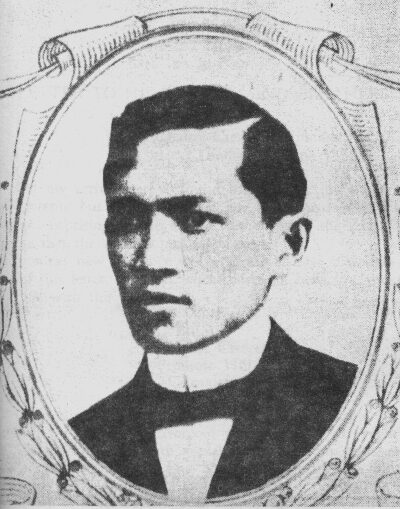
Rizal left Manila in February 1888 after six months at home, during which the Noli had been condemned and his family threatened. He travelled by way of Hong Kong, Japan and the United States and reached London in May 1888. He chose London for three reasons: it was a free country where the Spanish authorities could not touch him; its English would be useful to him; and the British Museum held the rarest books on the Philippines, including the few surviving copies of Morga. He lodged with the family of Charles Beckett, an organist, at 37 Chalcot Crescent, Primrose Hill, where the eldest daughter, Gertrude, grew attached to him and where he carved several small sculptures. He befriended Dr. Reinhold Rost, the librarian of the India Office and an orientalist, who opened doors for him and called him a pearl of a man.
His days went to the Museum. Reading the chroniclers of the conquest, he decided that the most useful of them was Morga, and because the book was too rare to buy he copied it out word for word, a labour of months, and began his notes. From London he also sent to Barcelona the satire La Visión de Fray Rodríguez and wrote his Tagalog letter to the young women of Malolos (Topic 9). In March 1889 he moved to Paris to finish the annotations and see the book through the press.
2. Why history, and why Morga
The Noli had drawn the standard reply of the friars: that Filipinos were an inferior people rescued from barbarism by Spain and the Church, and therefore unfit for the rights the novel claimed. Rizal saw that the political argument rested on a historical one. If Filipinos had possessed a civilisation of their own before 1565, then colonial rule had not created them but had interrupted their development, and the claim that they needed the friar as a permanent guardian collapsed. History was therefore a weapon, and he set out to find a witness the Spaniards themselves could not reject.
Antonio de Morga (1559–1636) was that witness. A doctor of canon law, he served in Manila from 1595 to 1603 as lieutenant governor and then as oidor, a judge of the Royal Audiencia, and later in Mexico and Quito. His Sucesos de las Islas Filipinas (Events of the Philippine Islands), printed in Mexico in 1609, has eight chapters: seven narrate Spanish rule from Legazpi to 1603, and the eighth describes the islands and their peoples, their government, dress, writing, religion, marriage, slavery and trade. Rizal preferred Morga to the friar chroniclers such as Chirino, Colín and Aduarte because he was a layman and a high official writing for the Crown, an eyewitness with no order to glorify and no miracles to record; a Spanish judge's praise of Filipino skill could not be dismissed as native vanity.
3. The book of 1890
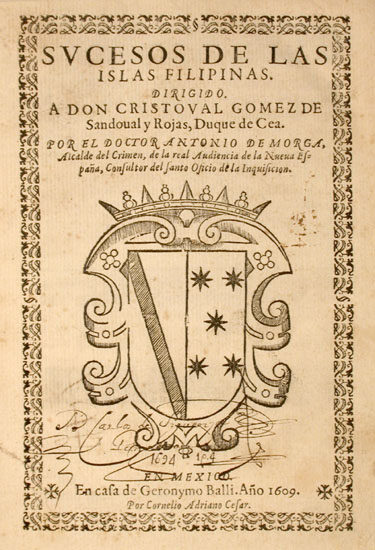
The edition appeared in Paris in 1890 from the house of Garnier Hermanos under a long title: Sucesos de las Islas Filipinas por el Doctor Antonio de Morga, obra publicada en Méjico el año de 1609, nuevamente sacada a luz y anotada por José Rizal y precedida de un prólogo del Prof. Fernando Blumentritt. It reprinted Morga's text with Rizal's footnotes beneath it, some a line long, some filling the page, and opened with a prologue by Blumentritt and a dedication by Rizal headed "A los Filipinos" (To the Filipinos). In the dedication Rizal explained that the Noli had sketched the present state of the country, and that before painting further pictures he had to make the past known, so that readers could judge the present and measure the road travelled in three centuries. The book sold poorly, was banned in the Philippines, and reached few of the readers it was written for; yet it is the first history of the Philippines written from a Filipino point of view.
4. What Rizal argued in the notes
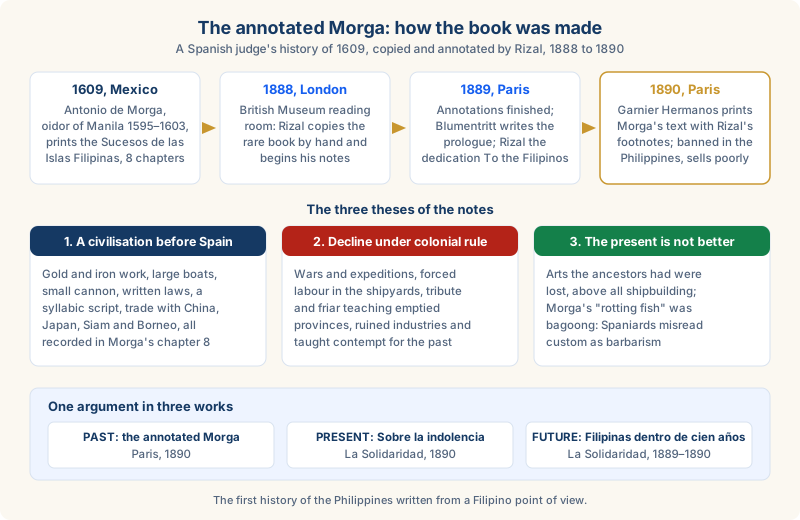
Three propositions run through the annotations. First, the people of the islands had a civilisation of their own before the Spaniards came. Morga's eighth chapter describes a people who mined and worked gold, wove cotton and silk, built large boats, cast small cannon, forged weapons, kept written laws and customs, traded with China, Japan, Siam, Cambodia and Borneo, and wrote in their own syllabic script; Rizal underlined each item and added evidence from Pigafetta, Chirino and other sources. Second, the conquest and colonial rule had decimated, demoralised and impoverished this people. The wars and expeditions of the governors, forced labour in the shipyards, tribute and the friars' teaching had emptied provinces, ruined industries and taught Filipinos to despise their own past. Third, the present was not necessarily better than the past: the Filipino of 1890 had lost arts his ancestors possessed, above all shipbuilding, because the cutting of timber and the building of galleons under forced labour had destroyed the craft and the men who practised it.
Many notes correct Morga's judgments of custom. Where Morga wrote that the natives ate fish that had begun to rot and smell, Rizal explained that this was bagoong, a salted and fermented fish paste that Filipinos prize, and that every nation finds strange the food it is not used to. Where Morga and later writers called the pre-Hispanic religion idolatry, Rizal pointed to its moral code and its belief in a supreme being. He defended Lapu-Lapu's resistance at Mactan, honoured Rajah Soliman and Lakandula, and argued that Legazpi's conquest had proceeded more by treaty and persuasion, as in the blood compact with Sikatuna, than by arms, so that Filipinos had entered the Spanish monarchy as allies rather than as a conquered race. He did not spare Morga himself: he questioned the judge's own account of the sea fight of 1600 against the Dutch, in which Morga's flagship sank.
5. A trilogy about past, present and future
The Morga belongs with two essays Rizal wrote at the same time for La Solidaridad. Filipinas dentro de cien años (1889–1890) looked at the future and asked whether the Philippines would remain Spanish. Sobre la indolencia de los filipinos (1890) examined the present and traced the supposed laziness of the Filipino to the same causes the Morga notes identified: wars, forced labour, the galleon trade, discouragement and bad teaching. Read together, the three works form one argument: a people with a prosperous past, ruined by colonial rule, and able to recover if educated and freed. Topic 9 studies the two essays in full.
6. Rizal the scholar: language and ethnology
The Morga was the largest of several scholarly works. In Berlin, on 25 April 1887, Rizal read before the Ethnographic Society a paper in German, Tagalische Verskunst (Tagalog Metrical Art), on the forms of Tagalog verse. In London in 1889 he wrote for Trübner's Record two short pieces, Specimens of Tagal Folklore and Two Eastern Fables, the second comparing a Tagalog tale of the monkey and the turtle with a Japanese one. In La Solidaridad of 15 April 1890 he published Sobre la Nueva Ortografía de la Lengua Tagala (On the New Orthography of the Tagalog Language), which defended the spelling he had begun to use in his Malolos letter: k for the Spanish c and qu, w for the Spanish u in diphthongs, and native rather than Spanish forms of words. He credited Trinidad H. Pardo de Tavera's study of Sanskrit in Tagalog as his inspiration. The reformed spelling was attacked as anti-Spanish and later adopted by the Katipunan and by modern Filipino.
In Paris in 1889 Rizal organised the Association Internationale des Philippinistes, a society of European and Filipino scholars to study the Philippines scientifically. Blumentritt was president, the French writer Edmund Plauchut vice-president, Rost and Antonio Regidor counsellors and Rizal secretary. It planned an international congress during the Paris Exposition of 1889, with papers on the islands before, during and after the conquest; the congress never met, but the plan shows the scope of Rizal's ambition to found a Philippine studies.
7. Reception and debate
Rizal hoped the Morga would be welcomed as a work of science. It was not. The friars treated it as another attack; the Spanish writer Wenceslao E. Retana, then a paid defender of the friars and later Rizal's admiring biographer, ridiculed the notes; and Spanish reviewers complained that Rizal had turned a chronicle into a pamphlet. Blumentritt and a few scholars praised it, and later historians recognised it as the foundation of a Filipino historiography.
Key terms
| Term | Meaning |
|---|---|
| Sucesos de las Islas Filipinas | Antonio de Morga's history and description of the Philippines, printed in Mexico in 1609; annotated by Rizal in 1890. |
| Antonio de Morga | Spanish lawyer, lieutenant governor and oidor in Manila, 1595–1603; a lay official, not a friar. |
| Oidor | A judge of the Royal Audiencia, the highest court of the colony. |
| Annotation | A note added to a text; Rizal's edition set his notes beneath Morga's lines. |
| British Museum | The London library where Rizal copied Morga by hand in 1888. |
| Garnier Hermanos | The Paris publishing house that issued Rizal's Morga in 1890. |
| Prologue | The introduction to the edition, written by Ferdinand Blumentritt. |
| Bagoong | Salted, fermented fish paste; Morga called it rotting fish, Rizal corrected him. |
| Blood compact | The pact of Legazpi and Sikatuna in Bohol, 1565, which Rizal cited as proof that Filipinos entered Spanish rule by agreement. |
| Tagalische Verskunst | Rizal's 1887 Berlin paper on Tagalog verse. |
| New Tagalog orthography | Rizal's 1890 proposal to spell Tagalog with k and w instead of Spanish letters. |
| Association Internationale des Philippinistes | The scholarly society Rizal organised in Paris in 1889 under Blumentritt. |
Guided readings
Reading 1: The dedication to the Filipinos
Source: José Rizal, dedication "A los Filipinos", Sucesos de las Islas Filipinas, Paris, 1890; our plain translation.
In the Noli Me Tángere I began to sketch the present condition of our country. The effect my attempt produced made me understand, before unrolling before your eyes other pictures to follow, the need first to make the past known, so that the present may be better judged and the road travelled in three centuries may be measured.
- Identify the two tasks Rizal assigns himself: the present (the novels) and the past (the Morga).
- Explain the phrase "the road travelled in three centuries": is he assuming progress, decline, or asking the reader to decide?
- Connect the dedication to the friar argument it answers, that Filipinos had no past worth knowing.
Takeaway: Rizal presented the Morga not as antiquarian curiosity but as the groundwork for judging colonial rule and planning the future.
Reading 2: Morga on the people, and Rizal's notes
Source: Morga, Sucesos, chapter 8, with Rizal's annotations of 1890; close paraphrase.
Morga recorded that the natives of Luzon were skilled workers in gold and iron, that they built large vessels and smaller swift boats, that they had their own letters and wrote on bamboo and leaves, that they kept laws handed down by their elders, and that they traded each year with ships from China and Japan. Rizal noted at each point that these were the arts of a civilised people, and asked where, after three hundred years, the shipwrights, the smiths and the writers had gone.
- List the five marks of civilisation Morga records: metalwork, shipbuilding, writing, law, trade.
- Note how Rizal turns description into argument with one question: where did these skills go?
- Decide which of Rizal's three theses (section 4) each note supports.
Takeaway: Rizal's method was to let a Spanish judge testify to Filipino civilisation and then to charge colonial rule with its loss.
Reading 3: Blumentritt's prologue
Source: Ferdinand Blumentritt, prologue to Rizal's edition of Morga, 1890; close paraphrase.
Blumentritt praised Rizal as a Filipino who had mastered the methods of European scholarship and returned them to the study of his own people; he observed that most histories of the Philippines had been written by friars with their own interests to defend; and he warned that the Spaniards who denied Filipinos a past were preparing the loss of the colony, because a people told it has no history will make one.
- Note the authority Blumentritt lends: a European professor vouching for a Filipino scholar.
- Identify his criticism of friar history and compare it with Rizal's reasons for choosing Morga.
- Weigh his warning against the Debate box: is it history or prophecy?
Takeaway: The prologue framed the Morga as European science in Filipino hands and as a warning to Spain.